

Two days after Dubai Islamic Bank (DIB) shares jumped 11% on merger talk, the deal is on paper. As we covered on 24 November in Dubai Islamic Bank surges 11% as potential Emirates Islamic merger takes centre stage, the market moved before either bank confirmed anything. On 25 November, the boards of DIB and Emirates NBD approved a share purchase agreement under which DIB will acquire 100% of Emirates Islamic in an all-share transaction, subject to regulatory and shareholder approvals.
Based on 30 September 2026 figures, the combined group would hold about AED 585 billion ($159 billion) in assets. That figure adds the two banks' balance sheets together and is not a statement of the completed group's financial position. It would make the enlarged DIB the second-largest listed Islamic banking group in the world by total assets, behind Saudi Arabia's Al Rajhi Bank, and the largest in the UAE.
DIB–Emirates Islamic Merger: Deal Terms and Share Exchange Ratio
DIB pays in new shares, not cash. Emirates NBD receives 0.642 new DIB shares for each Emirates Islamic share, which works out to 3,486,284,330 new shares.
Based on DIB's 25 November closing price of AED 8.92, the new shares would have an implied market value of approximately AED 31.1 billion. This is an indicative calculation, not an officially disclosed transaction valuation, and the shares will be issued at a nominal price of AED 1 each.
DIB and Emirates NBD Share Prices: Market Reaction to the Merger
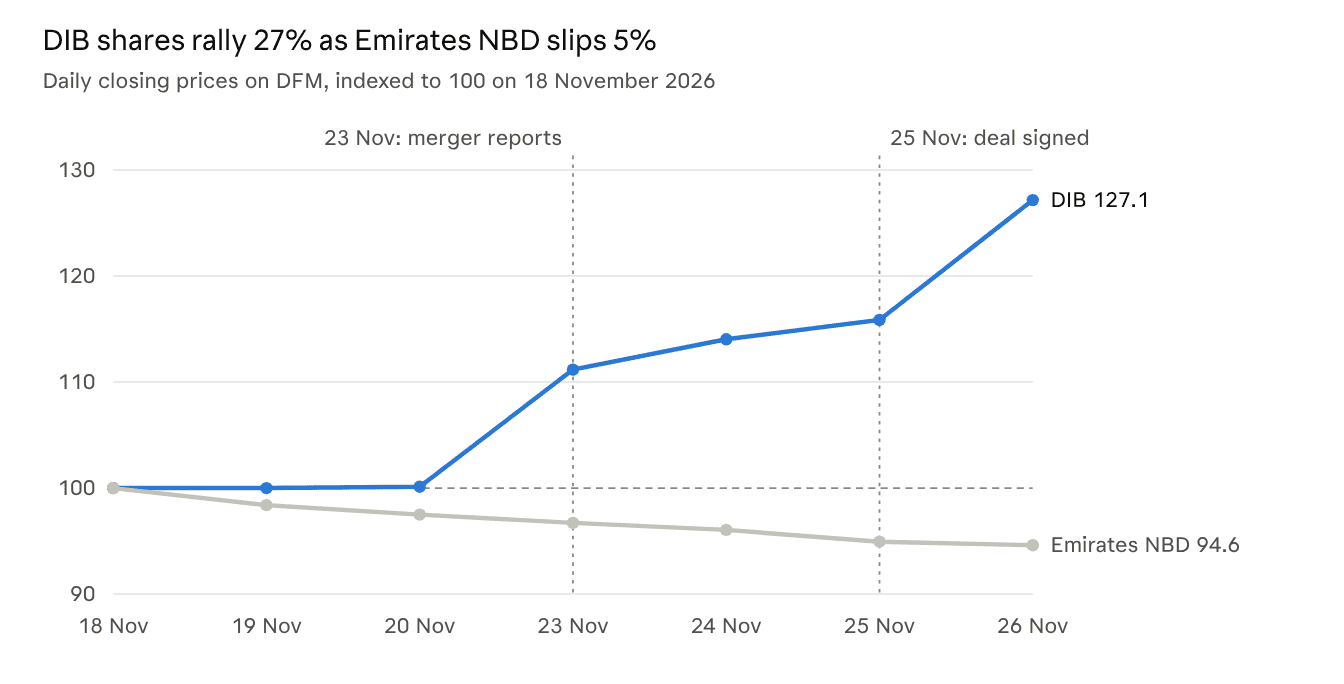
DIB shares have gained about 27% since 18 November, while Emirates NBD has slipped about 5%. The wider market has also moved higher, with the DFM General Index up 1.3% on 23 November and a further 1.51% on 26 November, its fifth straight gain. The financials index rose 3.14% on 26 November. Emirates NBD gives up full ownership of Emirates Islamic in exchange for a 32.5% stake in DIB, and its shares have closed lower in every session since the merger reports.
How the Emirates Islamic Acquisition Strengthens DIB's Deposit Base
The strategic case rests partly on funding and complementary customer franchises. Emirates Islamic has a much higher share of current and savings account (CASA) deposits, while DIB brings a larger balance sheet and an established corporate banking franchise.
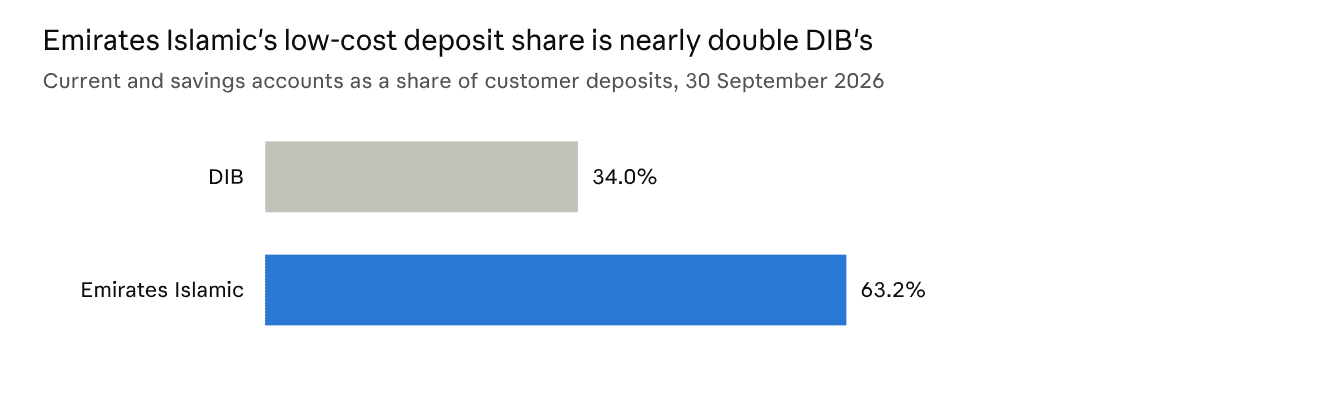
Source: DIB and Emirates Islamic 9M 2026 results releases
Zeeshan Mansoor of Alvarez & Marsal says the stronger CASA mix offers potential to improve funding efficiency and support financing margins. Kapil Chadda of Arthur D. Little expects financing rates and deposit returns to stay driven mainly by market benchmarks, liquidity and competition rather than by the merger itself.
What the Merger Means for DIB and Emirates NBD Shareholders
The all-share structure means DIB pays no cash, but its existing shareholders will own 67.5% of the enlarged bank once the new shares are issued, with Emirates NBD holding the remaining 32.5%.
On this simple historical comparison, Emirates Islamic adds profit roughly in proportion to the new shares, which points to a broadly neutral effect on earnings per share before integration costs and synergies. This is our calculation, not a company forecast. After completion, earnings per share, return on equity and capital ratios will show whether the deal adds value for existing holders.
For Emirates NBD, the deal swaps a wholly owned subsidiary for a 32.5% stake in a larger listed Islamic bank. According to the joint announcement, the all-share consideration lets Emirates NBD and its shareholders take part in the combined group's future growth and distributions. No board seats or other governance terms for the stake have been disclosed. Investment Corporation of Dubai, which owns about 28% of DIB and 41% of Emirates NBD according to AGBI, keeps significant interests on both sides.
How the DIB Deal Compares with Previous UAE Bank Mergers
Impact of the DIB–Emirates Islamic Merger on UAE ETFs
For the iShares MSCI UAE ETF, the deal changes the relationship between two existing holdings. As of 25 November, Emirates NBD was the fund's fourth-largest position at 8.78%, while DIB ranked eighth at 3.86%. Together, financial stocks accounted for 39.71% of the portfolio. The fund does not hold Emirates Islamic directly, so the transaction's impact will come through changes in the market values of its DIB and Emirates NBD holdings rather than a new look-through position. The ETF had $358.8 million in net assets, a P/E ratio of 10.56 and a year-to-date NAV total return of 16.22% as of 24 November, according to iShares.
The Shariah angle is sharper. Emirates NBD is a conventional bank outside the S&P UAE Domestic Shariah index, so Shariah funds such as UAEA have had no access to Emirates Islamic's business. DIB is already UAEA's second-largest holding after Emaar Properties at 20.51%, and the fund returned 15.51% over the month to 26 November, according to Lunate. After completion, Emirates Islamic's operations will become part of DIB, an existing index constituent, which could raise the economic weight of this banking franchise in the fund without it adding a new holding.
The new shares will increase DIB's issued share capital by about 48%. The effect on its index weight will depend on how MSCI and S&P assess the enlarged shareholder structure and adjusted free float, and Emirates NBD's 32.5% strategic stake could affect that calculation under each provider's methodology.
What to watch next
Completion needs approval from the Central Bank of the UAE, the Capital Markets Authority and other relevant authorities, as well as DIB shareholders at a general assembly whose date is yet to be announced. Neither bank has given a completion date, and the banks have announced no changes to customers' IBANs, cards or apps.
The benefits are not automatic. The announcement ties them to completion and successful integration, expects them to arrive progressively and gives no quantified synergy targets. Combining two large banks brings technology, branch and workforce costs, and Kapil Chadda expects some rationalisation in overlapping functions, with the net effect depending on the integration strategy. The shareholder circular and general assembly notice are the next documents to watch for detail on synergies, integration costs and timing.