


Gold was trading above $4,500 an ounce at the end of August 2026, after another volatile month for the metal. Investor demand has followed. Global physically backed gold exchange-traded products held 4,068 tonnes worth $530 billion at the end of July, according to the World Gold Council, after attracting $3 billion of net inflows during the month.
Buying “a gold ETF,” however, has become a surprisingly imprecise instruction.
SPDR Gold Shares holds bullion. VanEck Gold Miners owns mining companies. Simplify Gold Strategy uses futures and options. ProShares Ultra Gold targets twice the daily return of a gold-futures benchmark. WisdomTree offers Shariah-compliant physical gold through a European exchange-traded commodity structure.
They can all appear in a search for gold exchange-traded products, but investors are buying very different risks.
Sources: State Street, BlackRock, Simplify, VanEck, NEOS, ProShares and WisdomTree. Fees are issuer-reported figures available as of August 31, 2026 or the latest available issuer date.
1. Physical Gold ETFs and ETPs
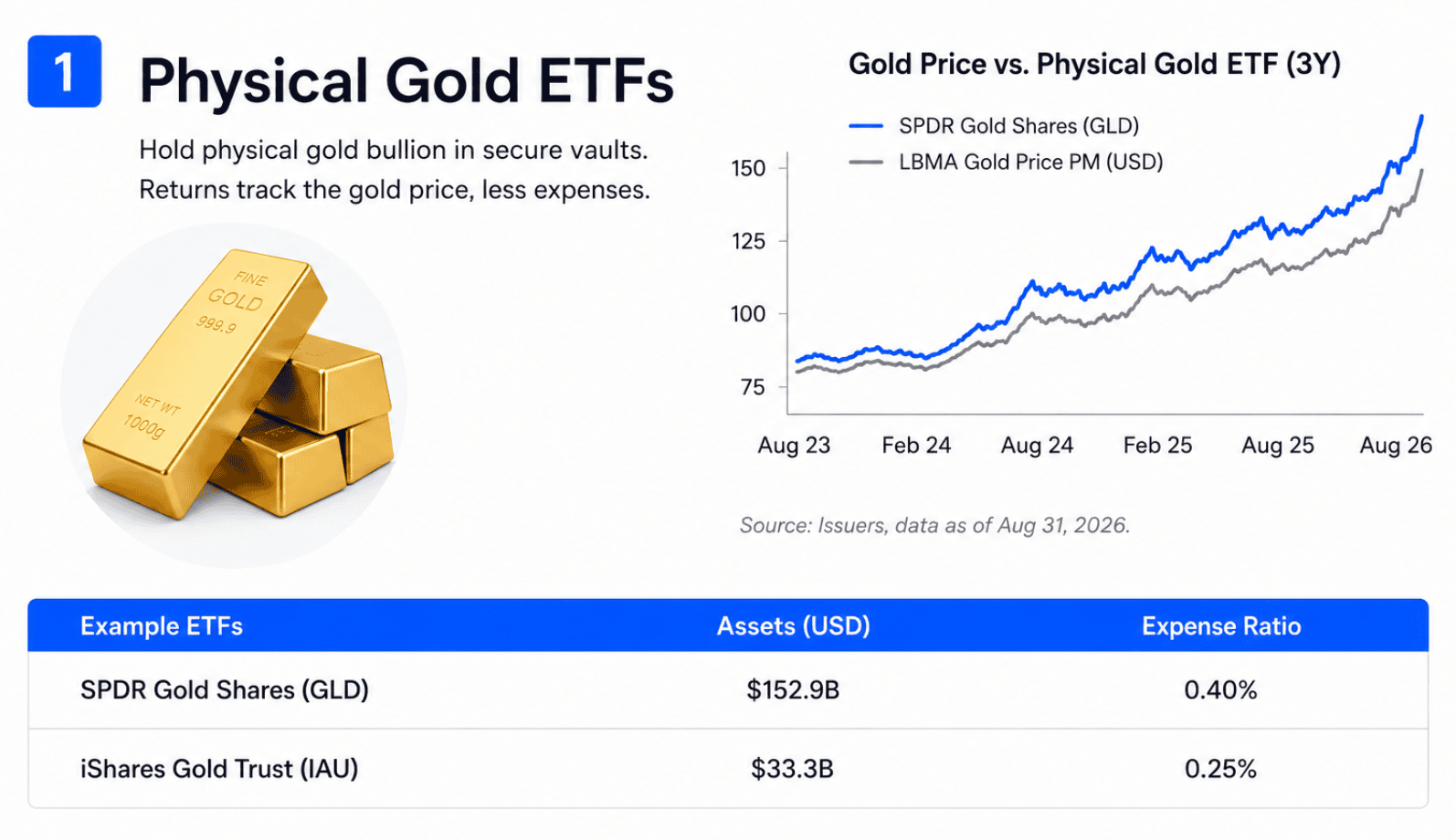
Physical products provide the closest exchange-traded substitute for owning bullion. The vehicle purchases gold bars and places them with a professional custodian, so returns should broadly follow bullion after fees and tracking effects.
SPDR Gold Shares is the giant of the category. As of August 31, 2026, GLD held $152.9 billion of assets and charged 0.40% annually. Its custodians are HSBC and JPMorgan, and its objective is to reflect the price of gold bullion less expenses. IAU follows the same basic economic idea with a 0.25% sponsor fee.
The tracking relationship is visible over longer periods. As of July 31, GLD had returned an annualized 26.37% over three years, compared with 26.87% for the LBMA Gold Price PM benchmark. The roughly 0.5 percentage-point annual gap is close to what an investor would expect once GLD's 0.40% expense and other tracking effects enter the calculation.
Physical backing still requires due diligence. Custody arrangements, allocated versus temporary unallocated balances, redemption rules and the legal claim represented by each security can differ between products.
2. Gold Futures ETFs
A futures strategy does not need to own a single bar.
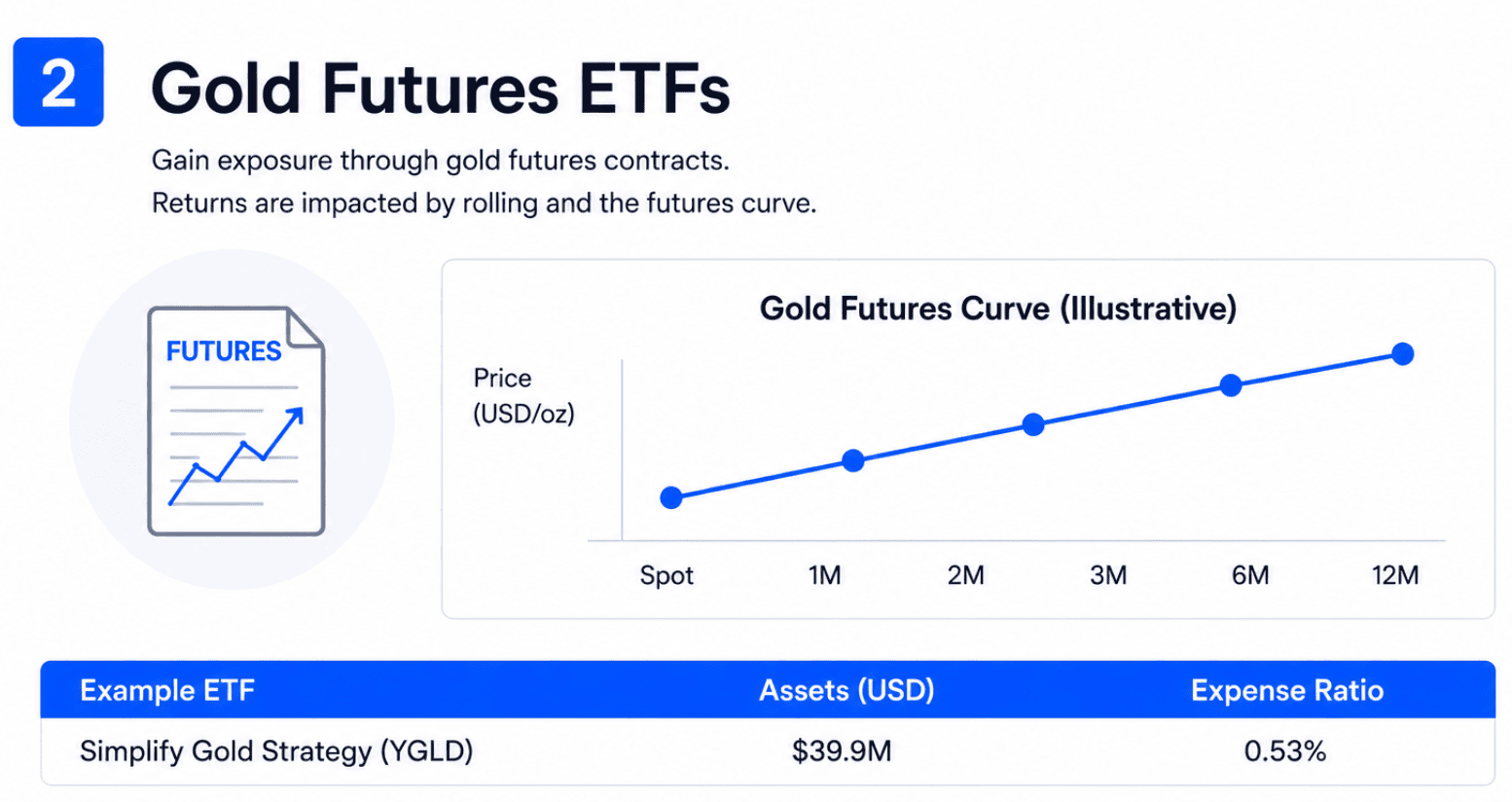
Instead, it obtains exposure through contracts referencing future gold delivery. Those contracts expire, forcing the strategy to replace an approaching contract with another maturity.
The shape of the futures curve then matters. When later contracts cost more than near contracts, rolling can subtract from returns. A downward-sloping curve can have the opposite effect.
One complication for investors researching this category in 2026 is stale product lists. Invesco DB Gold Fund, DGL, ceased trading in March 2023 and was liquidated, despite continuing to appear in some online comparisons.
A current example is the Simplify Gold Strategy ETF, YGLD, although it is a hybrid rather than a plain futures tracker. YGLD combines gold futures or gold ETPs with an options overlay and charges 0.53%. As of August 28, it had about $39.9 million of assets.
Physical product return ≈ bullion return minus costs
Futures-strategy return = futures movement + roll effects + collateral return minus costs
Those equations can produce different results even when both products are described as gold exposure.
3. Gold Mining ETFs
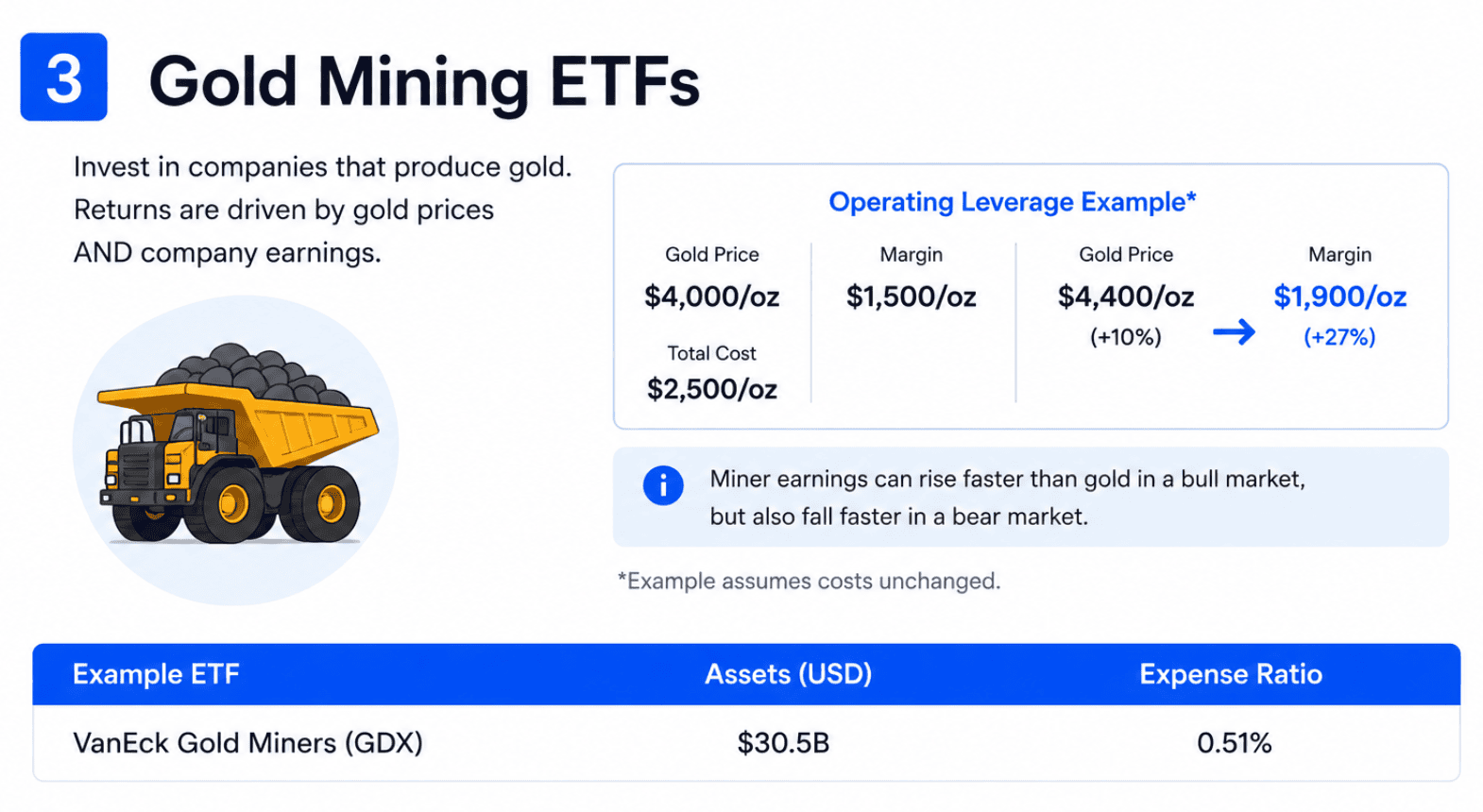
Gold miners introduce corporate economics into the equation.
The VanEck Gold Miners ETF, GDX, owned about $30.5 billion of mining equities as of August 31 and charged 0.51%. It tracks companies involved in gold mining rather than bullion itself. Its year-to-date NAV return stood at 14.69% on August 31.
Operating leverage helps explain why miners can behave differently from metal.
Consider a miner receiving $4,000 per ounce with costs of $2,500. Its hypothetical margin is $1,500. If gold rises 10% to $4,400 while costs stay unchanged, the margin rises to $1,900, an increase of about 27%.
The mathematics also works in reverse. Falling bullion prices can squeeze profits quickly, while wages, fuel costs, mine grades and financing conditions can move independently of gold.
A mining ETF is consequently an equity allocation with sensitivity to gold, rather than a substitute for bullion.
4. Junior Gold Miner ETFs
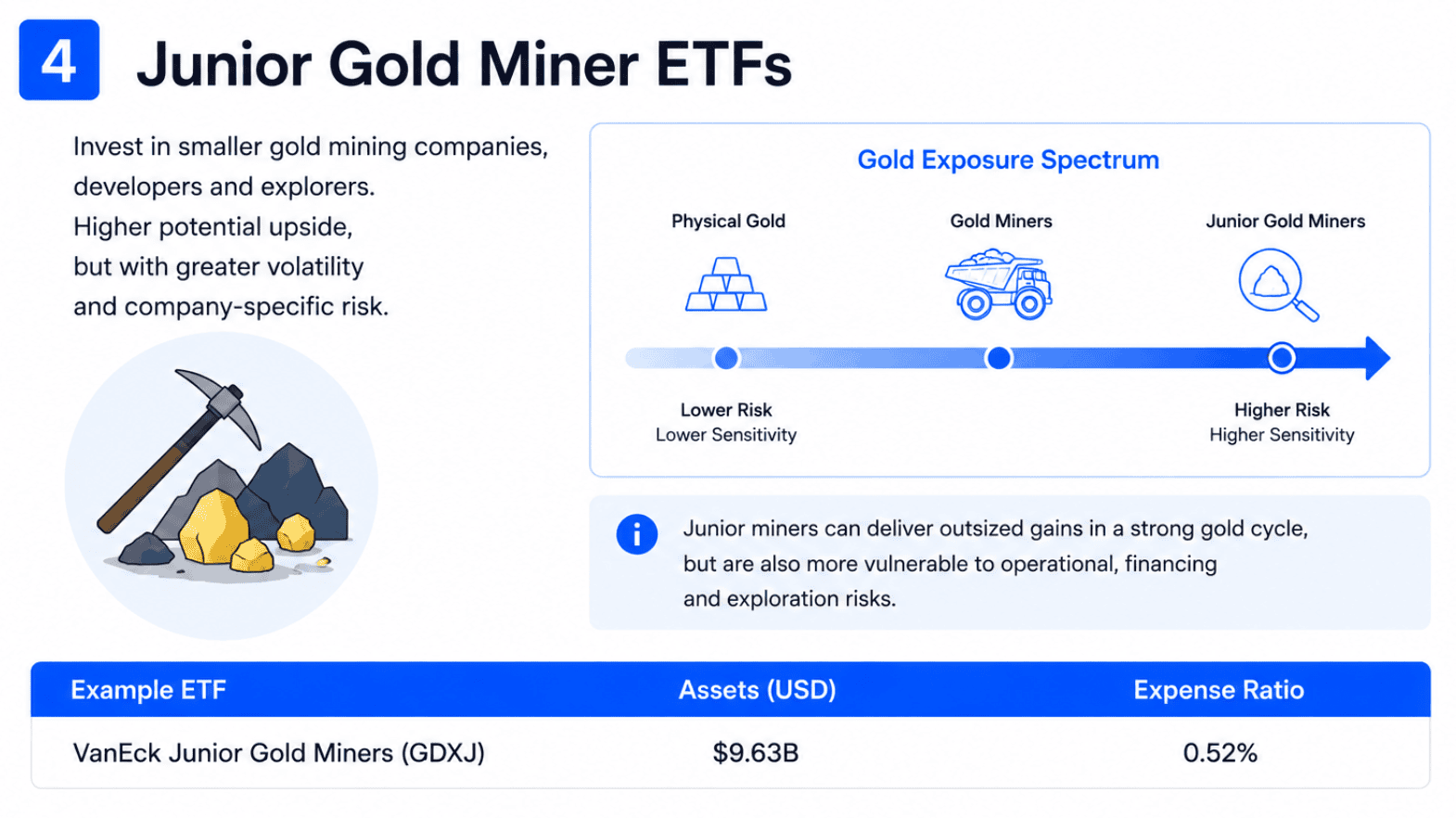
Junior miners take the equity relationship further.
The VanEck Junior Gold Miners ETF, GDXJ, had $9.63 billion of net assets as of August 31 and charged 0.52%. Its portfolio focuses on smaller gold and silver miners, where individual projects can matter far more to company valuations. GDXJ had gained 12.28% year to date at the same date.
Smaller miners can offer greater sensitivity to exploration results or higher gold prices, but balance sheets tend to be less diversified and trading liquidity can be lower.
The exposure spectrum therefore changes materially as an investor moves from bullion toward mining equities:
Physical gold → established miners → junior miners
Gold-price sensitivity may rise along that path, but so do operational and equity-market risks.
5. Gold Income and Covered-Call ETFs
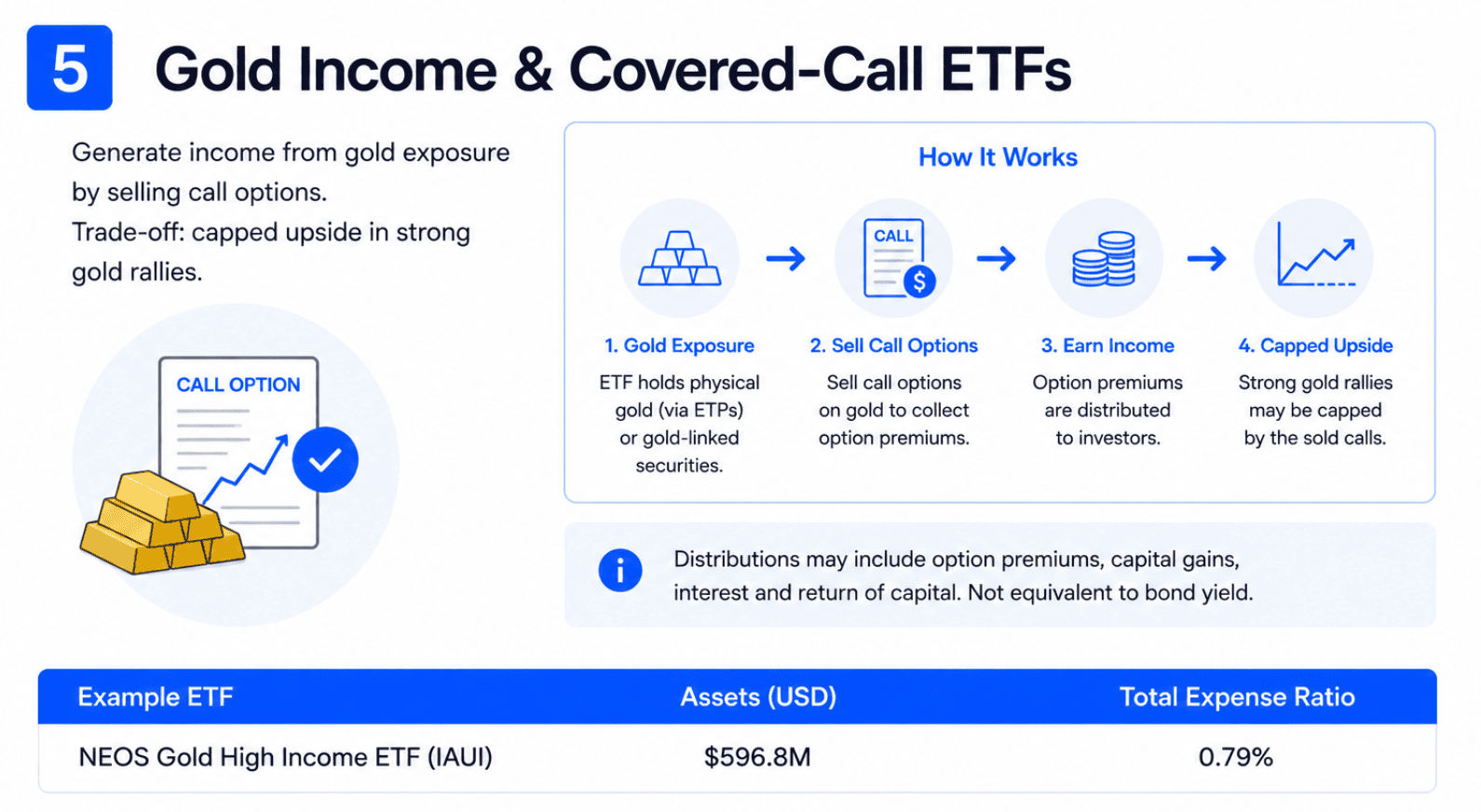
Gold produces no coupon or dividend, but options can manufacture a distribution stream around the exposure.
The NEOS Gold High Income ETF, IAUI, is one current example. It seeks exposure to physical-gold ETPs while using a call-option strategy to generate monthly distributions. As of August 28, 2026, the ETF held $596.8 million and had total annual operating expenses of 0.79%.
Its headline distribution rate was 11.81% as of July 31, compared with a 1.98% 30-day SEC yield. That difference is worth understanding. NEOS states that distributions can include option premiums, capital gains, interest payments and return of capital. The distribution rate therefore should not be read like the yield on a conventional bond.
Options also change the return profile. Selling calls can generate cash during flat or moderately rising markets, while potentially giving up part of a sharp gold rally.
Income is being created by changing the payoff, rather than by making bullion itself yield something.
6. Leveraged Gold ETFs
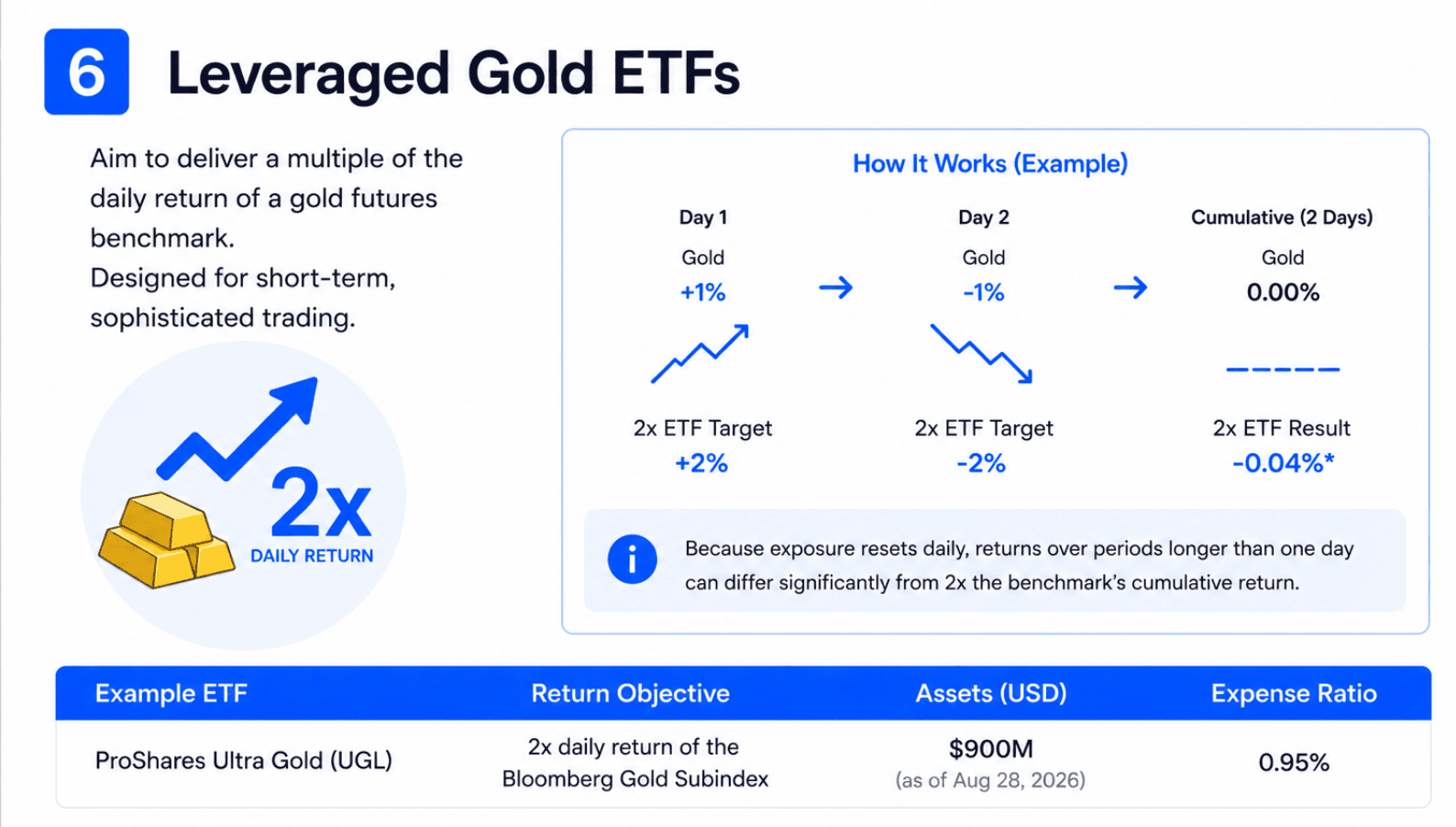
Leveraged products target a multiple of the benchmark's daily return.
ProShares Ultra Gold, UGL, seeks 2x the daily performance of the Bloomberg Gold Subindex, which measures COMEX gold futures. As of August 28, UGL had roughly $900 million of net assets and charged 0.95%. Its portfolio included gold futures and swaps rather than physical bullion.
If gold rises 1% in a session, a 2x product targets roughly 2% before costs. Over months, however, daily resets and compounding mean the outcome does not have to equal twice gold's cumulative return.
Higher volatility increases the potential divergence, making leveraged products structurally different from a long-term physical allocation.
7. Inverse Gold ETFs
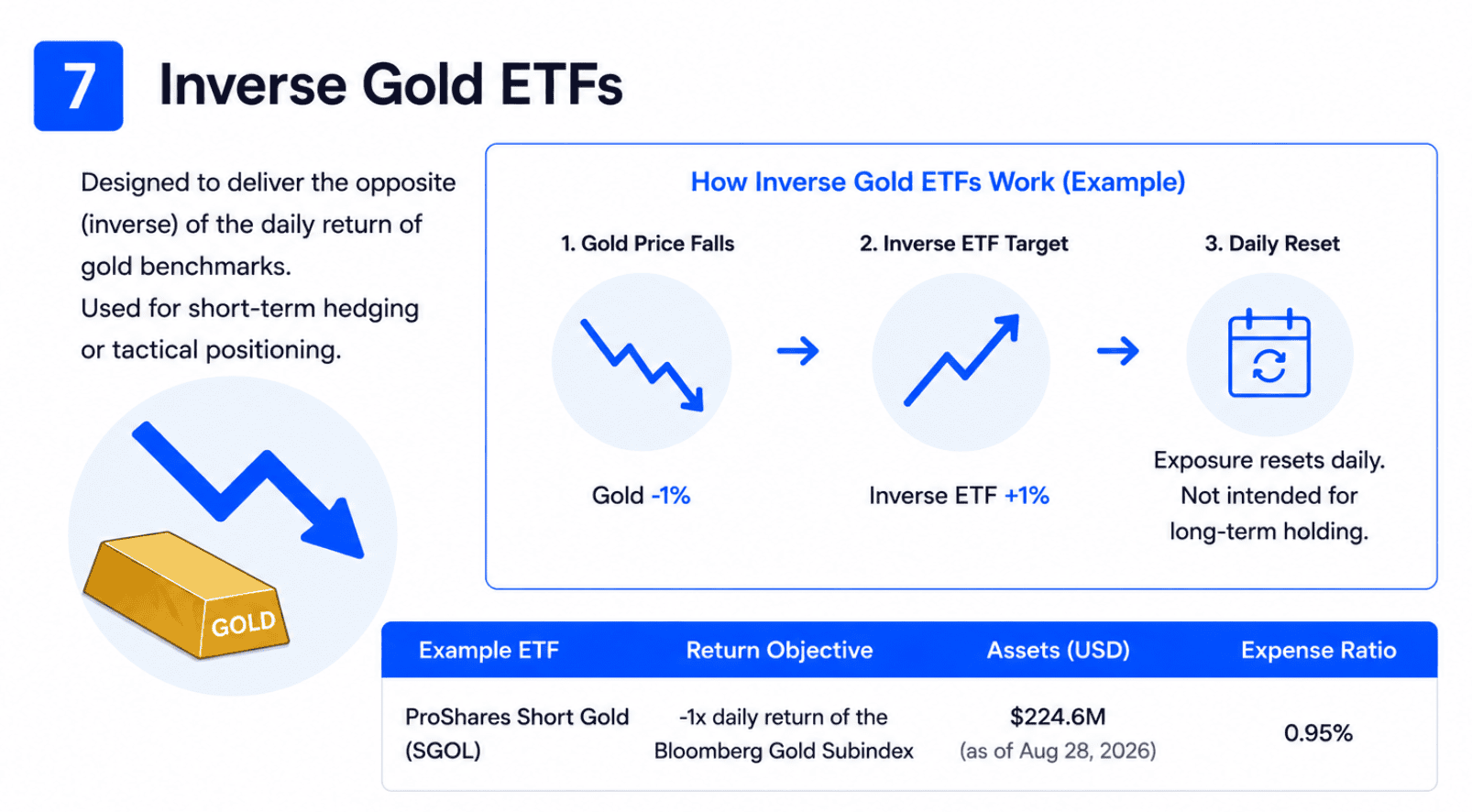
Inverse products apply the same daily-reset mechanism in the opposite direction.
ProShares UltraShort Gold, GLL, targets -2x the daily performance of the Bloomberg Gold Subindex. The ETF charged 0.95% and held roughly $98.5 million when ProShares reported its August 18 snapshot. Its positions included short futures exposure and swaps.
A 1% daily fall in the benchmark therefore implies a target gain of approximately 2% before expenses. That does not mean an investor holding GLL for six months should expect exactly twice the inverse of gold's six-month return.
8. Shariah-Compliant Gold ETFs and ETPs
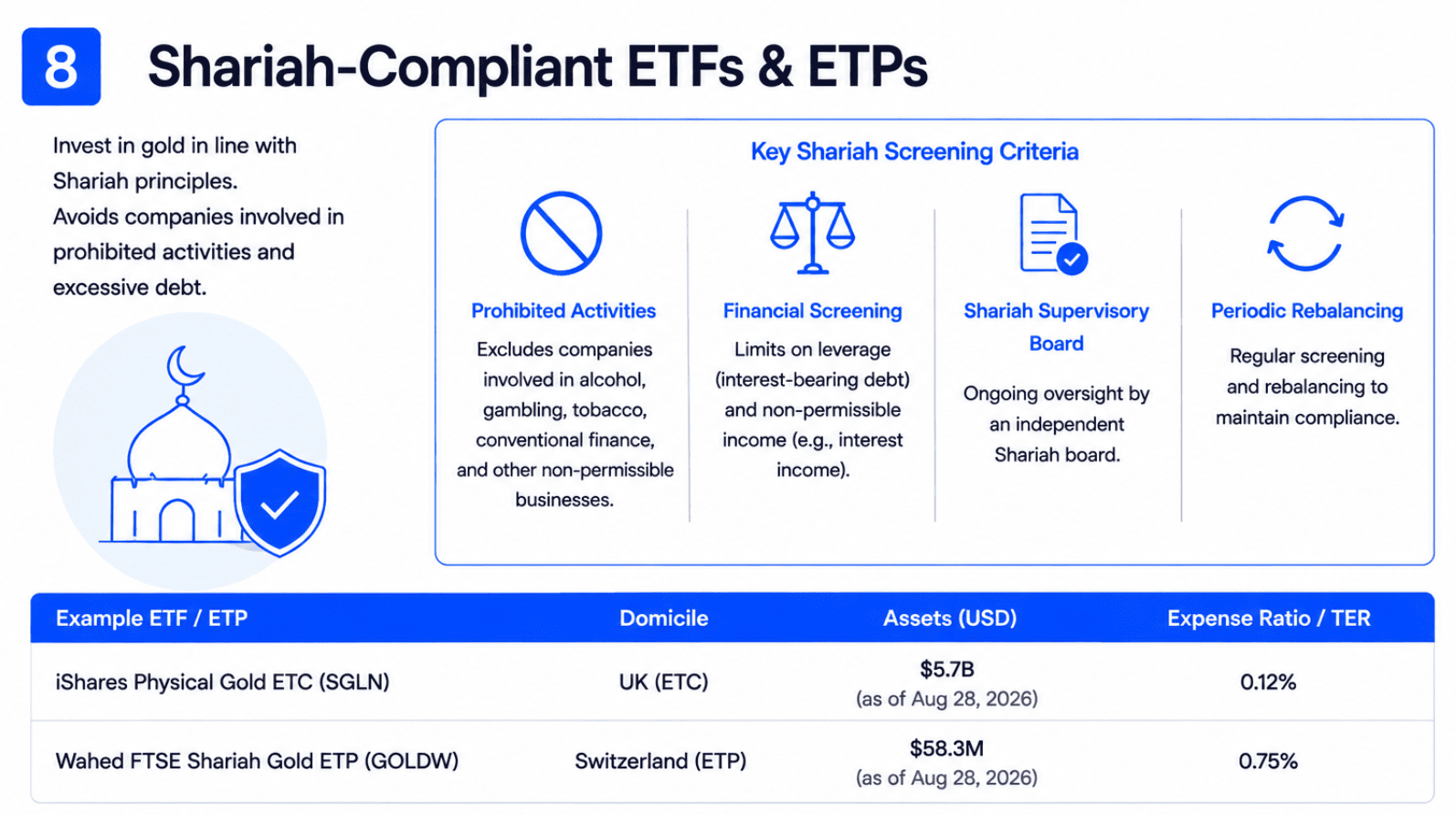
For GCC investors, physical backing and Shariah compliance overlap, but they are not synonymous.
Gold is a ribawi asset under Islamic finance, so product design can involve requirements around ownership, possession and settlement as well as the contractual structure used to buy and hold the metal. Investors therefore need to examine the specific Shariah certification rather than assume every physical product qualifies.
Europe's WisdomTree Core Physical Gold, WGLD, provides a useful example. As of August 24, 2026, WisdomTree classified it as Shariah compliant, physically backed by bullion and structured as a Jersey-domiciled exchange-traded commodity. It charged 0.12%. Legally, however, WGLD is a debt security, rather than a UCITS ETF.
Saudi Arabia offers a different structure. Albilad Gold ETF, ticker 9405, is an open-ended ETF regulated under the Saudi Capital Market Authority framework and traded on Tadawul. Albilad describes it as Shariah compliant and physically backed. As of August 25, 2026, the fund disclosed 470 kilograms, or 15,040 ounces, of physical gold bars. The metal is held on an allocated basis, with custody arrangements involving Riyad Capital and a secured vault in Dubai.
That makes the GCC distinction especially useful: a Saudi-listed Shariah gold ETF and a London-listed Shariah gold ETC can deliver similar bullion exposure through different legal wrappers.
ETF, ETP, ETC or Trust?
GLD is formally the SPDR Gold Trust. BlackRock states explicitly that IAU is not an investment company registered under the U.S. Investment Company Act of 1940, even though investors routinely describe it as an ETF.
Europe presents another wrinkle. UCITS rules do not permit a conventional diversified UCITS fund to hold a single physical commodity such as gold. Invesco consequently explains that European physical-gold ETCs are normally structured as asset-backed debt securities that can be UCITS eligible, rather than themselves being UCITS funds.
Saudi Arabia's Albilad product, meanwhile, is an actual open-ended ETF under the kingdom's fund regulations.
For a GCC investor comparing London, New York and Tadawul listings, the word “gold” may therefore describe the underlying economic exposure while saying little about the legal vehicle used to deliver it.
Match the Structure to the Exposure
The first question for investors is therefore less about finding the “best gold ETF” than identifying the exposure they intend to own.
GLD and WGLD own bullion through different legal structures. GDX owns companies. YGLD introduces futures and options. IAUI changes gold's payoff to create distributions, while UGL and GLL reset leveraged exposure every day.
Those distinctions become particularly relevant for GCC portfolios because domicile, Shariah certification, exchange liquidity and legal structure can matter alongside the gold price itself. A ticker can make gold easy to trade. It cannot make every form of gold exposure the same.