Two ETFs can track the same market but take different routes to get there. One buys the shares directly; the other relies on a bank to deliver the market’s return through a financial contract. So, which is safer for investors in the Gulf Cooperation Council (GCC)?
The answer is not as simple as it seems. Physical ETFs are often easier to understand, while synthetic ETFs can offer access to markets that are harder to reach. Both come with risks. Here’s how they work, what sets them apart, and what GCC investors should check before investing.
How Do Physical and Synthetic ETFs Work?
Imagine you invest AED 100,000 in a hypothetical ETF designed to track an Abu Dhabi stock market index. This example illustrates how physical and synthetic replication work; it does not refer to a specific ETF tracking that index.
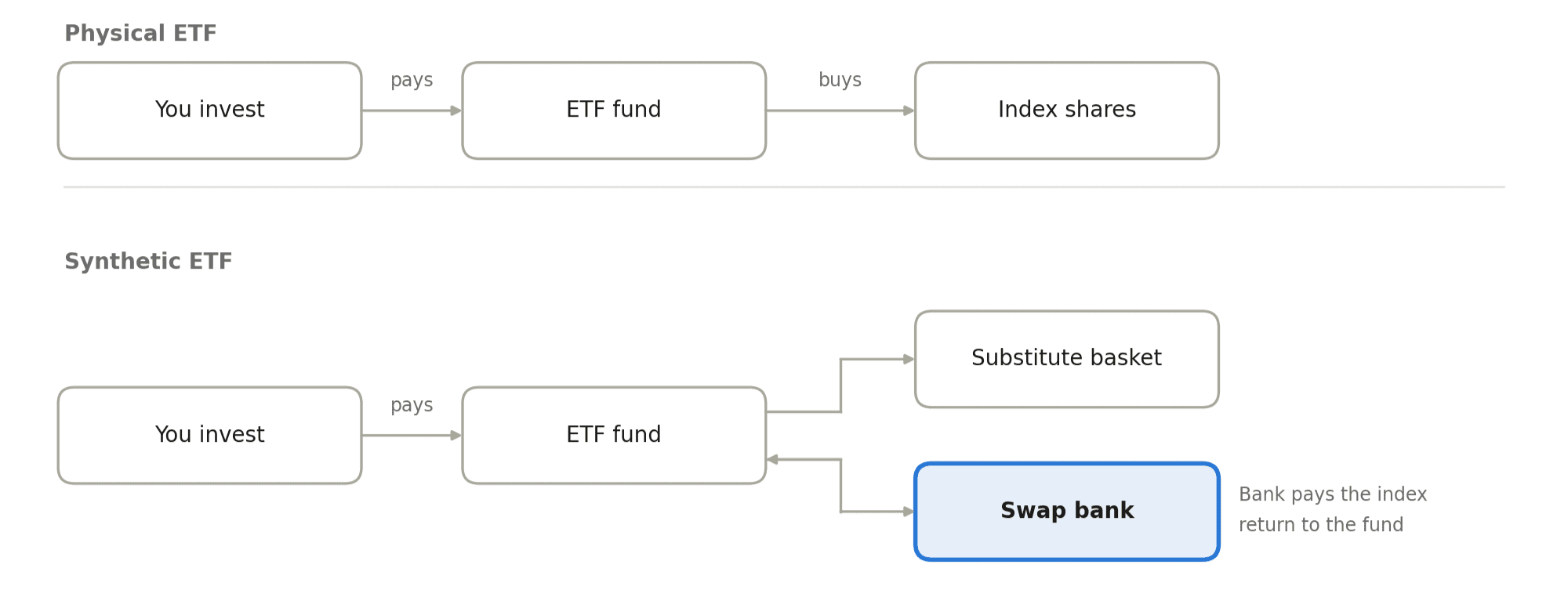
A physical ETF buys shares in the market it tracks, or a representative sample of those shares. If the shares rise in value, the fund benefits directly, before fees and other costs.
A synthetic ETF uses a swap contract with a bank to receive the index return. If the index rises by 10%, the ETF aims to deliver a similar return, equivalent to AED 10,000 on your investment before fees and other adjustments. The actual result depends on the swap terms, costs, and fund structure, as well as the bank meeting its contractual obligations. In both cases, you own ETF units, not the underlying companies directly.
Chart 1: Physical vs Synthetic ETFs: How Each Structure Works
Physical vs synthetic ETFs: Key differences
Neither structure eliminates the risk of the underlying market falling. The main difference is how the fund obtains its exposure.
What is counterparty risk in a synthetic ETF?
Counterparty risk is the possibility that a financial institution fails to meet its contractual obligations.
For example, if a bank owes a synthetic ETF money under a swap and defaults, the fund may not recover the full amount owed. This does not automatically mean investors lose their entire investment. The outcome depends on the fund’s assets, collateral, contractual rights, and recovery process.
Under applicable European UCITS rules, exposure to a counterparty in an over-the-counter derivative transaction generally cannot exceed 10% of a fund’s assets when the counterparty is a qualifying credit institution, or 5% in other cases. These limits apply to calculated counterparty exposure; they do not limit the fund’s total exposure to its target index. Actual risk also depends on the swap terms, collateral, and other protections.
Collateral can help reduce this risk, but it is not an insurance policy. Its value, liquidity, and legal enforceability matter, particularly during market stress.
Physical ETFs are not entirely free of counterparty risk either. Some lend securities to other market participants, creating the possibility that a borrower fails to return them as agreed.
Why Do Investors Choose Synthetic ETFs?
Synthetic ETFs can provide access to markets that are difficult or expensive to replicate through direct ownership. By using swap contracts, they aim to deliver a benchmark's return without necessarily holding all its constituent securities.
Potential benefits include efficient market access, flexible portfolio construction and closer index tracking. However, these advantages depend on the fund's structure and costs.
Before investing, GCC investors should check swap fees, counterparty arrangements, collateral quality, and historical tracking differences. Synthetic replication can be useful, but it does not guarantee better performance or lower costs than a physical ETF.
Physical vs Synthetic ETFs: Examples for GCC Investors
The following funds illustrate the two structures. They track different benchmarks, so they should not be treated as a direct performance or safety comparison.
The Albilad ETF provides exposure to its Saudi equity benchmark through physical replication. Its published terms state an annual management fee of up to 0.35% of net asset value.
The Xtrackers fund is an Irish-domiciled UCITS ETF that uses swap replication. Its stated annual all-in fee is 0.65%, although investors may still incur trading costs such as brokerage, bid–ask spreads and currency conversion. Its benchmark methodology also excludes certain securities, illustrating how index rules and foreign-ownership restrictions can affect market exposure.
These examples show why the replication method should be assessed alongside the benchmark, costs, liquidity and the investor’s access to the fund.
Currency, trading spreads and total costs
GCC investors buying overseas ETFs should consider currency exposure as well as fund fees. An ETF traded in US dollars may still hold exposure to assets denominated in other currencies. Your return in dirhams or riyals can therefore differ from the return reported in the fund’s base currency. Currency conversion can also add costs.
The bid–ask spread is the difference between the price at which you can buy an ETF and the price at which you can sell it. For example, if you can buy units for AED 101 and sell them for AED 100 at the same time, the spread is AED 1, or approximately 1% of the midpoint price of AED 100.50. This hypothetical example illustrates a trading cost in addition to the annual fund fee.
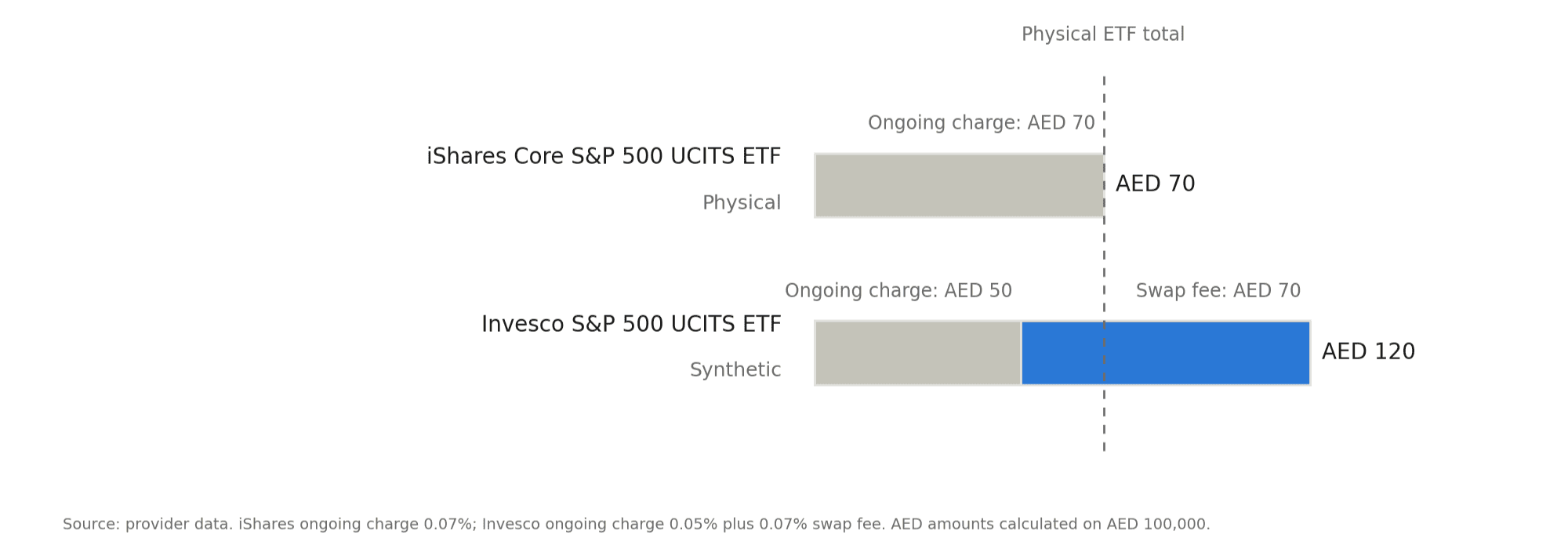
Fees also matter. The iShares Core S&P 500 UCITS ETF has a 0.07% ongoing charge, while the Invesco S&P 500 UCITS ETF has a 0.05% ongoing charge and a separate swap fee of 0.072%. Together, Invesco’s stated charges total approximately 0.12%.
On AED 100,000, these rates equate to AED 70 and AED 120 a year, respectively, assuming the investment value remains unchanged. The AED 50 difference does not establish which ETF will perform better. Brokerage, spreads, currency conversion, taxes, and tracking differences can also affect the final result.
Physical vs Synthetic ETFs: Annual Charges Compared
How to check an ETF before investing
Before buying either structure, check the following:
- Identify the fund: Use its ISIN to confirm the exact ETF and share class, benchmark, and replication method.
- Read the documents: Review the latest factsheet, Key Information Document (KID), and prospectus.
- Compare costs and tracking: Check annual charges, additional swap fees where applicable, historical tracking difference, and trading spreads.
- Review the risks: For synthetic ETFs, examine counterparty and collateral arrangements. For physical ETFs, check whether securities lending is permitted and how associated risks are managed.
- Check access and liquidity: Review fund size, trading activity, broker availability, currency exposure, and the cost of buying and selling.
Historical tracking results can help you assess how closely an ETF followed its benchmark, but past performance does not guarantee future results.
Frequently asked questions
1. What is the difference between physical and synthetic ETFs?
A physical ETF buys the shares or other securities it tracks, or a representative sample. A synthetic ETF uses a swap contract with a financial institution to receive the return of its target index.
2. What happens if a bank providing a swap to a synthetic ETF defaults?
The fund may lose some of the amount owed under the swap or incur costs replacing the contract. Collateral and other protections may reduce the loss, but the outcome depends on the specific arrangements.
3. Can synthetic ETFs be Sharia-compliant?
Potentially, but the replication method alone does not determine Sharia compliance. The fund’s underlying assets, derivative contracts, screening methodology, and relevant Sharia governance arrangements must be assessed. Investors should consult the fund’s documentation and applicable Sharia guidance.
4. How can I check whether an ETF uses physical or synthetic replication?
Check the issuer’s official product page, latest factsheet, KID and prospectus. Search for terms such as “physical replication”, “optimised sampling”, “synthetic replication”, “swap” and “counterparty”. Confirm the exact share class using its ISIN rather than relying on the ticker alone.
Physical vs Synthetic ETFs: Which Is Safer for GCC Investors?
For many first-time investors, a physical ETF may be easier to understand because it generally holds the securities it tracks. A synthetic ETF can also be appropriate when it provides efficient market access or tracks its benchmark effectively, provided its swap and collateral arrangements are sufficiently transparent.
Neither is automatically safer. The better choice depends on the underlying market, fund structure, tracking record, total costs, liquidity, and access through your broker.
Physical or synthetic is a starting point for the comparison, not a guarantee of safety.
Explore More ETF Resources
Read our ETF Glossary to understand key terms related to ETF structures, physical and synthetic replication, and counterparty risk. Then use the Nukoud ETF Screener to compare available funds and review their characteristics before investing.