



Saudi Arabia is heading into 2027 with an unusually strong economic growth forecast. The Kingdom expects real GDP to rebound 12.8% in 2027, following an estimated 3.6% contraction in 2026. But renewed fighting in neighboring Yemen is creating another risk for the recovery, particularly as the escalation spreads around the Red Sea and Bab el-Mandeb shipping route, a key corridor for regional energy and trade.
The question for investors is not whether Yemen alone can derail Saudi Arabia's growth forecast. It is whether a prolonged conflict can disrupt the oil-production and export recovery underpinning the 2027 outlook, while also raising shipping costs and weighing on non-oil activity.
What Does Saudi Arabia's 12.8% GDP Forecast Mean?
Saudi Arabia's Ministry of Finance expects real GDP to contract 3.6% in 2026, with oil activity falling approximately 21.8%, while non-oil activity is expected to grow around 3.2%. For 2027, the government projects a sharp rebound in overall economic activity.
The 2027 budget also assumes expenditure of about SAR 1.392 trillion and revenue of approximately SAR 1.202 trillion, leaving a projected deficit of around 3.6% of GDP.
The scale of the projected rebound is notable because it is considerably stronger than forecasts from international institutions. The OECD's June outlook projected Saudi real GDP growth of 3.2% in 2026 and 4.3% in 2027, while the IMF's July outlook put 2027 growth at 5.5%. This makes the Ministry of Finance's 12.8% projection a particularly strong recovery assumption.
The size of the rebound partly reflects the low 2026 base. If an economy contracts 3.6% in one year and then grows 12.8% the following year, the resulting economy would be approximately 8.7% larger than its 2025 level, based on the two growth rates.
Nukoud previously examined the outlook for Saudi equities ahead of the projected 2027 rebound: Saudi Arabia Sees 12.8% Growth in 2027 — Is Tadawul Starting to Look Undervalued?
How Could the Yemen Conflict Affect Saudi Arabia's Economy?
There are three channels through which the escalation could affect Saudi Arabia.
First is oil production and exports. Any disruption to Saudi production, pipelines, or export infrastructure could prevent the oil-sector recovery assumed in the 2027 forecast and reduce the volume of crude the Kingdom can sell.
Second is fiscal revenue. Saudi Arabia has increased non-oil revenues over the past decade, but oil activity remains important to the fiscal outlook. A sustained disruption to production or exports could therefore weaken government revenue and widen pressure on the fiscal balance.
Third is the non-oil economy. Higher security costs, shipping disruptions and weaker regional trade could increase costs for businesses and weigh on investment and confidence if the disruption persists. The Riyad Bank Saudi Arabia PMI rose to 53.8 in August, marking a fifth consecutive month of expansion, but export orders declined amid regional tensions, suggesting that external risks are becoming more visible.
How Have Gulf Markets Reacted?
Saudi Arabia's stock market has weakened alongside several other Gulf exchanges as regional tensions have intensified.
Using the October 7 market data in the table below, Saudi Arabia, Abu Dhabi and Dubai were down around 1%–1.4% from September 21, while Qatar recorded the largest decline at 3.7%.
Reuters reported that on October 7, the Saudi benchmark fell around 0.5%, while Dubai declined 0.2%, Abu Dhabi 0.3%, and Qatar 0.5%.
The comparison should not be interpreted as evidence that Yemen alone caused each market's decline. Oil prices, shipping disruptions, the wider regional security environment, and domestic market factors are also influencing Gulf equities.
How Did the Yemen Escalation Develop?
The escalation unfolded in several stages between July and early October, with the conflict increasingly affecting Saudi territory, Red Sea shipping risks, and investor sentiment.
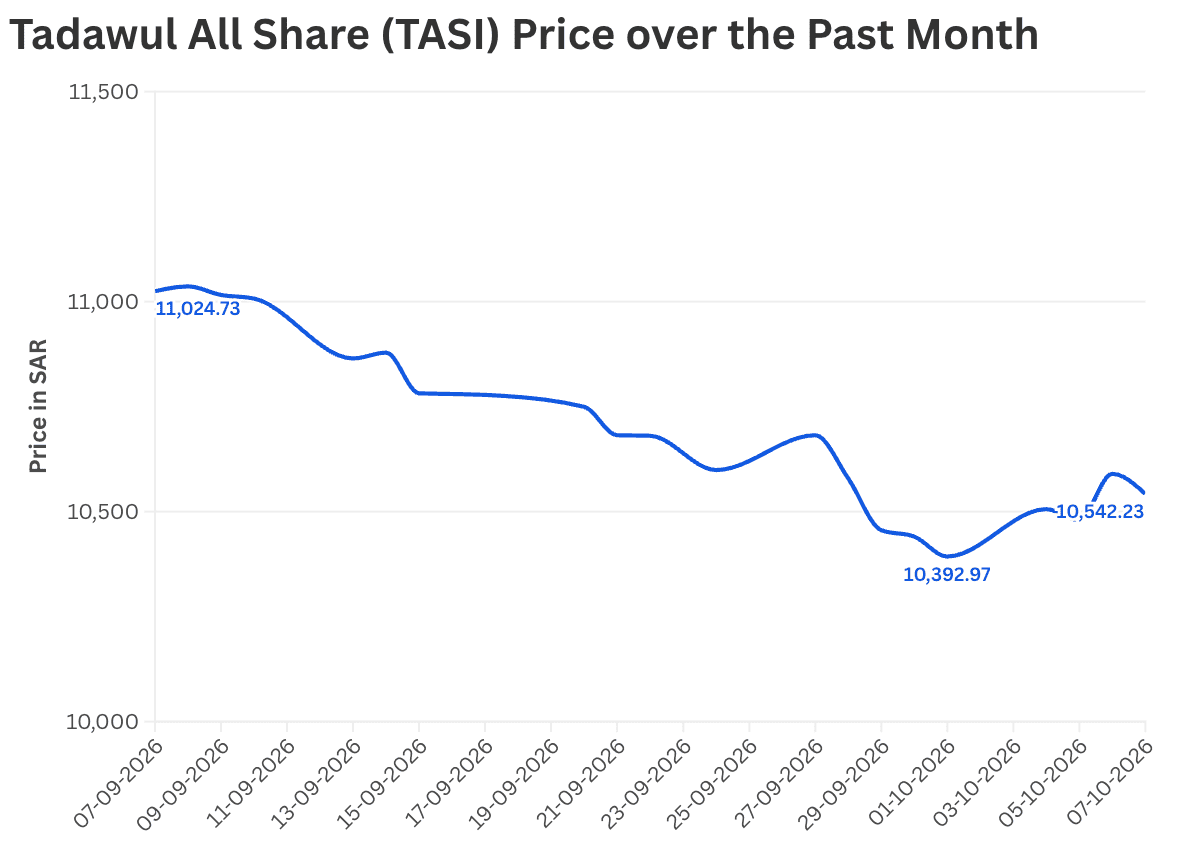
TASI fell from 11,015.72 on September 9 to 10,542.23 on October 7, a decline of approximately 4.3%. The decline coincided with the escalation, but the market reaction reflects more than the Yemen conflict alone, including oil prices, wider regional security risks, and domestic market factors.
How Has the Tadawul Responded?
The Tadawul All Share Index (TASI) closed at 10,681.82 on September 21 and 10,542.23 on October 7, representing a decline of approximately 1.3%.
The index peaked on 27 September, then fell 2.70% in four sessions to the period low close on 1 October. It subsequently recovered 1.90% by October 6 before declining 0.45% on October 7. Brent had settled above $106.50 on September 24 amid heightened regional supply concerns and was trading near $101.65 on October 7.
Why the Oil Recovery Matters
The key issue is whether the escalation affects Saudi oil production and exports.
If Saudi production and exports remain largely uninterrupted while Brent stays elevated, higher oil prices could support government revenues and economic activity. The East-West Pipeline provides an important buffer by giving Saudi Arabia an alternative route from its eastern oil-producing region to the Red Sea, reducing its reliance on Gulf shipping routes. Saudi Energy Minister Prince Abdulaziz bin Salman said on October 6 that flows through the pipeline had reached about 5.8 million barrels per day. However, crude shipped onward through the Red Sea can still face risks around Bab el-Mandeb.
The risk becomes more significant if attacks disrupt Saudi oil infrastructure, export routes or the wider Red Sea logistics network. Even if Saudi production remains intact, prolonged disruption around Bab el-Mandeb could raise freight and insurance costs and complicate shipments.
The latest escalation therefore creates an important test for the 2027 forecast: can Saudi Arabia achieve the oil recovery assumed in its budget while keeping export infrastructure and regional trade flows functioning?
How Is the Yemen Escalation Affecting Saudi ETFs?
The recent weakness in Saudi equities is also visible in Saudi-focused ETFs, although their performance reflects a combination of geopolitical risk, oil-price movements, and broader Saudi market conditions rather than the Yemen conflict alone.
Performance dates are not identical across all funds. KSA data are through October 5; 9402, 9408, and 9400 data are through October 1; 9401 data are through September 28; and 9413 data are through October 7. Source: Nukoud.
What Should Saudi Investors Watch Next?
Investors should focus on four indicators: Saudi oil production, East-West Pipeline flows, Brent crude, and non-oil economic activity. The security situation around Bab el-Mandeb and the Red Sea should also be monitored, particularly for signs of sustained disruption to shipping and export routes.
Saudi Arabia also has significant economic buffers, including alternative oil-export infrastructure and a growing non-oil economy.
But the size of the 12.8% growth forecast means the oil recovery remains critical. If production and exports recover as assumed, the Yemen escalation may have a more limited effect on the 2027 growth outlook. If the conflict begins to constrain production, exports, or Red Sea logistics for an extended period, the gap between Saudi Arabia's 12.8% forecast and more conservative international forecasts could become increasingly important for investors.