

Recently, we saw GTN and State Street Investment Management announce a partnership to bring model portfolios to the region.
The move reflects a broader shift already underway: model portfolios are increasingly becoming a central delivery mechanism in wealth management, not just in the United States but also across the Middle East.
Fintech platforms such as Sarwa and Vault have also embedded model portfolios into their offering, providing investors with pre-built, diversified allocations rather than single-product exposure. As adoption accelerates across banks, broker-dealers and digital wealth platforms, the question becomes more fundamental:
How exactly do ETF model portfolios work and why are they gaining traction?
What Are ETF Model Portfolios?
ETF model portfolios are structured asset allocation frameworks built using exchange-traded funds across asset classes such as equities, fixed income, real assets and, increasingly, alternatives.
At their core, they provide predefined portfolio allocations designed around specific risk profiles or objectives, with portfolios rebalanced either strategically (long-term asset mix) or tactically (short-term positioning adjustments). The objective is consistency, scalability and disciplined implementation.
While early model portfolios focused primarily on traditional liquid ETFs, the structure has evolved. Today, models increasingly incorporate active ETFs, ESG strategies, alternative income solutions and, in certain structures, selective private market exposures. This reflects both changing investor demand and the broader toolkit now available within advisory platforms.
The expansion of model portfolios also coincides with the growth of outsourced chief investment officer (OCIO) services. As independent wealth firms, fintech platforms and family offices grow outside traditional banking channels, many require institutional-grade portfolio construction but lack in-house investment committees. Model portfolios form the operational backbone of these OCIO relationships. Organizations can partner with global asset managers such as BlackRock or State Street to access centralized asset allocation frameworks, risk management infrastructure and ongoing oversight, while maintaining their client-facing brand and advisory relationships.
Why Model Portfolios Are Growing
The growth of model portfolios is closely linked to structural changes in the wealth management industry. As advisory firms scale beyond traditional bank platforms, particularly in independent and fintech-led channels, many lack the internal investment committees and portfolio construction infrastructure required to manage assets at scale.
This has driven increased demand for outsourced chief investment officer (OCIO) services, where external asset managers provide centralized asset allocation, portfolio oversight and risk management.
Model portfolios form the operational foundation of these OCIO relationships. They allow organizations to deliver institutional-grade portfolio construction while maintaining their own client relationships and brand identity. Firms can partner with large global providers such as BlackRock or State Street to access established investment frameworks, research capabilities and ongoing oversight, while tailoring solutions to their client base.
At the same time, model portfolios enhance scalability by standardizing construction and rebalancing processes, enabling advisers to manage larger client bases efficiently. Broker-dealers and advisory platforms increasingly rely on centralized research teams to oversee asset allocation decisions, reducing dispersion in portfolio implementation. For asset managers, competition has shifted toward securing inclusion within model allocations rather than relying solely on individual fund flows. Technology has further accelerated adoption, with modern platforms enabling automated rebalancing, reporting and implementation across thousands of accounts.
Who Controls the Models?
Approximately 80% of model portfolio assets are directed by centralized research groups rather than individual advisers.
This concentration shifts influence toward home-office decision-makers and strategist teams who determine model construction and fund selection. For asset managers, distribution strategies increasingly focus on these gatekeepers.
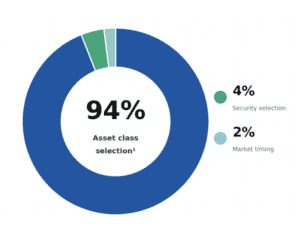
The emphasis on centralized allocation is not incidental. Decades of asset allocation research, most notably the Brinson, Hood and Beebower framework, suggests that the vast majority of portfolio return variability, often cited at 90% or more, is explained by asset allocation decisions rather than individual security selection or market timing. In that context, control over model construction effectively means control over the primary driver of portfolio outcomes.
Major Providers
BlackRock
BlackRock is one of the largest global providers of model portfolios, managing trillions of dollars across thousands of allocations spanning growth, income and outcome-oriented strategies. Its multi-asset teams make strategic and tactical asset allocation decisions across equities, fixed income and alternatives, with updates typically communicated to clients on a monthly or quarterly basis. Integration with the firm’s Aladdin risk platform allows advisory partners to monitor exposures, run scenario analysis and generate portfolio reporting.
State Street Investment Management
State Street Investment Management similarly leverages its multi-asset Investment Solutions Group to deliver target-risk, income and tactical ETF model portfolios. Allocation decisions are guided by long-term capital market assumptions and periodic tactical adjustments, supported by regular client communication and research updates.
Other Providers
Fidelity, Capital Group and a range of boutique strategists also offer model solutions, often within broader OCIO frameworks as portfolio construction becomes increasingly centralized across advisory platforms
Shariah-Compliant Model Portfolios
In the Middle East, the development of Shariah-compliant ETF model portfolios is gaining attention as ETF adoption rises.
Such portfolios can integrate:
- Islamic equity indices
- Sukuk ETFs
- Global Shariah-screened exposures
These frameworks offer scalable Islamic asset allocation solutions for regional wealth platforms.
The Bigger Picture
Model portfolios represent a structural shift in wealth management, moving the industry from product selection to portfolio construction, from adviser-led discretion to increasingly centralized investment frameworks, and from single-fund distribution to embedded allocation within broader portfolio strategies. As trillions of dollars flow through model-driven channels, ETF competition increasingly centres on inclusion within model portfolios rather than standalone fund performance.
At the same time, investor preferences are evolving. There is growing demand for open-architecture models, where portfolios are not limited to a single asset manager’s products but instead combine ETFs from multiple specialist providers within one allocation framework. This approach allows advisers to blend best-in-class exposures across issuers rather than relying exclusively on vertically integrated models. In response, major asset managers are increasingly forming partnerships with boutique strategists and external model providers to broaden their platform offerings.
In this context, model portfolios are not simply a product innovation, they are reshaping how capital is allocated across advisory ecosystems.