
The launch of the KraneShares Global Carbon Strategy ETF (KRBN) on the Abu Dhabi Securities Exchange marks a pivotal moment for GCC investors seeking carbon credit exposure. With compliance carbon markets valued at over USD 110 billion in 2024 and carbon-pricing systems generating more than USD 100 billion in public revenues, carbon allowances are increasingly emerging as a strategic asset class.
This is particularly relevant for the Gulf. GCC economies are advancing net-zero commitments, expanding renewable capacity, and integrating climate risk into national investment frameworks. As carbon prices increasingly influence industrial competitiveness, trade flows, and energy-intensive sectors, access to regulated carbon markets offers investors a way to align portfolios with the global energy transition.
What Is a Carbon Credit?

A carbon credit represents the right to emit one metric tonne of carbon dioxide. In compliance markets, governments impose legally binding emissions caps and issue a limited supply of allowances. Companies that emit less can sell excess credits, while higher emitters must buy them, creating a transparent market price for carbon. As caps tighten over time, allowances become scarcer and more valuable.
What began as an environmental policy mechanism has evolved into a policy-driven investment asset. Carbon prices now shape energy costs, industrial margins, and global trade dynamics, offering investors exposure driven by regulation rather than economic cycles or corporate earnings.
Against this backdrop, KRBN provides direct exposure to the world’s most established compliance carbon markets through a single, exchange-listed instrument, making its availability in the GCC both timely and strategically relevant.
Two Kinds of Carbon Credits
- Compliance Carbon Credits
These are mandatory credits issued by governments under legally binding cap-and-trade systems. Companies are required to hold allowances to cover their emissions in markets such as the EU, the UK, California, and parts of the U.S. East Coast. Prices are driven by regulation, emissions caps, and policy tightening.
- Voluntary Carbon Credits
These are optional credits, typically generated from projects in the Global South, such as forest conservation, renewable energy, or community-based climate initiatives. They are purchased voluntarily by companies or individuals to offset emissions and are more exposed to variability in quality, verification, and pricing.
For GCC investors, this distinction is critical. Compliance carbon credits reflect real, regulated pricing of emissions that directly affects industrial costs and global competitiveness, providing a credible and policy-aligned exposure consistent with the region’s long-term decarbonization goals.
Key Fund Facts & Data
Fund Specifications
- Fund Name: KraneShares Global Carbon Strategy ETF
- Ticker Symbol: KRBN
- Launch Date: July 30, 2020
- Primary Exchange: NYSE Arca
- GCC Listing: Abu Dhabi Securities Exchange (ADX)
- Annual Expense Ratio: 0.89%
- Net Assets (Oct 31, 2025): $171.6 million
- Index Tracked: S&P Global Carbon Credit Index
Investment Methodology
KRBN employs a futures-based strategy that provides direct exposure to global compliance carbon markets. The ETF invests in December-maturity carbon credit futures contracts selected based on trading volume and market liquidity, open interest depth, market significance, and regulatory stability, with dynamic rebalancing to maintain optimal market exposure. This structure delivers low correlation with traditional equities, bonds, and commodities, creating a return profile driven primarily by climate policy developments and carbon supply-demand fundamentals rather than traditional market factors.
Understanding KRBN and Its Role in Global Carbon Markets
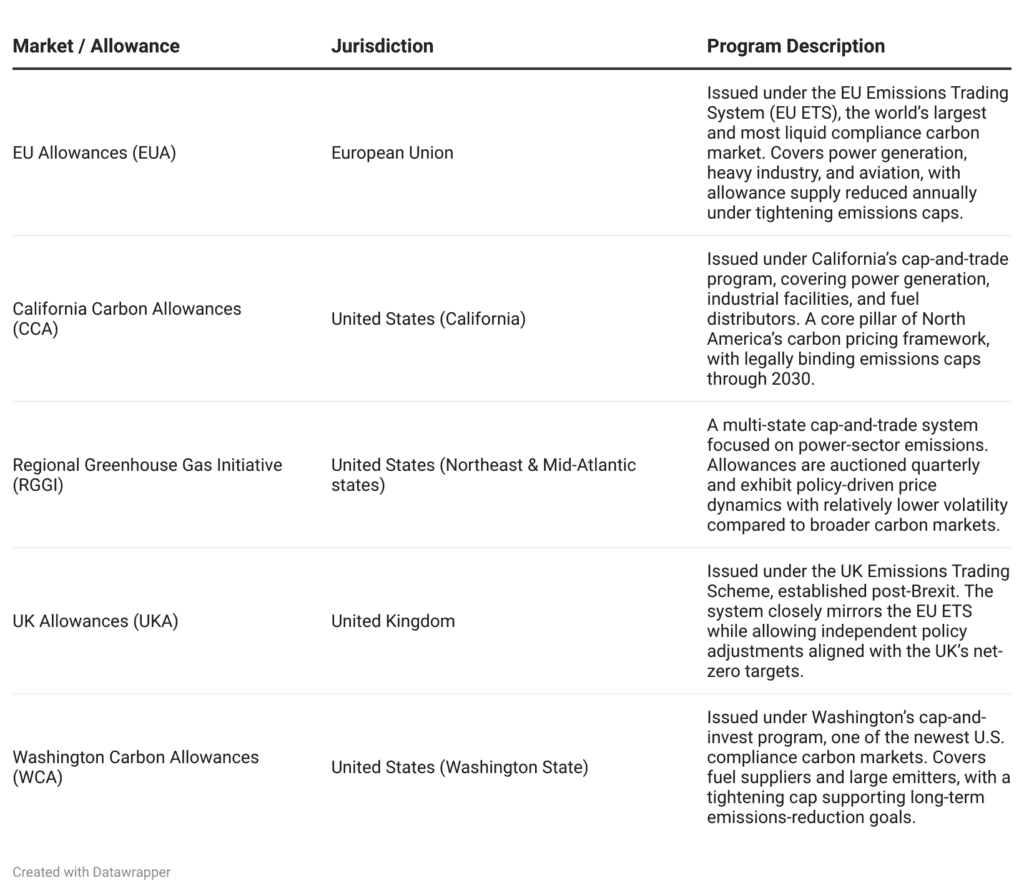
The KraneShares Global Carbon Strategy ETF (KRBN) provides direct exposure to the world’s major compliance carbon markets, the regulated cap-and-trade systems that impose legally binding emissions caps on industry. KRBN tracks the S&P Global Carbon Credit Index, which includes futures linked to:
Recent data reinforces the growing importance of these markets. Carbon-pricing systems generated over USD 100 billion in public revenues in 2024, while the global compliance carbon-credit market was valued at approximately USD 113.1 billion in 2024. At the exchange level, liquidity expanded rapidly. ICE reported over 20.4 million environmental futures and options contracts traded in 2024, representing more than USD 1 trillion in notional value.
KRBN remains the first, largest, and most liquid carbon-allowance ETF globally, offering investors direct access to this expanding asset class. Because carbon allowance prices are driven primarily by regulatory tightening rather than corporate fundamentals, they show low correlation with traditional markets, positioning KRBN as both a diversifier and a way to participate in the long-term evolution of global climate policy.
Several factors make carbon allowances strategically relevant to GCC portfolios:
1. Low Correlation and Diversification Benefits
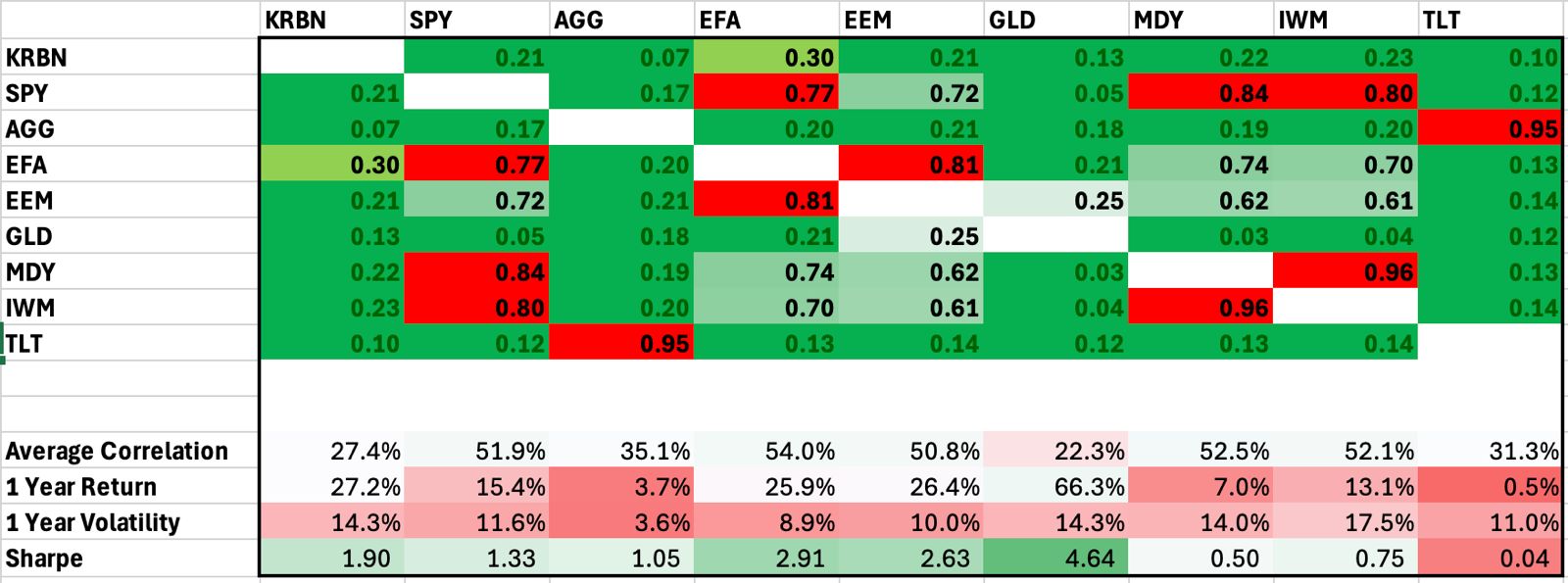
Carbon allowance prices are shaped by regulatory tightening and emissions caps, rather than corporate earnings. This creates a low-correlation profile versus equities, bonds, and commodities, adding a distinct risk factor to institutional portfolios.
2. Alignment With National Net-Zero Strategies
Countries across the GCC, led by the UAE and Saudi Arabia, have set ambitious net-zero timelines and are expanding renewable-energy capacity. Exposure to carbon-pricing mechanisms complements these national climate commitments and supports climate-aligned investment frameworks.
3. Natural Fit for Energy-Linked Economies
As global carbon prices influence the cost structures of heavy industry, shipping, and long-distance supply chains, GCC investors, many of whom have exposures across these sectors, can use carbon allowances as a strategic hedge against tightening international climate policy.
4. Access to Global Climate-Policy Momentum
With the compliance carbon-credit market valued at around USD 113.1 billion in 2024, and liquidity rising across major exchanges, carbon allowances offer GCC investors a liquid and institutional-grade way to express views on global climate-policy direction.
KRBN Portfolio Composition
KRBN provides exposure to the world’s largest and most established compliance carbon markets through a diversified basket of futures contracts. As of October 31, 2025, the ETF held $171.6 million in net assets and tracked the S&P Global Carbon Credit Index.
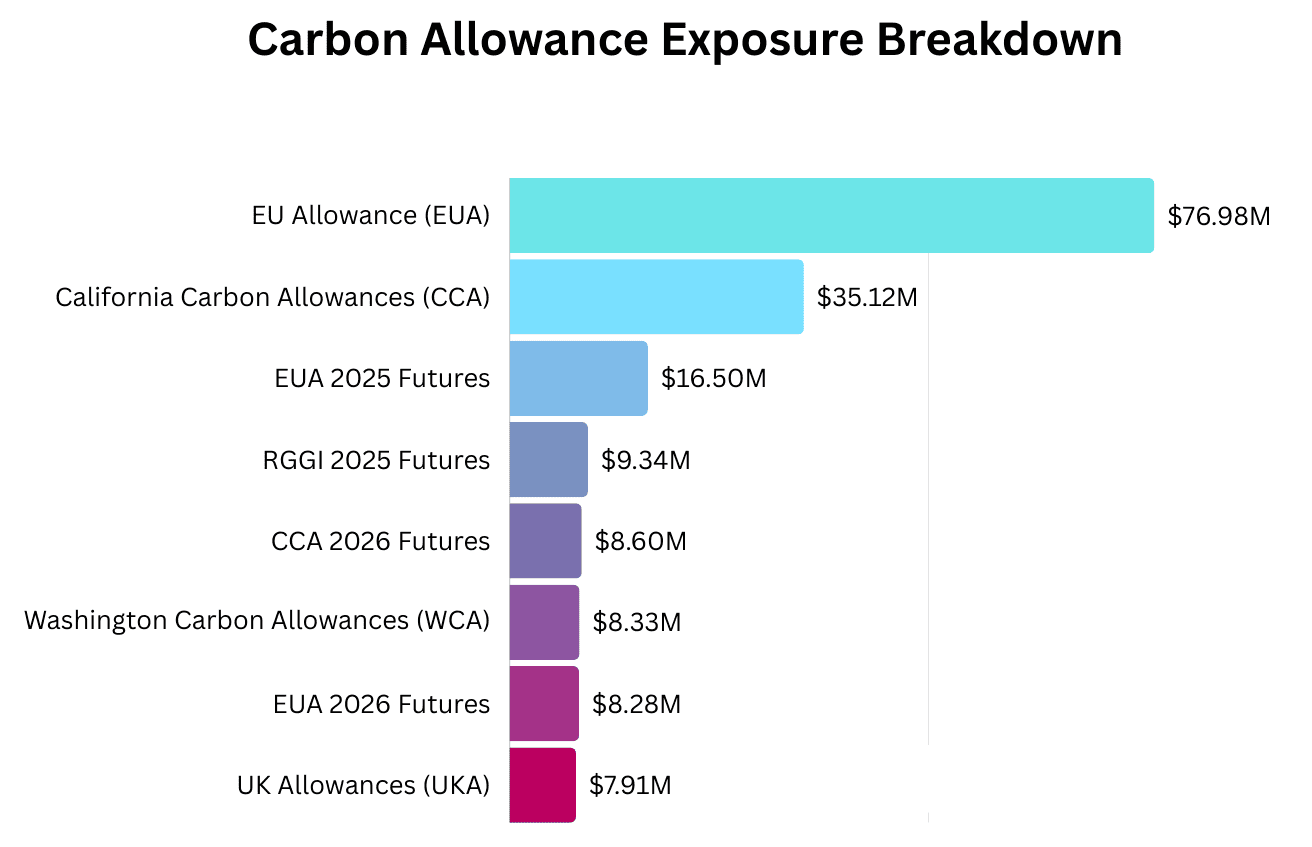
KRBN’s portfolio is primarily concentrated in the European and North American cap-and-trade systems:
| Market / Instrument | Exposure ($) | % of NAV |
| EU Allowance (EUA) 2025 Note | $76.98M | 45.46% |
| California Carbon Allowances (CCA) 2025 | $35.12M | 20.74% |
| EUA 2025 Futures | $16.50M | 9.74% |
| RGGI 2025 Futures | $9.34M | 5.51% |
| CCA 2026 Futures | $8.60M | 5.08% |
| Washington Carbon Allowances (WCA) 2025 | $8.33M | 4.92% |
| EUA 2026 Futures | $8.28M | 4.89% |
| UK Allowances (UKA) 2025 | $7.91M | 4.67% |
KRBN Performance Analysis
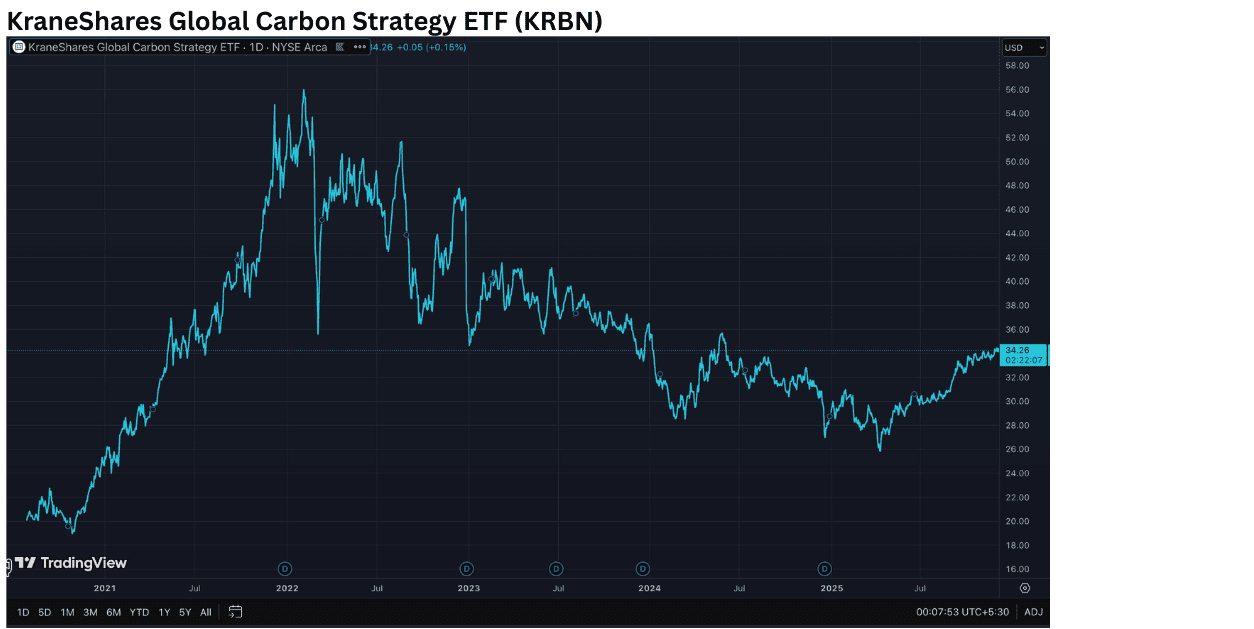
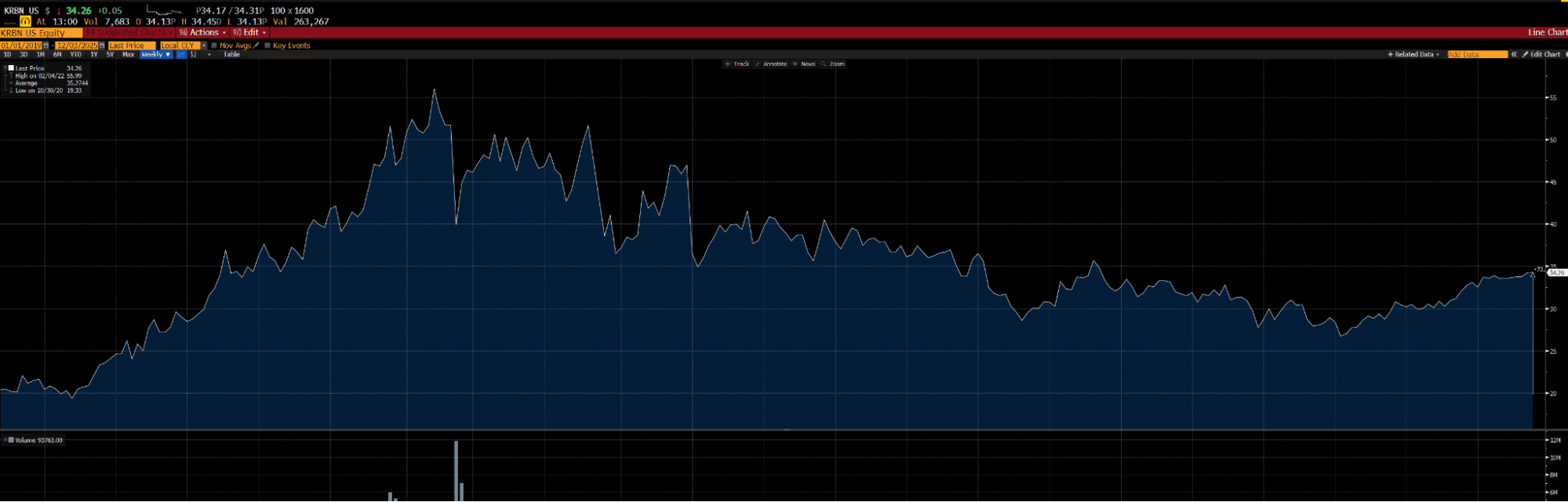
KRBN has delivered strong long-term gains since its inception, rising roughly 72% from its launch level after initially climbing as high as 150%. Much of the pullback from those highs came during the past two years, when global events, including the Russia–Ukraine war, Europe’s energy crisis, shifting U.S. policy signals, and broader market uncertainty, put pressure on carbon prices. Despite this volatility, the ETF has begun to stabilize, with the current price hovering around USD 34 and showing a positive recovery trend.
On a trailing basis, KRBN has posted a 10 to 18% gain over the past year and maintains an impressive average annual return of around 18% since inception. With global emissions caps tightening and regulated markets expanding, the structural backdrop for carbon pricing remains intact, suggesting KRBN may be positioned to resume its longer-term upward trajectory as policy momentum strengthens and market conditions normalize.
Key Risks GCC Investors Should Know
Carbon markets offer diversification benefits but come with several risks that GCC investors should be aware of. The most important is regulatory risk, as carbon prices are shaped almost entirely by government policies and emissions caps. Any shift in rules within the EU, UK, California, or other regulated systems can quickly influence KRBN’s performance. Because the ETF holds futures contracts, investors should also expect higher volatility and occasional tracking differences versus spot carbon-allowance markets.
Liquidity and concentration are additional considerations. Some carbon programs, particularly smaller U.S. markets, have thinner trading volumes, and KRBN’s exposure is still largely concentrated in European and Californian allowances. As a USD-pegged region, GCC investors should also note KRBN’s indirect exposure to EUR and GBP, which can affect returns through currency movements.
Taken together, these risks don’t diminish KRBN’s strategic value but underline the importance of viewing it as a thematic or satellite allocation rather than a core holding.
Bottom Line
The listing of KRBN on the Abu Dhabi Securities Exchange gives GCC investors timely access to a fast-growing, policy-driven asset class that aligns directly with the region’s net-zero ambitions. With compliance carbon markets exceeding USD 110 billion in value and backed by enforceable emissions caps, KRBN offers a credible, liquid way to gain exposure to regulated carbon pricing, unlike voluntary offsets, which remain less reliable.
Despite recent volatility caused by geopolitical and policy shifts, KRBN has shown strong long-term performance and continues to reflect the structural tightening of global cap-and-trade systems. As GCC economies expand renewable energy and integrate climate-risk frameworks, KRBN stands out as a strategic, low-correlation addition to regional portfolios, providing institutional investors with straightforward access to the world’s most established compliance carbon markets at a critical juncture in the global energy transition.