
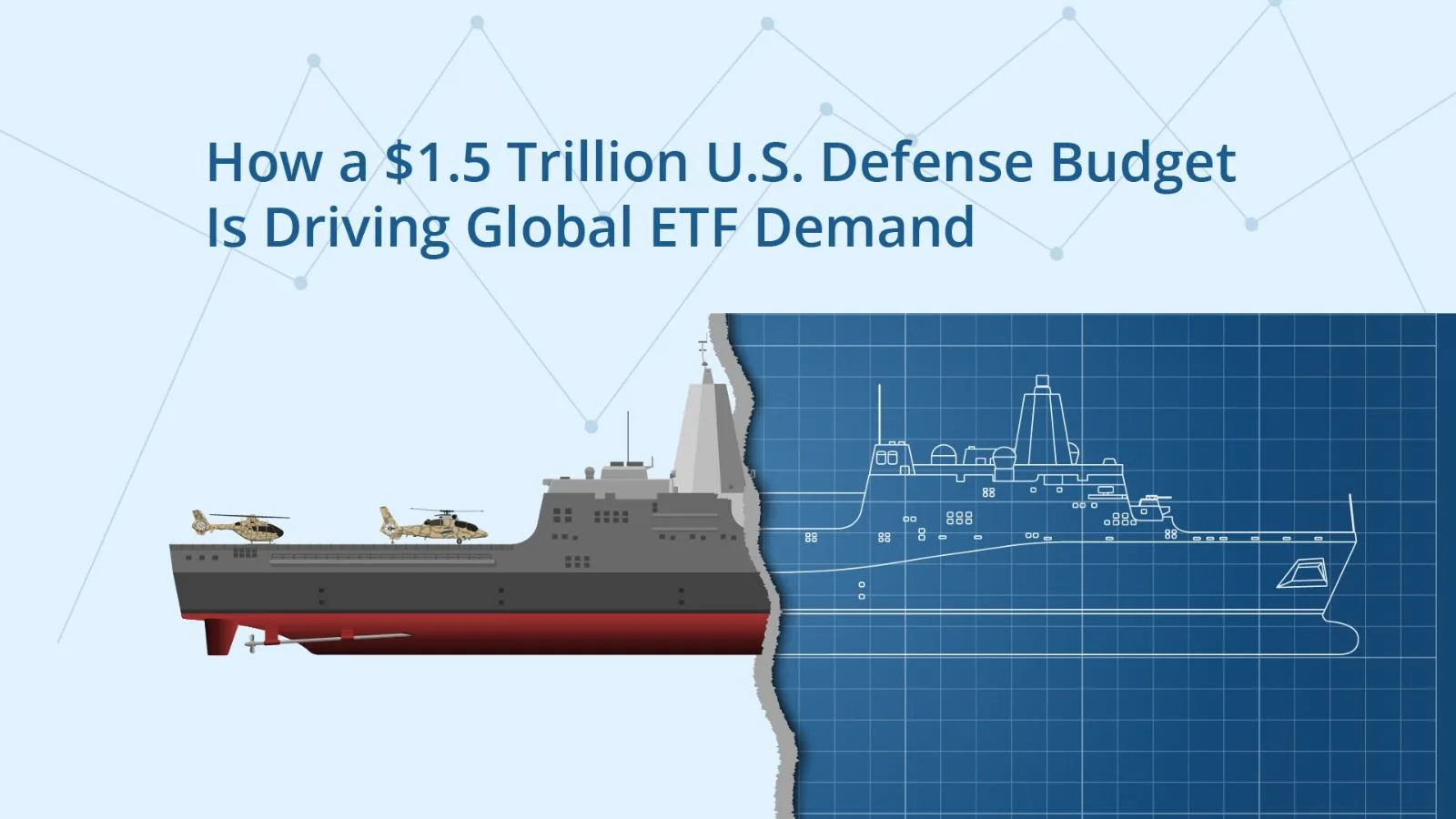
The Pentagon’s proposed $1.5 trillion defence budget is not just setting a new spending record; it is redrawing the global investment map. From missile makers and drone companies to Korean defence exporters, a new wave of military spending is fuelling one of the fastest-growing ETF themes in the market. Nearly $10 billion has already flowed into defence ETFs in 2026 as investors position for what may become a multi-year global re-armament cycle. However, the US defense is subject to Congress approval.
This article explores where the money is flowing, which companies and ETFs stand to benefit most, why South Korea has emerged as a key defence winner through KDEF, and what the trend could mean for GCC investors seeking exposure to a rapidly changing geopolitical landscape.
"Trump's proposed $1.5 trillion budget would increase military spending by more than 50%, pushing the US further from NATO spending norms and into uncharted fiscal territory." - Visual Capitalist · U.S. Military Budget 1997-2027P.
Presidential Spending in Context
The chart below maps total real military spending by administration, anchored against headline geopolitical catalysts that drove surge spending in each era.
The Structural Drivers Behind the Surge
Three compounding forces underpin the sustained re-arming thesis. First, Russia's ongoing land war in Ukraine has exposed NATO's chronic underinvestment in munitions stockpiles, spare parts, and conventional ground forces. Second, China's accelerating military modernisation, particularly naval expansion and contested Taiwan Strait posturing, has galvanised bipartisan American will to fund a Pacific deterrence architecture. Third, the proliferation of drone warfare, electronic warfare, and contested-domain conflicts has created entirely new spending categories that barely existed in Pentagon budget lines a decade ago.
Critically, US allies are responding in kind. European NATO members are rushing towards or past the 2% of GDP spending threshold. South Korea has launched its most ambitious indigenous defence procurement cycle in history. Saudi Arabia, the UAE, and other GCC sovereigns are accelerating diversification of their defence procurement base, a trend with direct implications for US prime contractors and the ETFs that hold them.
Defence Industry: The Companies Cashing the Check
The most direct beneficiaries of the budget surge are the US prime contractors, a cluster of companies whose revenue is substantially government-sourced and whose order books are denominated in multi-year, often cost-plus contracts. Below, we profile the core holdings that dominate the defence ETF universe.
K-Defense: South Korea's Export Miracle and the KDEF ETF
South Korea has emerged as perhaps the most compelling defence growth story outside the United States. Driven by a unique combination of price-competitive manufacturing, NATO-interoperable product lines, and domestic urgency from the North Korean threat, Korean OEMs are winning major export contracts from Poland, Australia, Romania, and increasingly the Middle East.
KDEF: The Purest Play on the Korean Re-Armament Cycle
With an 86.3% inflow-to-AUM ratio, KDEF ranks among the fastest-growing defence ETFs globally on a relative basis. The fund offers concentrated exposure to Hanwha Aerospace, Korea Aerospace Industries, LIG Nex1, Hyundai Rotem, and other defence-industrial champions whose order books have expanded dramatically since Russia invaded Ukraine.
Poland's $7.9 billion K2 tank and K9 howitzer deal, the largest European land-forces procurement in decades, cemented Korean OEMs as Tier-1 NATO supply-chain partners. Australia's $7 billion selection of Hanwha's Redback IFV for its Land 400 program further validates the export thesis. For GCC investors seeking non-US, non-European defence exposure, KDEF provides a differentiated vector into a sector where Korean companies are taking share from legacy Western primes.
The Korean Defence Export Scorecard
The $47bn Universe: Defence ETF Flow Tracker
The global listed defence ETF universe has grown to 25 products with a combined AUM of $47.1 billion, more than doubling since early 2022. YTD through April 19, 2026, these products absorbed $9.94 billion of net new capital. Concentration is a feature: the top five products (ITA, SHLD, PPA, XAR, IDEF) account for 87.6% of total assets. Yet the most striking flow story is at the growth end, newer thematic products are posting inflow ratios far exceeding the megafunds, signalling allocators are building new positions rather than simply topping up existing ones.
Three products dominated flow capture YTD: SHLD (+$2.97bn), IDEF (+$3.64bn), and XAR (+$0.94bn), together accounting for ~76% of total inflows. IDEF's extraordinary ratio reflects its launch-phase accumulation as an actively managed BlackRock product, arguably the most significant structural endorsement of the defence thesis by a major asset manager in years. Among thematic growth names, JEDI (+187%), HEFT (+906%), and WDGF (+225%) are posting triple-digit inflow ratios: drone warfare and European re-armament are the two hottest sub-themes in the space.
The GCC Dimension
For investors in the Gulf Cooperation Council, the global re-arming cycle intersects directly with sovereign defence spending priorities, economic diversification mandates under Vision 2030, and the strategic pivot of major GCC sovereign wealth funds towards hard-power industrial assets.
Saudi Arabia's PIF, Abu Dhabi's ADIA, and QIA collectively manage over $2.5 trillion in assets. The defence ETF universe offers these pools of capital a liquid, diversified vehicle to gain exposure to the re-armament cycle without the governance complexity of single-name direct holdings. SHLD's technology tilt, EUAD's European re-armament exposure, and KDEF's Korean OEM focus provide a modular architecture for GCC institutional investors to express views across geography, technology tier, and risk appetite.
Positioning Framework: What Comes Next
Three structural tailwinds make the current environment distinctly different from prior cyclical defence bounces. First, this is a multi-decade under-investment reversal, not a war premium: NATO allies are rebuilding structural capacity, not funding temporary surge ops. Second, the dual-use technology blurring where AI, autonomy, space, and cybersecurity converge with military applications, creating entirely new market segments that didn't exist in prior cycles. Third, allied supply chain onshoring is concentrating procurement away from China-adjacent vendors, directly benefiting US, European, and Korean OEMs.
"At a 21.1% YTD inflow rate against a $47bn base, the defence ETF space is absorbing capital at a pace consistent with a structural re-rating, not a tactical rotation." Shield Capital Research · April 2026