


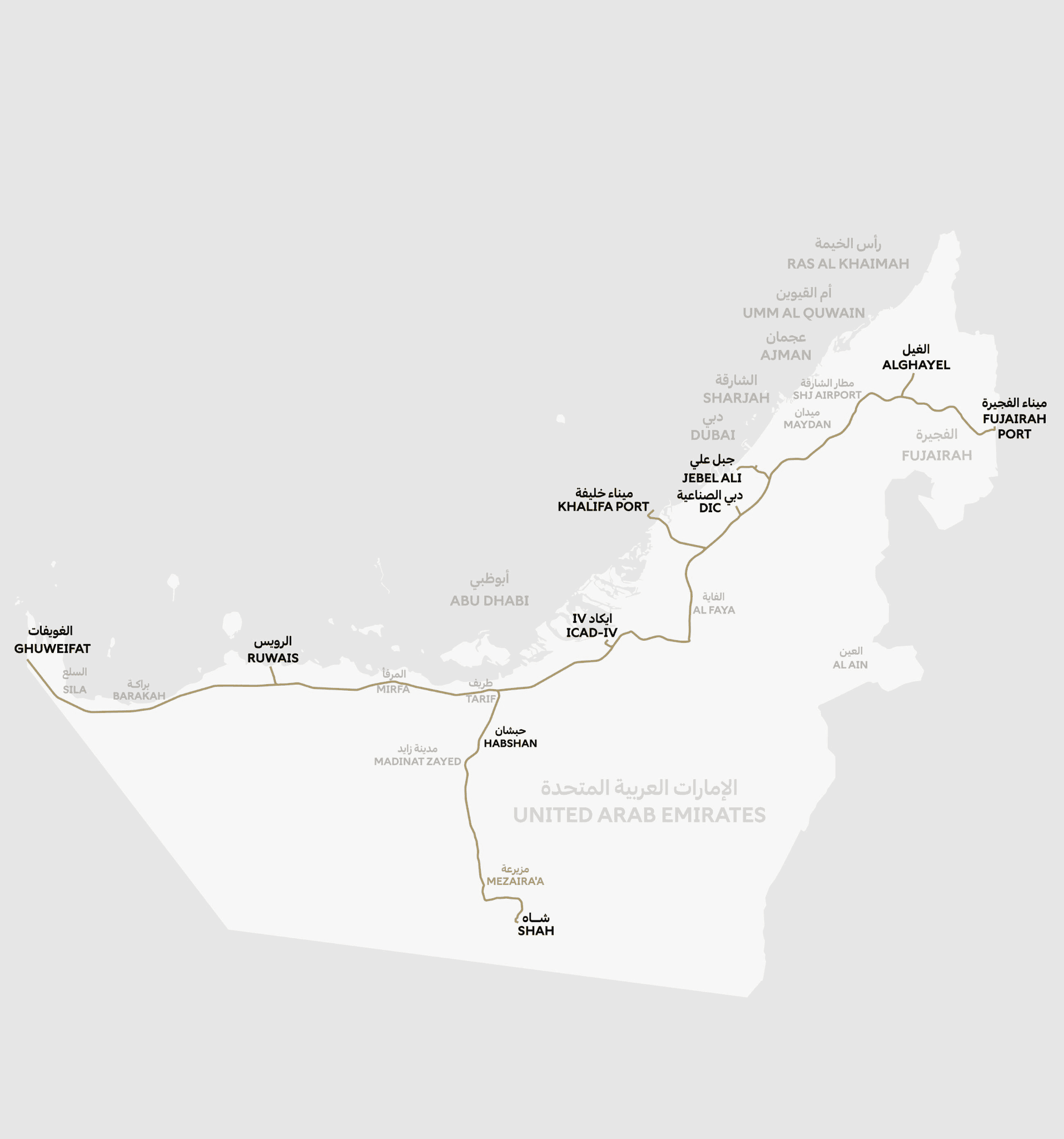
The United Arab Emirates is launching its first national passenger rail network, with Etihad Rail confirming the full list of stations ahead of its planned 2026 rollout. The network’s first phase will connect 11 cities and regions, stretching from Al Sila’ in Abu Dhabi’s Western Region to Fujairah on the east coast, marking a significant milestone in the country’s long-term infrastructure strategy.
Stations are planned in key population and transit-linked areas including Mohammed Bin Zayed City (Abu Dhabi), Jumeirah Golf Estates (Dubai), University City (Sharjah), and Al Hilal (Fujairah), alongside additional nodes such as Al Dhannah, Al Mirfa, Madinat Zayed, Mezaira’a, Al Faya, and Al Dhaid. According to Etihad Rail, these locations were selected to maximise accessibility and reduce journey times, forming the backbone of an integrated national transport system.
The passenger service is expected to begin operations in 2026, with each train accommodating up to 400 passengers and offering onboard amenities such as Wi-Fi and power outlets. The rollout builds on the success of the UAE’s freight rail network, which has been operational since 2023 and already connects key industrial and logistics hubs across the country.
A Transport Project With Economic Spillovers
While the rail network is a transport story on the surface, its implications extend much further. Large-scale infrastructure projects of this nature tend to reshape urban development patterns, property demand, and economic connectivity.
Travel time compression is a key factor. Estimates suggest that journeys such as Abu Dhabi to Dubai could take under an hour, fundamentally changing commuting dynamics between the UAE’s largest economic centers. This effectively expands residential catchment areas, making previously distant communities more viable for both living and business activity.
Historically, similar rail projects globally have driven higher property values near stations, increased retail activity, and supported the development of mixed-use districts. In the UAE context, where master-planned communities and transit-oriented development are already central to urban planning, the impact could be even more pronounced.
The momentum is not limited to Etihad Rail. Dubai has also announced plans for the Dubai Metro Gold Line, a new underground rail project aimed at expanding capacity across high-density corridors. Together, these developments point to a broader acceleration in transport infrastructure investment across the UAE reinforcing the long-term case for sectors tied to urban development, mobility, and connectivity.
Where Investors See the Impact
There is no direct listed exposure to Etihad Rail itself. Instead, the investment angle lies in second-order beneficiary companies that stand to gain from improved connectivity and increased economic activity.
The most immediate beneficiaries are likely to be real estate developers. Companies such as Emaar Properties and Aldar Properties which are key players in residential and commercial development and could benefit from increased demand in areas linked to the rail network, particularly near station hubs.
Transport and mobility-related companies may also see indirect gains. Improved connectivity can boost passenger volumes for airlines such as Air Arabia, increase toll road usage for operators like Salik, and support logistics activity through companies such as ADNOC Logistics & Services.
ETF Angle: Accessing UAE Growth Themes
For investors seeking diversified exposure, these themes are already reflected in listed ETF products. The Chimera S&P UAE Shariah ETF provides broad access to the UAE equity market, with significant allocations to sectors most sensitive to domestic growth and infrastructure development.
As of April 2026, the ETF’s sector breakdown shows a strong tilt toward:
- Real Estate (~32%)
- Financials (~23%)
- Industrials and Logistics (~8%)
- Utilities and Infrastructure-linked names (~8%)
Top holdings include Emaar Properties, Aldar Properties, Air Arabia, Salik, and ADNOC Logistics, effectively capturing a cross-section of companies positioned to benefit from long-term economic expansion.
While Etihad Rail itself is not investable, the broader “UAE connectivity and growth” theme is already accessible through public markets.
A Structural Shift in How the UAE Moves
Beyond immediate market implications, the project supports several long-term objectives, including:
- Reducing road congestion
- Lowering carbon emissions
- Strengthening domestic tourism
- Enhancing labor mobility across emirates
These factors contribute to a more integrated national economy, aligning with broader diversification efforts away from oil.
The Bottom Line
Etihad Rail is a foundational piece of national infrastructure with wide-reaching economic implications. For investors, the opportunity lies not in the rail operator itself, but in the ecosystem it supports.
As connectivity improves, capital is likely to follow into real estate, logistics, and consumer-facing sectors. ETFs and listed equities provide a practical way to capture that exposure.
In that sense, the announcement of station locations is an early signal of future growth and investment opportunities which may begin to concentrate across the UAE.