
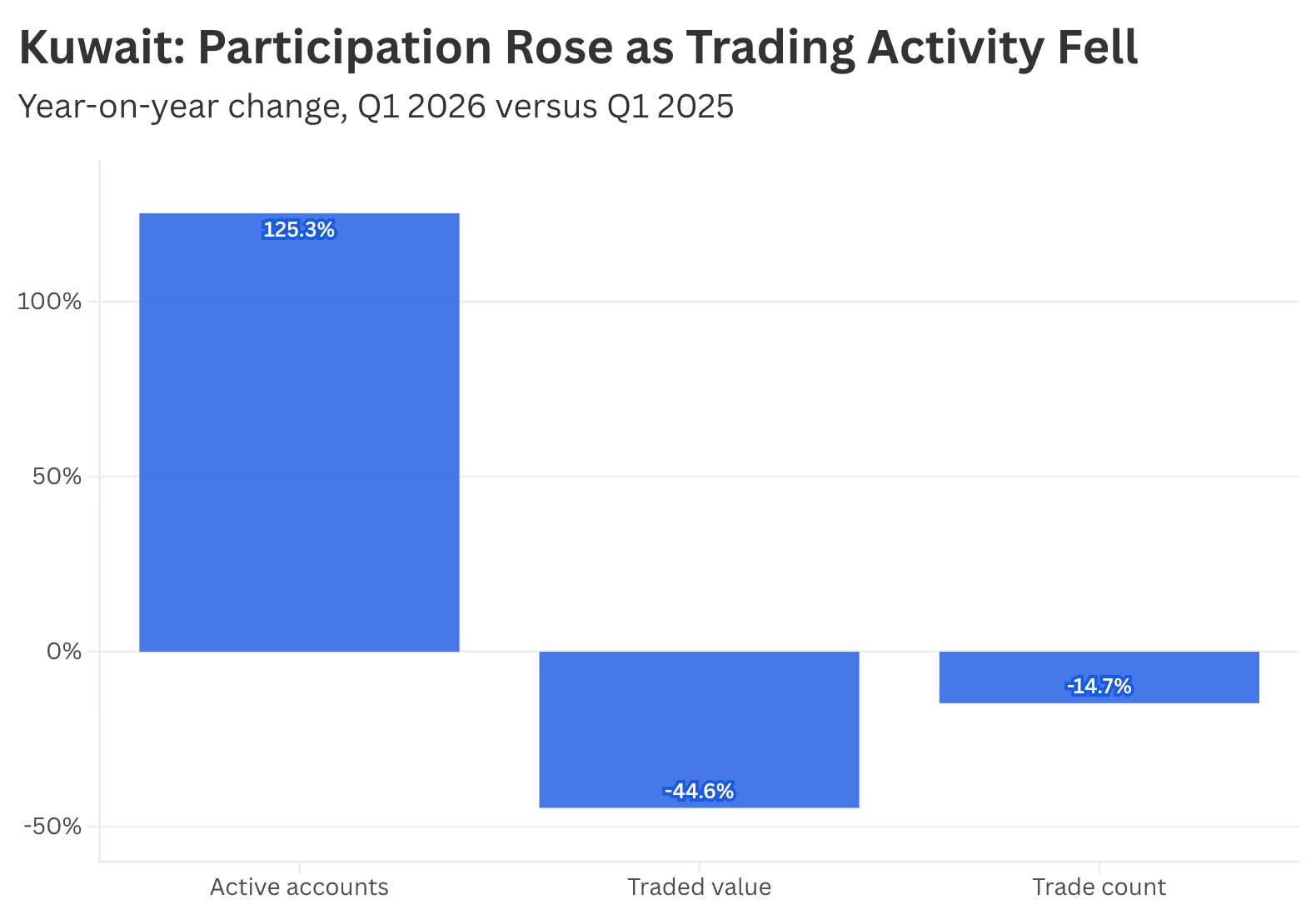
Boursa Kuwait entered 2026 with an unusual split between participation and activity. Active trading accounts rose 125.3% year on year to 48,078 in the first quarter, from 21,340 a year earlier, while traded value fell 44.6% to KWD3.72 billion. Trade count declined by a much smaller 14.7% to roughly 926,000. Boursa Kuwait linked the weaker turnover partly to caution surrounding the regional conflict that began in late February.
The Account Boom Needs Context
The jump in accounts does not mean Kuwait suddenly gained 27,000 entirely new investors. Boursa Kuwait said much of the increase resulted from a sub-account initiative introduced under Market Development Phase 3.2 in July 2025. Investors who had previously traded through omnibus or investment-company accounts could now be counted individually. “Active” also has a relatively broad definition: an account needs to have executed only one trade during the preceding six months.
Kuwait is getting a clearer view of who participates in its market at the same time that the value of trading has shifted toward larger institutions.
Institutions and Foreign Investors Take More Share
Institutional investors generated 73% of Q1 turnover, up from 66% a year earlier, while the retail share fell to 27% from 34%. International investors, including GCC participants, increased their share of trading value to 22% from 13%. Boursa Kuwait also reported a 30.38% increase in foreign trade confirmations during the quarter.
The Q1 decline was not sustained through the second quarter. Boursa Kuwait data show traded value rebounding 63.9% quarter on quarter to KWD6.10 billion in Q2, while trade count increased 67.3%. That suggests Q1 was a period of unusually low risk-taking rather than evidence that liquidity had permanently disappeared.
Kuwait Still Has an ETF Gap
The exchange has already built much of the commercial framework for exchange-traded funds. Boursa Kuwait lists a KWD2,000 listing and annual subscription fee for funds and ETFs, with trading commissions of 10 basis points. Its Q1 presentation said equity and commodity ETFs were the final remaining part of Market Development Phase 3.2 and were still undergoing regulatory review.
Until local products arrive, investors seeking Kuwait exposure through ETFs must look abroad. The U.S.-listed iShares MSCI Kuwait ETF, KWT, held $69.3 million in assets and 36 securities as of August 11, with a 0.75% expense ratio and a 5.51% trailing 12-month yield. Financials represented 67% of the portfolio.
UAE investors also have the Lunate S&P Kuwait Shariah ETF, KWTI, which tracks 15 liquid Shariah-compliant Kuwaiti companies and trades through a GCC-listed wrapper.
Kuwait therefore has more visible investor participation and a larger institutional footprint, but its domestic ETF market remains unfinished. The next step is converting the exchange’s new infrastructure into products that give those accounts another way to invest.