


A rush to withdraw money from Turkish investment funds has spilled into the stock market, exposing how quickly liquidity stress can move from funds to listed shares. What began with redemption problems at one portfolio manager has now involved at least three firms, prompting heavy selling and a market-wide circuit breaker on Borsa Istanbul.
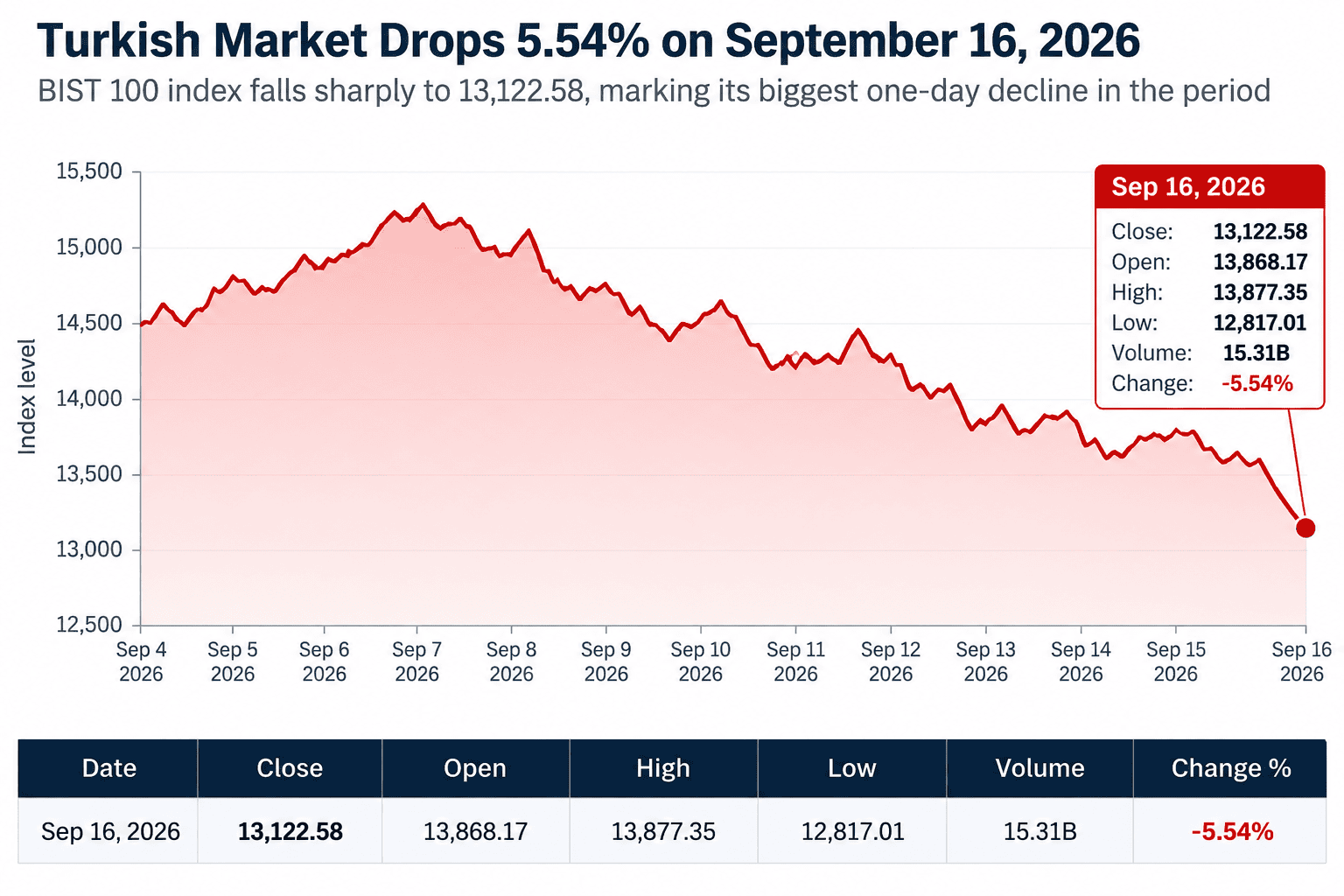
The Borsa Istanbul 100 Index fell as much as 7.7% on Wednesday before closing 5.54% lower, as investors reacted to concerns over fund liquidity, concentrated positions and the ability of asset managers to meet redemption demands. The episode has since drawn a broader regulatory response, putting Turkey's fund industry and market liquidity under closer scrutiny.
Turkish Stocks Fall as BIST 100 Triggers Circuit Breaker
The Borsa Istanbul 100 Index fell as much as 7.7% during Wednesday's session before closing 5.54% lower at 13,122.58, a slide sharp enough to activate the exchange's market-wide circuit breaker and halt trading. Nearly every stock in the index declined, with only two constituents managing to close higher. Destek Finans Faktoring AS led the losses, dropping 10%. Trading resumed at 4:24 p.m. local time. The decline extended the benchmark's losses from the previous two sessions.
Turkish Fund Redemptions Spark Liquidity Concerns
The selloff traces back to an announcement from Pusula Portfoy Yonetimi on Tuesday that some of its investment and money market funds could not meet investor redemption requests. Tera Yatirim Menkul Degerler, which had agreed to acquire Pusula's portfolio management and securities businesses, said the transaction has not closed and that it bears no responsibility for Pusula's redemption process.
Days later, Tera Portfoy Yonetimi, a separate and prominent asset manager, disclosed that it too had failed to meet redemption requests on two funds together holding 366 billion lira (roughly $7.5 billion) in assets, the Tera Portfoy Money Market Fund and the Tera Portfoy Equity Intensive Fund. Tefas lists these as Tera's second and third largest funds, at 224 billion lira and 142 billion lira respectively. A third manager, Atlas Portfoy, changed the redemption terms on its Atlas Portfoy Serbest Fon, following an August 28 Capital Markets Board decision citing the fund's liquidity structure.
Turkish Investment Fund Outflows Reach 55 Billion Lira
According to financial data platform Fintables, investors pulled a net 55 billion lira (about $1.13 billion) from Turkish investment funds on Wednesday alone.
Other Turkish funds is derived from the reported total less the reported Tera and Pusula outflows, not a separately reported figure.
Fund Concentration and Liquidity Risks Deepen Market Pressure
Tera's funds had built a large following for some of the highest returns in Turkish fund markets in recent years, achieved partly through concentrated positions in related, relatively illiquid stocks, exposure that had already drawn scrutiny before this week. Turkey's Capital Markets Board tightened investment rules at the end of August, including limits on certain funds' exposure to related parties and concentrated positions. Economist Banu Kivci Tokali of BVeri Consulting linked the selling to a broader erosion of sector confidence, while Alper Akalin of Akalin Finance said the pressure likely prompted managers to sell more liquid holdings first to raise cash, an explanation rather than a fact.
TURKI ETF Sees Heavy Volume as Turkish Stocks Sell Off
The selloff has also reached the Lunate S&P Turkey Shariah ETF (TURKI), listed on the Abu Dhabi Securities Exchange. TURKI's NAV fell 4.82% on September 16, while its performance remained positive at 43.71% YTD and 51.72% over one year.
The sharp pullback and elevated trading activity could put TURKI on the radar for investors looking at a potential bottom-fishing opportunity, although further volatility remains possible while Turkey's fund-redemption and liquidity pressures continue.
TURKI Performance Across Key Periods
TURKI Top Holdings
TURKI held 20 stocks, with its largest positions including Aselsan, Tüpraş and BIM Birleşik Mağazalar.
TURKI also saw unusually strong trading activity during the recent volatility. On September 9, the ETF gained 2.62% on 6.02 times its seven-day average volume. On September 16, it fell 2.53%, with volume at 2.02 times its seven-day average. See Nukoud's September 9 market wrap and September 16 market wrap.
Turkey Expands Regulatory Response to Fund Market Stress
On September 17, the Capital Markets Board said it had filed criminal complaints against 38 people over transactions involving shares of Katilimevim, Gundogdu Gida and Destek Finans Faktoring, and imposed two-year trading bans on Pusula Portfoy and several fund managers in connection with the Katilimevim share transactions; Pusula Portfoy is affiliated with Katilimevim. Separately, the board closed all TEFAS-traded investment funds established by Tera Portfoy, Pusula Portfoy, Hedef Portfoy, Atlas Portfoy, A1 Portfoy, Pardus Portfoy and Bulls Portfoy to purchases and sales, and ordered certain funds to be liquidated. It also let brokers temporarily lower the minimum equity-maintenance ratio on leveraged securities trades to 20% from 35%, through October 2. The enforcement action and the redemption stress occurred in the same period of volatility, but current reporting does not establish a single cause linking them.
Financial Stability Committee Addresses Turkish Market Volatility
Turkey's Financial Stability Committee met on September 17 under Treasury and Finance Minister Mehmet Simsek to review the volatility. The committee said it stemmed from credit and liquidity problems at some funds run by a limited number of portfolio management companies, rather than a fundamental or structural risk to Borsa Istanbul or Turkey's capital markets, and called the situation temporary and manageable. The Central Bank of the Republic of Türkiye said it would increase funding through weekly repo auctions as liquidity conditions warranted, while also updating banks' borrowing limits and reviewing collateral discount rates.
Investors will be watching whether more funds disclose redemption problems and whether selling linked to efforts to meet redemption requests continues to weigh on BIST-listed stocks.