
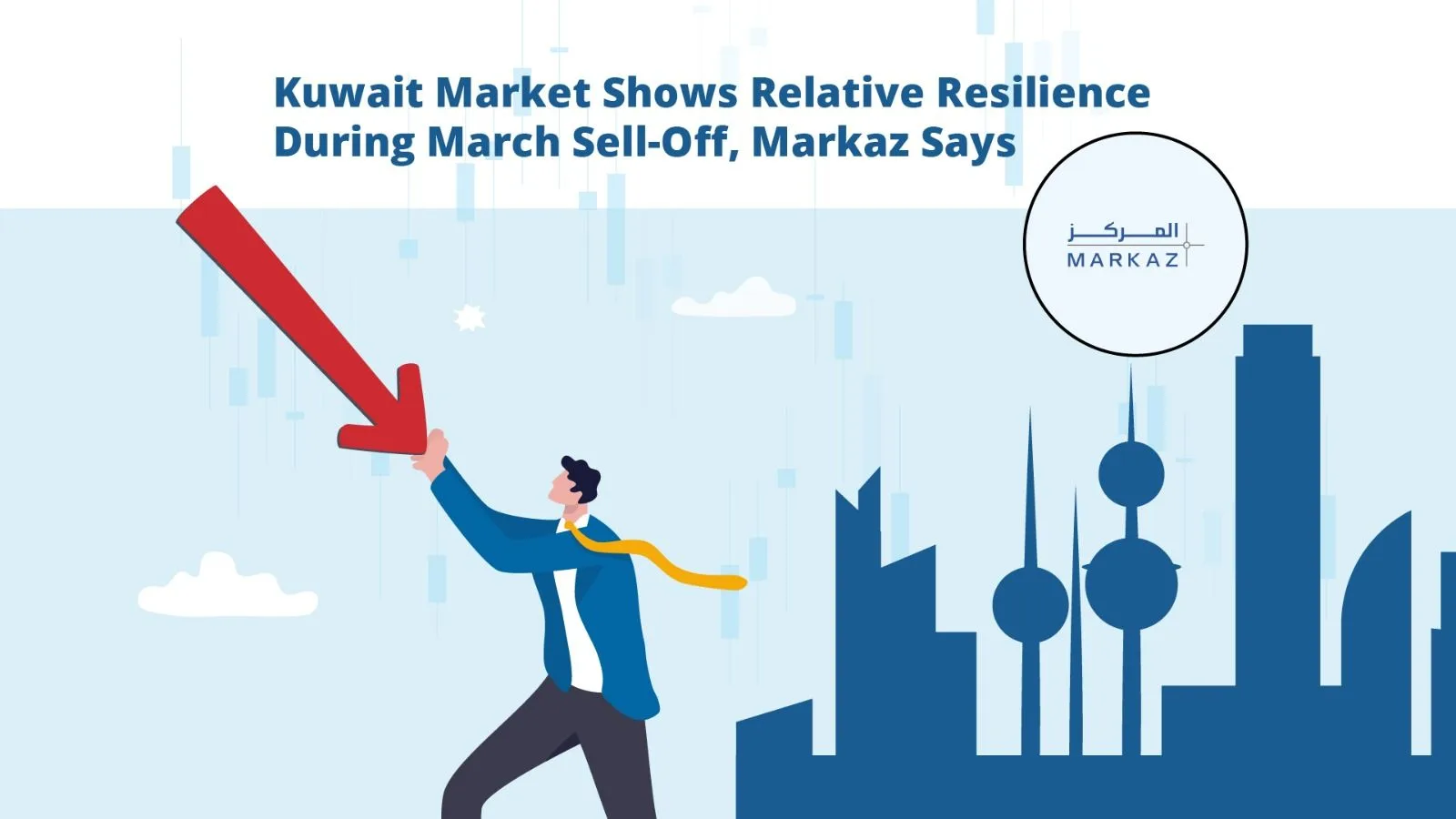
Kuwait’s equity market held up better than most global and regional peers during March’s broad risk-off episode, according to a recent note from Kuwait Financial Centre (Markaz) though the resilience is specific to the one-month sell-off rather than the year as a whole.
Despite The Kuwait All Share Index declining more than 22% year to date, the market have only declined 1.8% in March 2026, outperforming both regional and international benchmarks during a period marked by rising geopolitical tensions and a global equity pullback. By comparison, the S&P GCC Composite Index fell 2.3%, while major global indices saw steeper declines, including the S&P 500 (-5.1%), Nasdaq Composite (-4.9%), MSCI World (-6.6%), and MSCI Emerging Markets (-13.3%).
A Defensive Profile in a Risk-Off Month
The data suggests Kuwait did not escape the sell-off, but faced softer declines than most global markets during the peak stress window. Within the market, the banking sector proved particularly resilient, falling just 0.7%, reflecting its central role in Kuwait’s defensive positioning.
However, this short-term resilience contrasts with broader performance. Kuwait equities remain significantly weaker on a year-to-date basis, underscoring that Markaz’s assessment is tied specifically to March’s volatility episode rather than a structural outperformance trend.
Regional Divergence Within the GCC
Kuwait’s relative stability also needs to be viewed within the broader GCC context. While it outperformed markets such as Dubai (-16.4%) and Abu Dhabi (-8.9%) during March, it lagged stronger performers like Saudi Arabia (+5.0%) and Oman (+10.5%).
Kuwait behaved as a defensive market, not necessarily the strongest performer.
Structural Buffers Supporting Stability
Markaz attributes Kuwait’s resilience to a combination of domestic and macroeconomic factors.
The country’s banking system remains well-capitalized, with non-performing loans at 1.5% and provisioning coverage around 252%. At the sovereign level, Kuwait holds an AA-/A-1+ credit rating with a stable outlook, supported by sovereign wealth assets estimated at roughly 490% of GDP.
These structural buffers help explain why Kuwait tends to behave differently from higher-beta emerging markets during periods of global stress. A larger domestic investor base and strong institutional participation can absorb foreign outflows more effectively, dampening volatility.
Implications for GCC Investors
For regional investors, the takeaway is less about outright returns and more about portfolio construction.
Kuwait’s behavior during March reinforces its role as a defensive allocation within GCC equities, particularly during periods of global market stress. This makes it a potential stabiliser in portfolios that are otherwise heavily exposed to higher-beta markets or global growth sectors.
Exposure to the market can be accessed through vehicles such as the Lunate Kuwait Equity ETF, which provides a listed, diversified route into Kuwaiti equities for regional and international investors.
The Bottom Line
Kuwait’s performance in March underscores an important distinction, that the market is not immune to global shocks, but it can absorb them more effectively than many peers.
In a region often treated as a single trade, this episode highlights how differences in market structure, investor base, and fiscal strength can lead to materially different outcomes, particularly when volatility rises.