
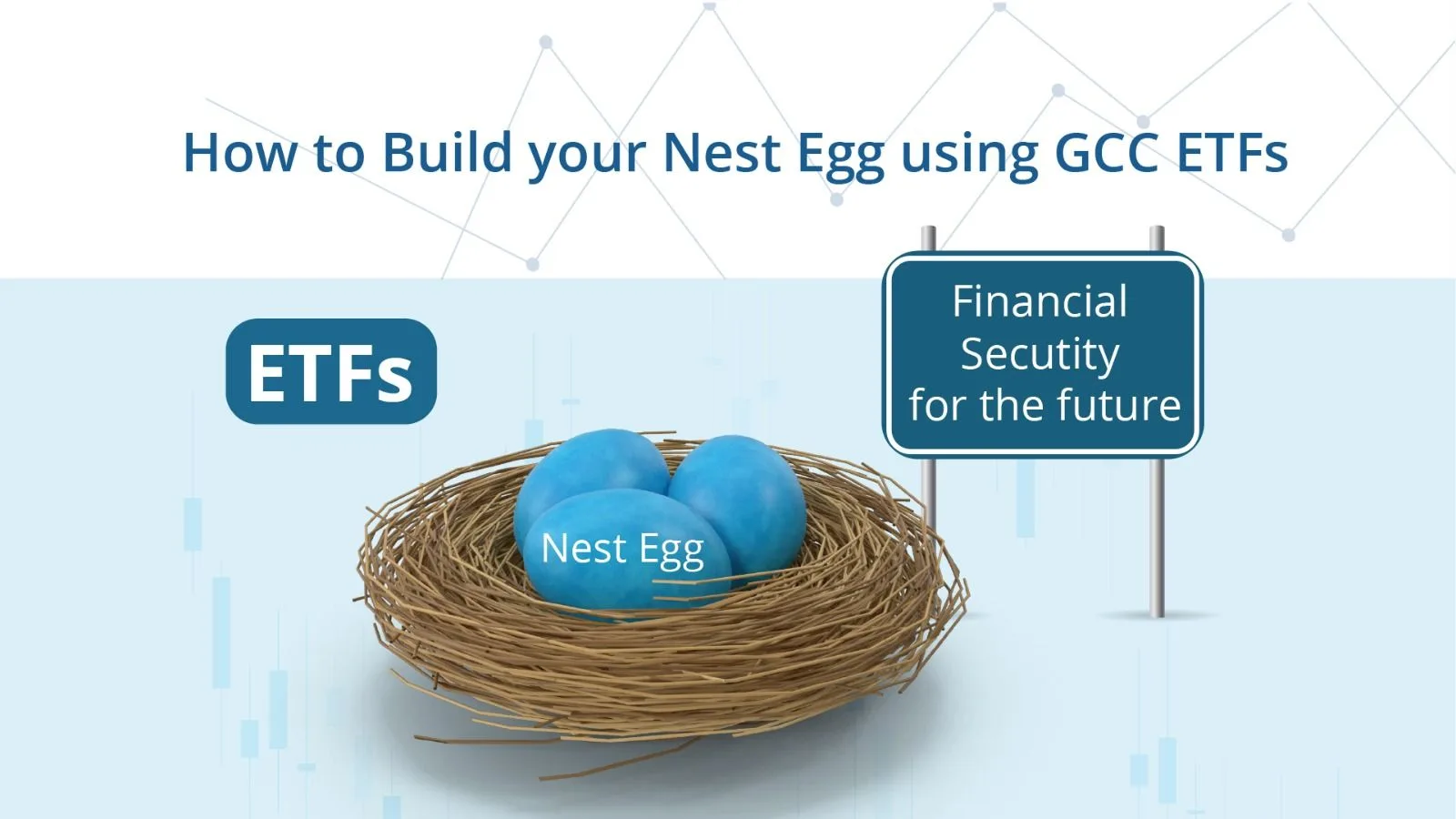
Exchange-traded funds have become a preferred building block for both retail and institutional investors because they combine diversification, transparency, liquidity, and cost efficiency in a single vehicle. In the Gulf Cooperation Council, the ETF ecosystem has expanded meaningfully, with Saudi Arabia and the UAE leading regional retail fund growth and exchanges such as ADX and DFM continuing to broaden the range of listed ETF products, including core equity, Shariah, sukuk, and thematic exposures. This evolution gives investors in the region a more practical toolkit for building long-term wealth through disciplined portfolio construction rather than isolated security selection.
Building wealth is essential for long-term financial security and retirement planning. Increasingly, investors are allocating a portion of their savings to the markets on a regular monthly basis through a strategy known as dollar-cost averaging, where investments are made consistently over time at different market prices.
If you are looking to start building your nest egg, here are several approaches and strategies you can consider.
Why ETFs Matter for Long-Term Wealth Building
Wealth building is usually driven by consistency, diversification, and time in the market. ETFs support all three. A single ETF can provide exposure to a broad market index, a sector, a factor, or a fixed-income segment, helping investors avoid concentration risk while keeping implementation simple. Because ETFs trade like shares, they are easy to buy, monitor, and rebalance. For long-term investors, this means portfolios can be built gradually, contributions can be added over time, and compounding can work more effectively across a diversified base of assets.
The Core-Satellite Approach
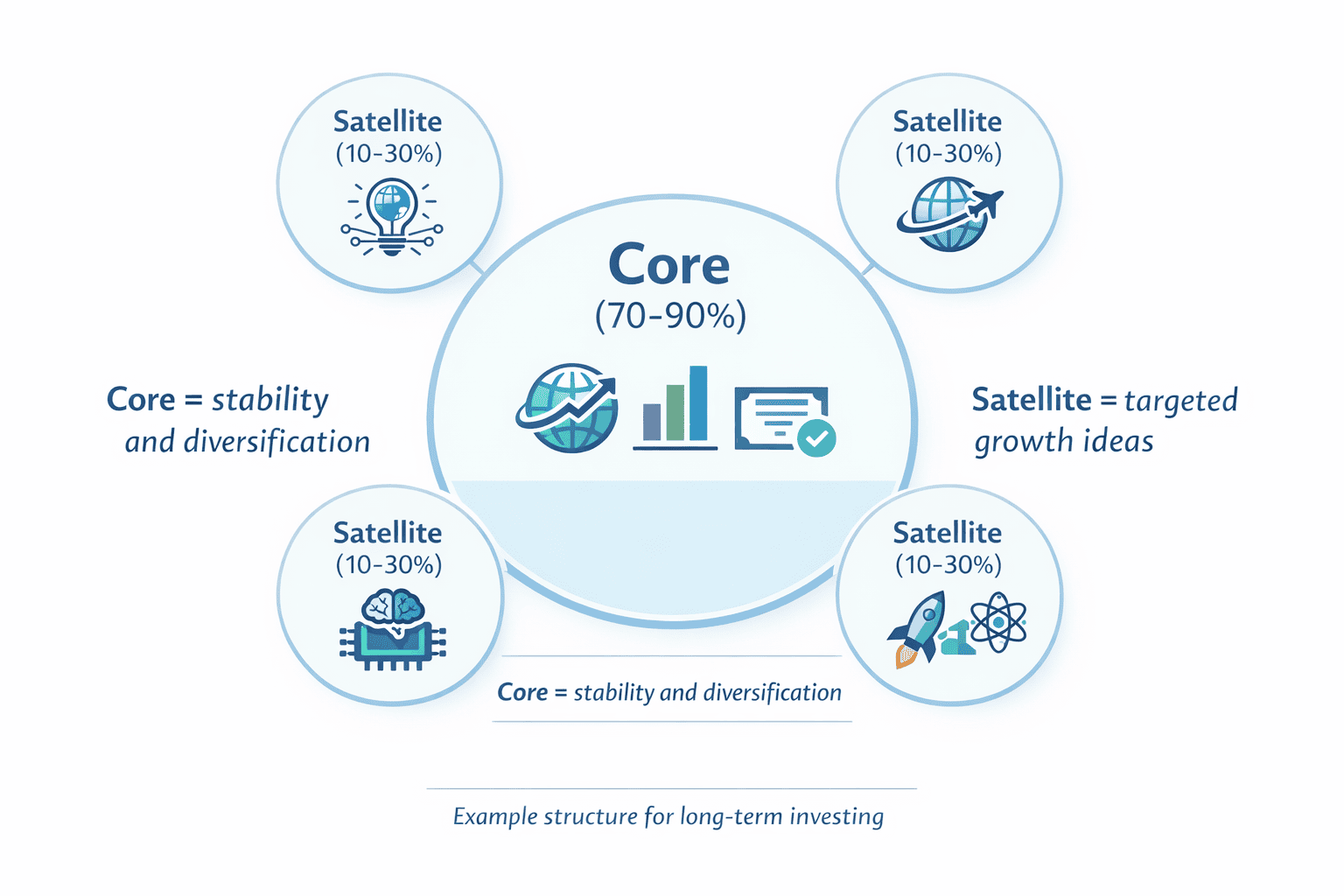
The core-satellite method is one of the most effective ways to use ETFs in a disciplined portfolio. The core is the largest allocation and is designed to deliver broad, stable market exposure at a relatively low cost. This core typically consists of diversified equity and fixed-income ETFs that can anchor long-term returns. The satellite portion is smaller and more selective. It is used to express high-conviction views, pursue structural growth themes, or add targeted exposure to sectors, styles, or geographies that may enhance return potential over time. Together, the two layers help balance resilience and opportunity.
How This Works in a GCC ETF Portfolio
For a GCC-based investor, the core of the portfolio can be constructed using broad-market ETFs listed in regional exchanges or accessible through local brokers. These may include GCC equity exposures, Saudi market trackers, UAE market ETFs, or diversified income solutions such as sukuk and bond ETFs for stability. Around this foundation, satellite positions can be added through thematic or strategy-driven ETFs that reflect forward-looking trends such as technology adoption, sustainability, income generation, or Shariah-compliant growth. The result is a portfolio that remains regionally relevant while still giving investors a framework to participate in long-term structural changes.
Practical Portfolio Construction Guidelines
1-Start with a clear allocation between core and satellite holdings, such as a larger core for stability and a smaller satellite sleeve for conviction ideas. Use third party allocation advice if need be.
2-Determine the time horizon and the level of risk you are willing to withstand. Risk is measured by standard deviation or level of variability in historic prices of an ETF.
3-Use core ETFs to cover the main return drivers of the portfolio, including broad equities, fixed income and commodities
4-Limit each satellite allocation so that a single theme does not dominate total portfolio risk.
5-Rebalance periodically to maintain target weights and prevent strong-performing themes from becoming oversized.
6-Focus on investment objectives, liquidity, fees, and index methodology before selecting any ETF. Read the ETF Guide for more information.
7-Build gradually through regular contributions rather than trying to time the market. Dollar cost averaging every week or month or quarter is a great way to avoid buying at the top.
Using the GCC ETF Menu to Build Core and Satellite Allocations
The expanding menu of ETFs listed across GCC exchanges gives investors a more complete toolkit for portfolio construction than was available only a few years ago. Within this regional universe, a core allocation can be built across local, global, fixed-income, commodities and international exposures. For the equity sleeve, investors can use products such as the Chimera S&P UAE UCITS ETF (UAED), the Albilad MSCI Saudi Equity ETF (9412), and the Chimera S&P US Shariah Growth ETF (USGRWTH), in addition to more ETF options.
For the fixed-income sleeve, investors can complement equities with the Chimera JP Morgan Global Sukuk ETF (SUKUK) and the KraneShares Wahed Alternative Income Index ETF (KWIN), in addition to more ETF options. International diversification can then be extended through single-country allocations such as the Chimera S&P Germany UCITS ETF (GRMNY), the Albilad CSOP MSCI Hong Kong China Equity ETF (9410), and the Chimera S&P India Shariah ETF (INDI), in addition to more ETF options.
Once the core is established, investors can use satellite allocations to express higher-conviction themes and add a forward-looking growth dimension to the portfolio. Thematic ETFs can play an important role here. Products such as the KraneShares CSI China Internet ETF (KWEB), the Boreas Quantum ETF (QUANTM), the Boreas AI Power ETF, and the KraneShares Artificial Intelligence and Technology ETF (AGIX) can provide targeted exposure to innovation themes, in addition to more ETF options. Used selectively and in measured position sizes, these thematic exposures can enhance return potential without overwhelming the stability provided by the core portfolio.
An 80/20 Core/Satellite Option
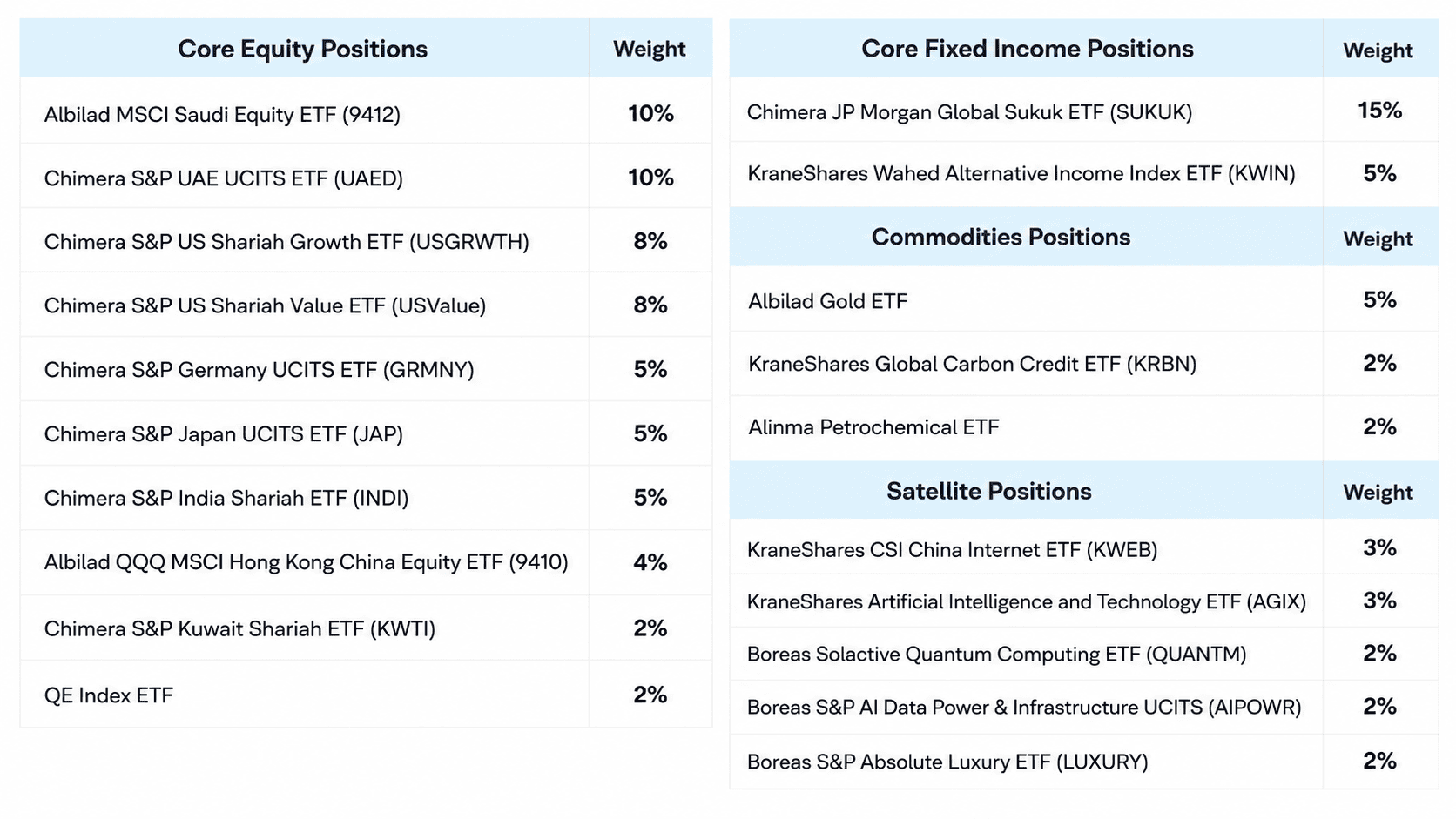
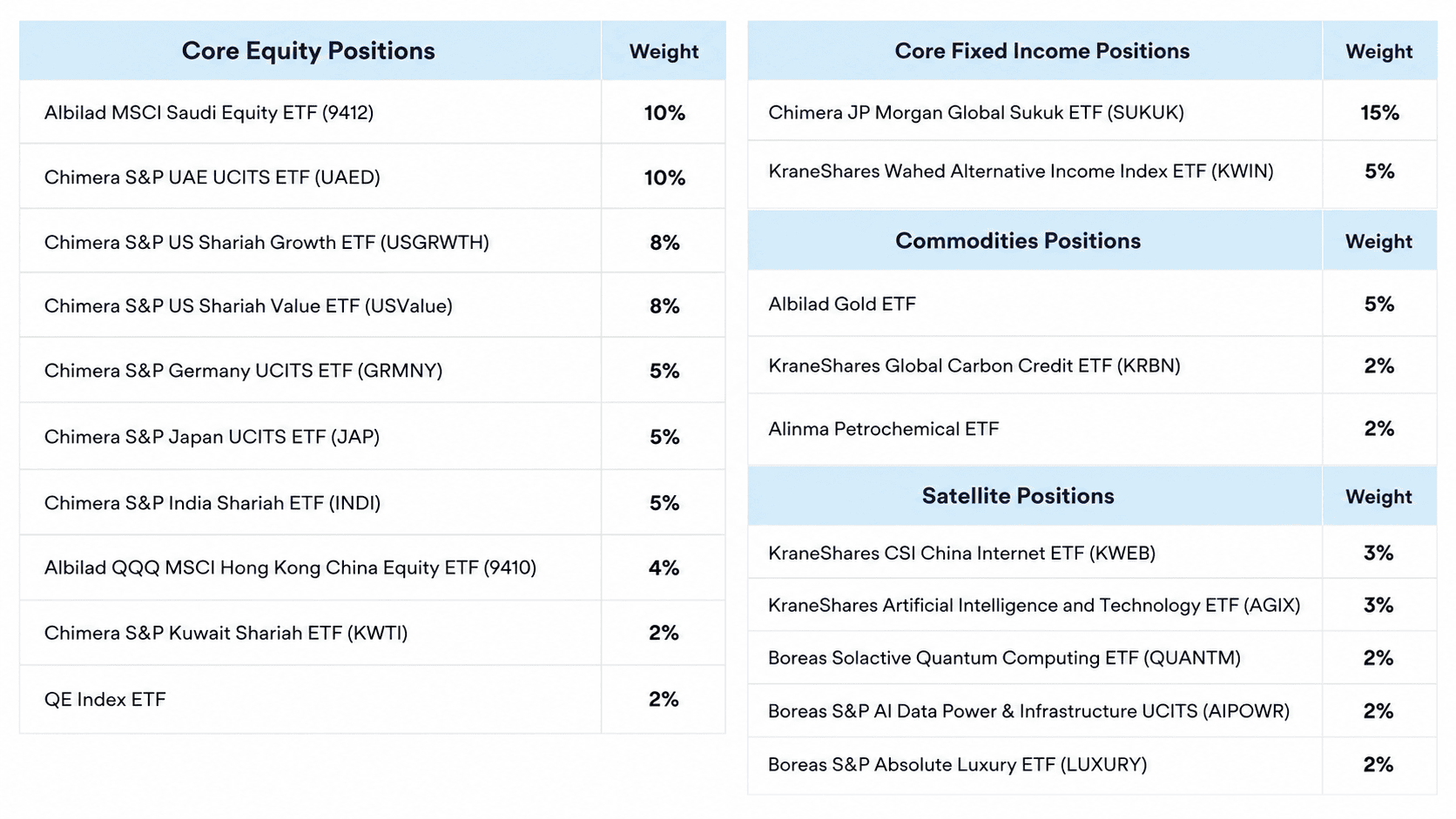
A more conservative approach, investors can implement the 60/40 approach where 40% of the portfolio is in fixed income ETFs which tend to be less risky and the 60% is in equities.
60/40 Core/Satellite Option
The Power of Diversification
Diversification remains one of the most powerful tools in portfolio construction because combining assets with lower correlation can help reduce overall portfolio risk without necessarily reducing long-term return potential. By spreading exposures across regions, asset classes, and investment themes, investors can build portfolios that are more resilient through different market cycles. At the same time, investors should be mindful of home bias, which can lead to excessive concentration in familiar domestic markets and limit the benefits of broader global diversification.
For example, if Investment A and Investment B each have a standalone standard deviation of 10%, a 50/50 portfolio of the two would still have a 10% standard deviation only if they were perfectly correlated. If their correlation is lower, say 0.30, the combined portfolio standard deviation falls to about 8.1%. This illustrates why combining assets that do not move in lockstep can improve the risk profile of a portfolio even when the individual investments have the same level of volatility.
Risks and Considerations
While ETFs are efficient tools, they are not risk-free. Investors should assess market liquidity, index concentration, tracking differences, underlying holdings, and the suitability of each fund for their own objectives and risk tolerance. In the GCC, the ETF landscape is growing but remains smaller than more mature global markets, so product selection and trading conditions can vary significantly. A thoughtful due diligence process is essential, particularly when using thematic exposures that may be more volatile than core market allocations.
Conclusion
The rise of ETFs has changed how investors build portfolios, making sophisticated asset allocation more accessible than ever. As the GCC ETF market deepens, investors now have a growing opportunity to combine regional relevance with disciplined long-term wealth creation. By using a core-satellite structure, investors can build a diversified foundation, add targeted growth ideas, and create portfolios that are both resilient and forward looking.