Artificial intelligence is moving beyond computer screens and into the physical world. From factory assembly lines to automated logistics, humanoid robots are emerging as one of technology's most ambitious investment opportunities.
For investors in the GCC, that opportunity is becoming more accessible through the Boreas VettaFi Humanoid Robots UCITS ETF (ROBOTS), developed by Abu Dhabi-based Lunate. The Initial Offering Period (IOP) for the ROBOT ETF will begin on Monday, November 23, and run through November 30, giving investors an opportunity to subscribe through local brokers ahead of its listing. The offering is expected to attract strong investor interest as robotics continues to gain momentum as a major investment theme.
The launch follows the successful IOP of GQG Partners’ GQGU ETF, which raised more than AED 12 million during its subscription period before listing on the Abu Dhabi Securities Exchange (ADX) on November 19. (Source: Nukoud)
Scheduled to list on the Abu Dhabi Securities Exchange (ADX) on December 8, 2026, ROBOTS will provide exposure to 41 companies involved in humanoid robotics, spanning manufacturers, semiconductor producers, software developers and component suppliers.
What's Inside the ROBOTS ETF?
Visual 1. What's Inside the Humanoid Robotics Index?
Sector allocation · October 30, 2026
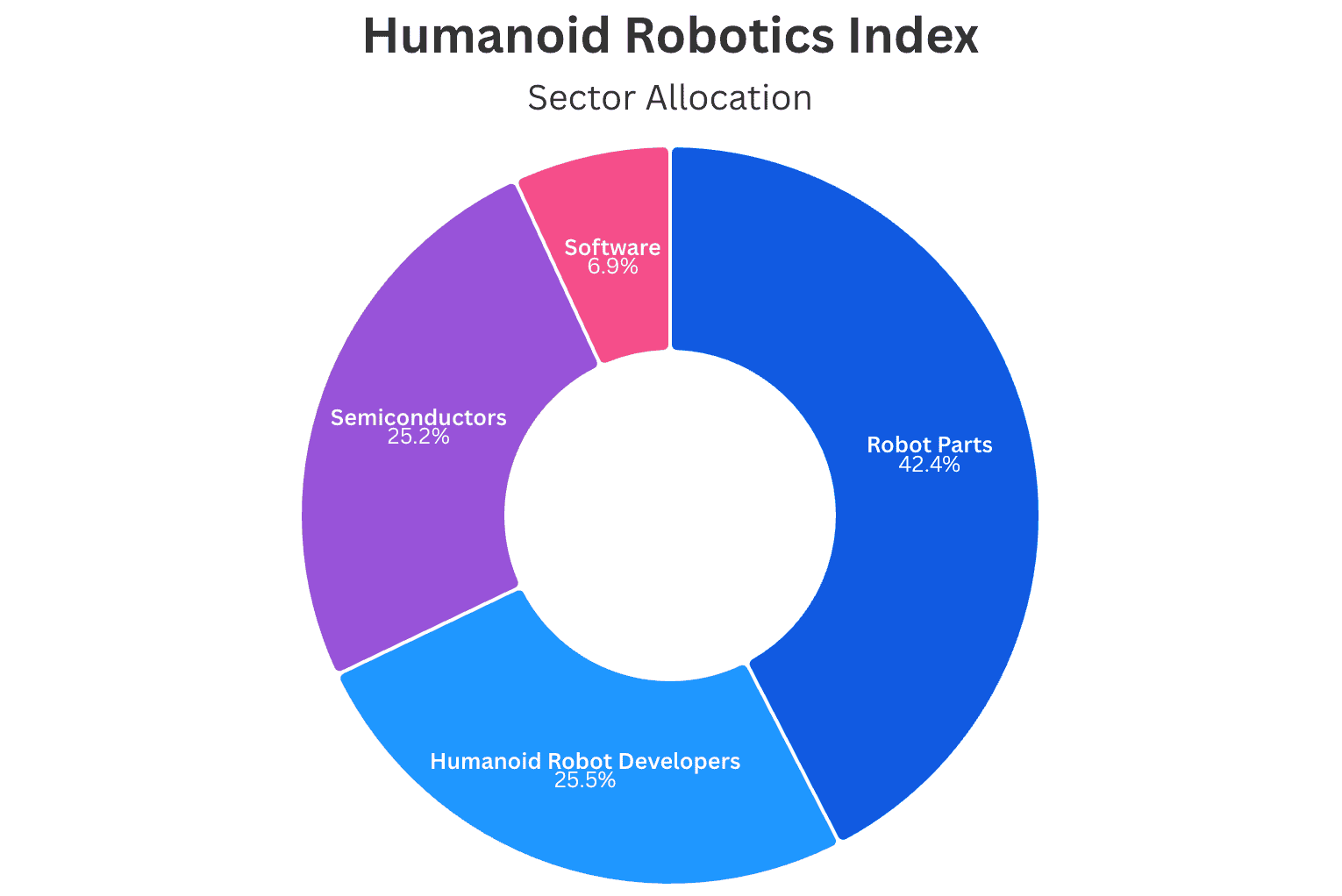
ROBOTS tracks the VettaFi Humanoid Robot Select Markets Net Total Return Index, which selects companies based on their relevance to humanoid robotics rather than simply their market capitalization. According to VettaFi's October 30, 2026 factsheet, the index holds 41 companies across four industry categories.
Robot parts manufacturers represent the largest allocation at 42.4%, followed by humanoid robot developers at 25.5% and semiconductor companies at 25.2%. Software businesses account for the remaining 6.9%. This structure offers exposure to the broader robotics supply chain, including businesses that could benefit regardless of which humanoid robot manufacturer eventually dominates the industry.
The Companies Building the Humanoid Economy
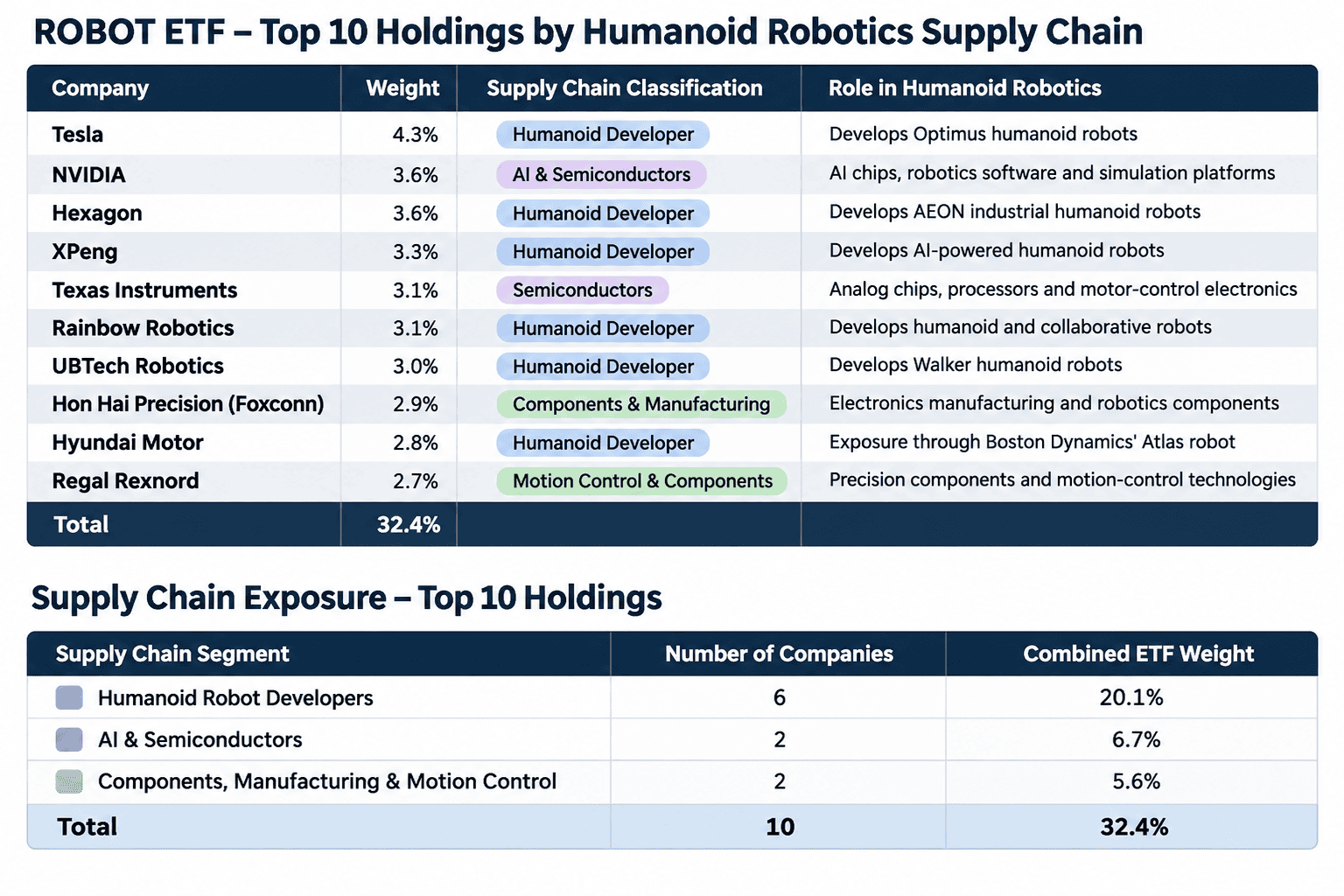
Visual 2. Top 10 Companies in the ROBOTS Index
Index weights as of October 30, 2026
For the horizontal bar chart, show the exact values on the bars themselves or just to the right of each bar:
Tesla, Nvidia and the Robotics Supply Chain
Tesla leads the index with a 4.3% allocation. Beyond electric vehicles, the company is developing its Optimus humanoid robot, designed to perform tasks in industrial and potentially commercial environments. Nvidia follows at 3.6%, providing AI computing technology used in robotic perception, simulation and autonomous decision-making.
Other major holdings include Sweden's Hexagon (3.6%), Chinese electric vehicle manufacturer XPeng (3.3%) and US semiconductor company Texas Instruments (3.1%). South Korea's Rainbow Robotics, China's UBTech Robotics and Taiwan's Hon Hai Precision Industry provide additional exposure to the development and manufacturing of robotic systems.
The ten largest holdings account for 32.5% of the index, giving investors exposure to established technology companies alongside specialized robotics businesses.
A Global Investment Theme, Not Just a US Technology Bet
Unlike many AI-focused ETFs, ROBOTS distributes its exposure across several major technology markets. The United States represents 31.5% of the index, followed by China at 20.7%, Japan at 13.1% and South Korea at 12.1%.
Together, these markets account for more than three-quarters of the portfolio, reflecting the importance of American AI infrastructure and Asian robotics manufacturing. For GCC investors, this provides a different type of technology exposure compared with portfolios dominated by large US software companies.
How Big Could the Humanoid Robotics Market Become?
The investment case rests partly on expectations that humanoid robots will become increasingly capable and commercially viable. Research cited by Lunate from Bank of America projects annual humanoid robot shipments could grow from approximately 20,000 in 2025 to 10 million by 2035.
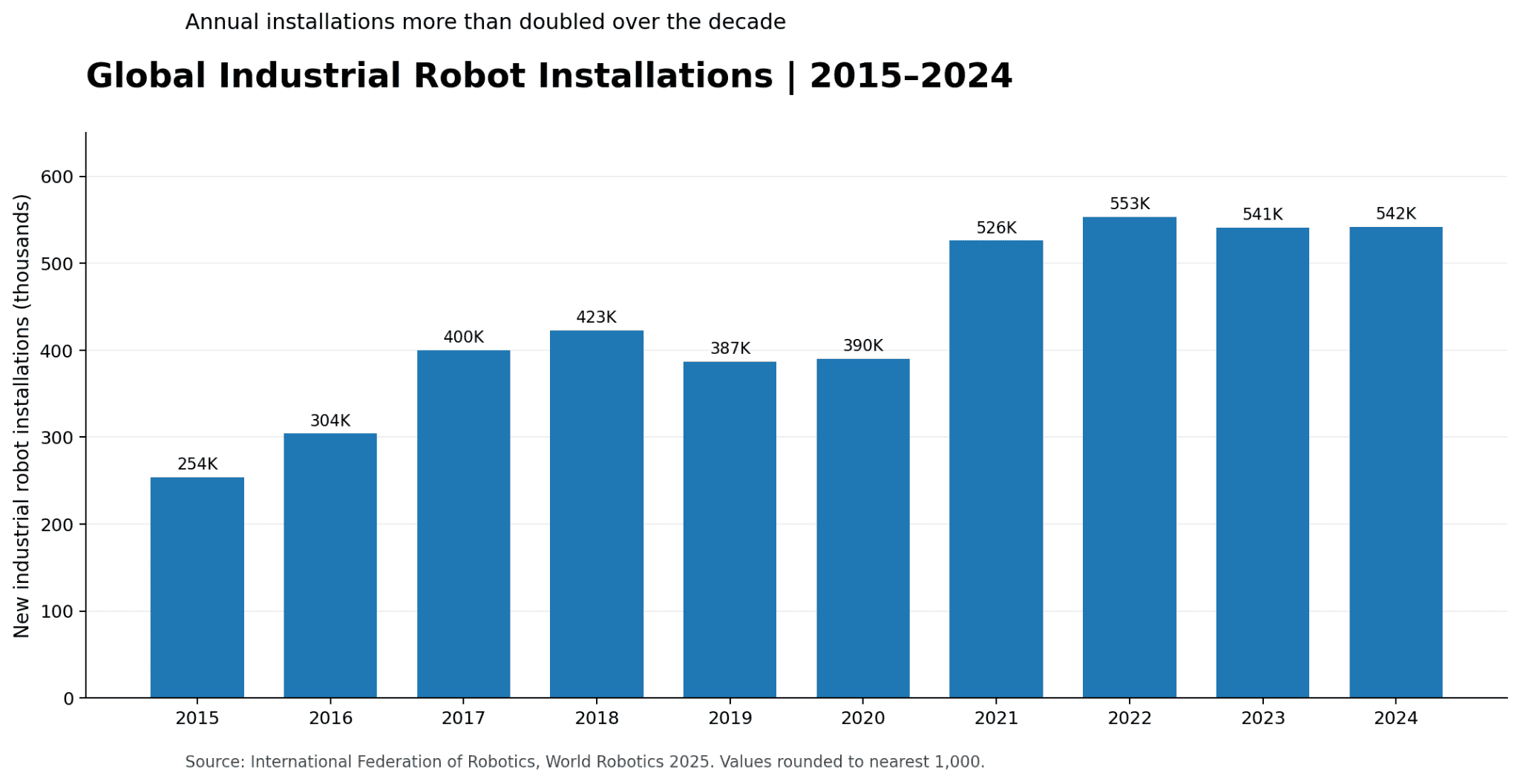
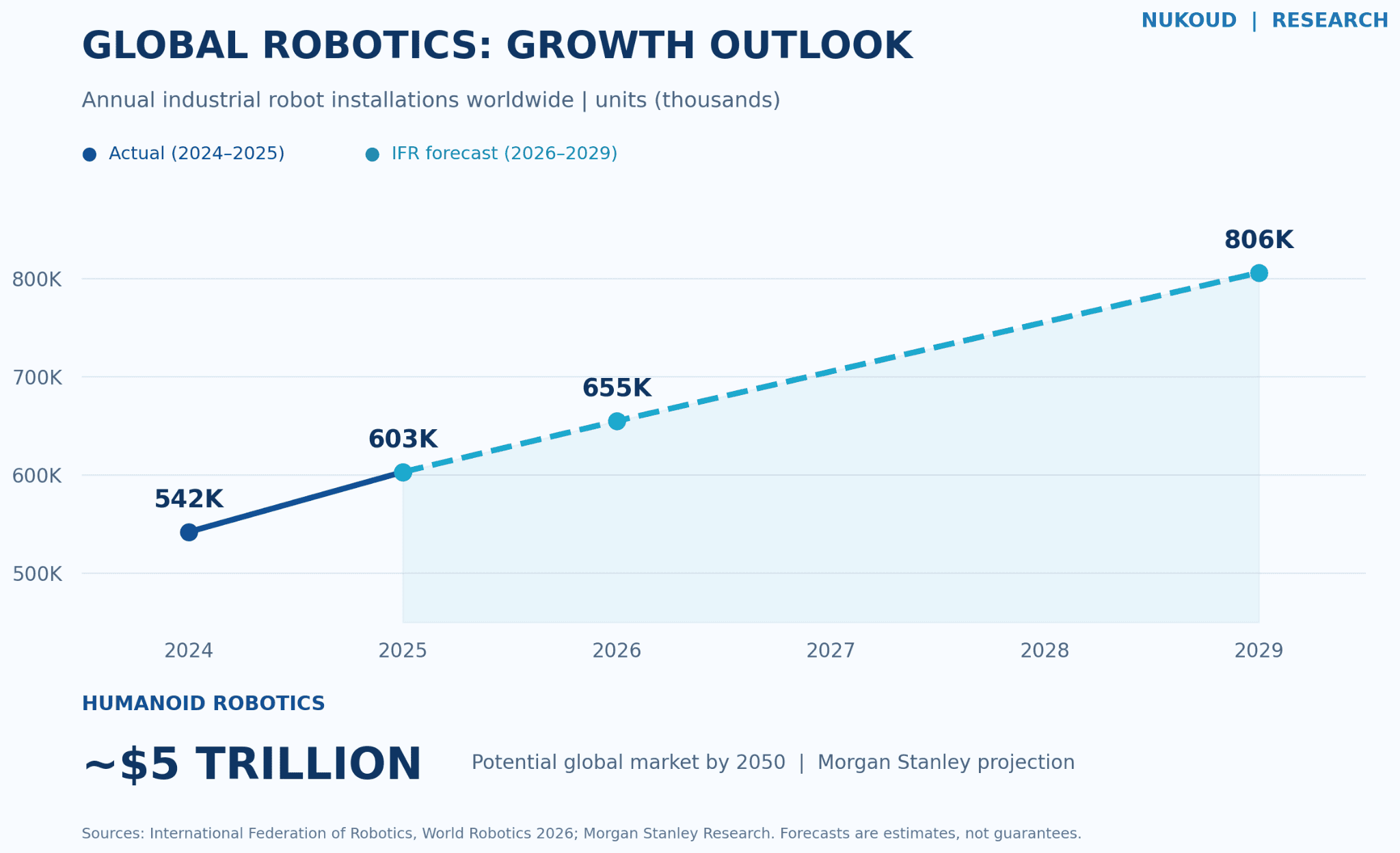
Robotics and humanoid technology are emerging as major global investment themes, driven by rapid advances in artificial intelligence, automation and the growing need to address labor shortages and improve productivity. From industrial robots used in manufacturing to humanoid robots capable of performing increasingly complex tasks, the industry is entering a new phase of innovation. According to the International Federation of Robotics, 542,000 industrial robots were installed worldwide in 2024, highlighting the accelerating adoption of automation. Meanwhile,
Morgan Stanley estimates that the global humanoid robotics market could approach $5 trillion by 2050, underscoring its enormous long-term potential. Companies such as Tesla, NVIDIA and leading robotics manufacturers in China, Japan and South Korea are investing heavily in the sector. The investment opportunity extends beyond robot manufacturers to include semiconductors, sensors, motion-control systems, software and AI infrastructure. As adoption expands across manufacturing, logistics, healthcare and consumer services, robotics could become one of the defining growth industries of the next decade, although high valuations, commercialization challenges and technological uncertainty remain key risks for investors.
The ETF is aligned with the UAE’s Future Vision
The UAE is positioning itself as a global hub for robotics, automation and artificial intelligence, with both Dubai and Abu Dhabi launching ambitious initiatives to accelerate adoption. Dubai’s Robotics and Automation Programme aims to deploy 200,000 robots by 2032, boosting productivity across manufacturing, logistics, healthcare and other industries. Dubai also targets 25% autonomous transportation by 2030. Meanwhile,
Abu Dhabi is investing heavily in robotics and autonomous technologies through its Smart and Autonomous Vehicle Industries (SAVI) cluster, which aims to attract global companies and accelerate innovation in self-driving vehicles, drones, maritime systems and advanced robotics. These efforts are supported by Abu Dhabi’s broader industrial strategy, which prioritizes advanced manufacturing, automation and smart technologies. Together, these initiatives highlight the UAE’s ambition to become a global leader in robotics and create a favorable environment for the sector’s long-term growth and investment opportunities.