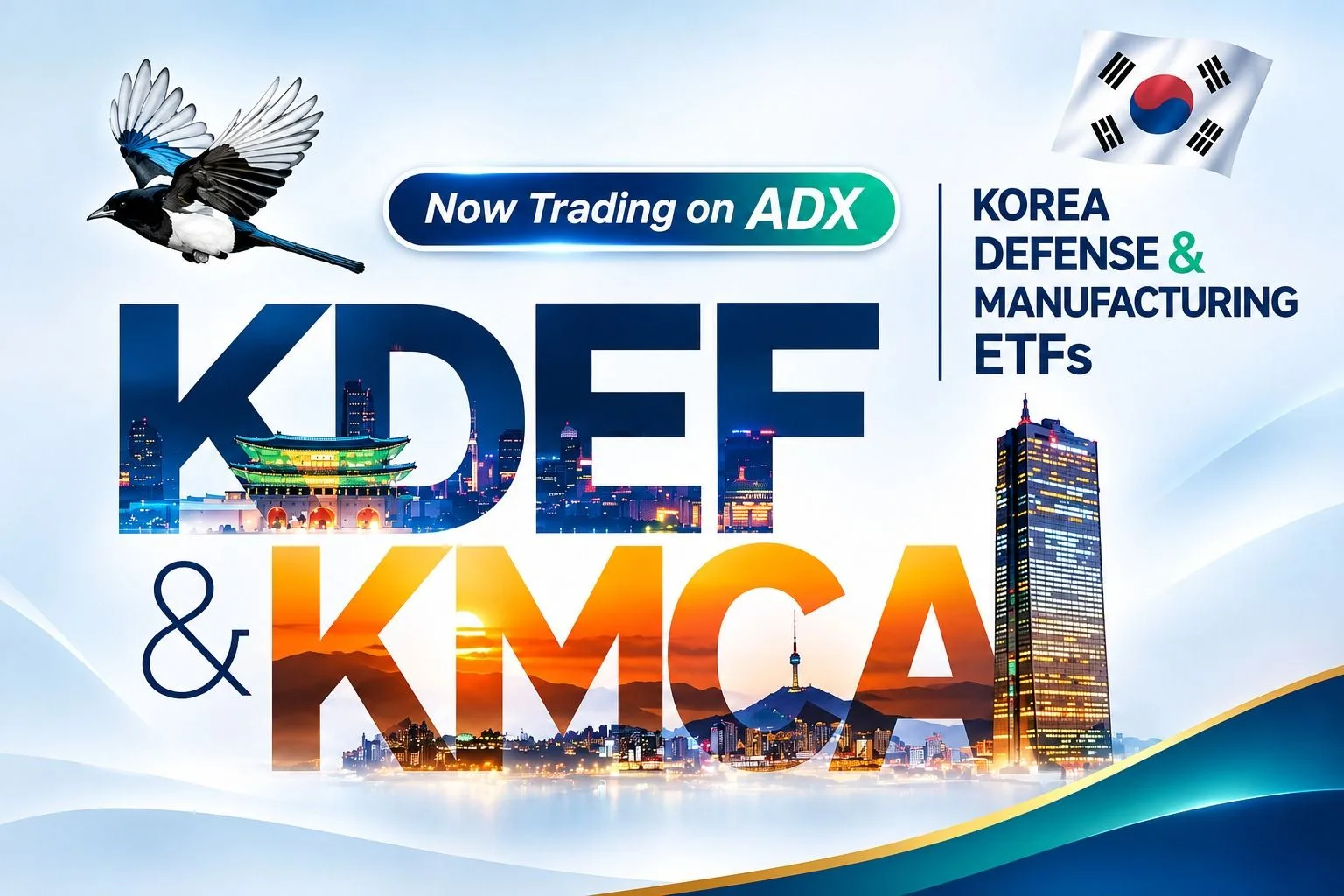
Hanwha Asset Management rings the bell at the Abu Dhabi Securities Exchange (ADX) today as the PLUS Korea Defense Industry Index ETF (KDEF) and the PLUS Korea Manufacturing Core Alliance Index ETF (KMCA) begin trading in Abu Dhabi alongside their primary listings on NYSE Arca. Hanwha is the first Korean asset manager to list ETFs on a Middle Eastern exchange. ADX hosted 24 ETFs at the end of the first half of 2026, and these two funds extend that count.
The two funds differ sharply in size. KDEF holds $93.47 million, down from a peak above $200 million reached within 15 months of its launch, while KMCA holds $4.98 million, according to figures Hanwha gave The Korea Herald on 23 October. Together, the funds hold about $98.5 million, or roughly AED 362 million, which is close to 1% of the nearly $10 billion that KWEB and KRBN brought to ADX in December 2025 as the first US-domiciled ETFs cross-listed in the Arab world.
The listings at a glance
Hanwha designs the strategies and supplies the indices, and Exchange Traded Concepts (ETC), a US adviser based in Oklahoma City, manages and operates both funds under a white-label arrangement. Hanwha uses the same structure to reach Europe, where it plans listings in London and Frankfurt within the year, according to MoneyToday.
Why Abu Dhabi draws US-listed ETFs
ADX began listing US-domiciled ETFs in December 2025 with the KraneShares CSI China Internet ETF (KWEB) and the KraneShares Global Carbon Strategy ETF (KRBN). KWIN, a Shariah-compliant fund from KraneShares and Wahed Invest, became the fourth NYSE-listed ETF on the exchange on 30 April 2026. Investors in the UAE trade these funds during Gulf market hours, settle in dirhams and use UAE brokers without opening offshore accounts, while the shares remain fungible with the units listed in the US.
Two ratios from the table show how much room remains. ETFs account for about 0.9% of ADX market value (AED 24.3 billion of AED 2.8 trillion) and about 0.1% of first-half traded value (AED 203 million of AED 171 billion). Turnover of the ETF base over the six months is about 0.8% (AED 203 million against AED 24.3 billion). These ratios are Nukoud calculations from the ADX totals above. Light trading makes the quoted spread, which depends on the market maker supporting each fund, a material cost for orders of any size, and the effect is largest for KMCA given its $4.98 million asset base.
KDEF: concentrated exposure to Korean arms exporters
KDEF uses an AI scoring method to select Korean companies with high defense relevance, and it holds about 20 securities. The seven largest positions as of 31 August 2026 are below.
These seven names account for 59.0% of assets, and the top 15 account for 86.5%. Hanwha Aerospace alone carries 23.4%, so the fund's result depends heavily on a single company.
The asset trend deserves attention. KDEF crossed $200 million within 15 months of launch and now holds $93.47 million, a decline of more than half, even though its market price return since inception is 112.75%. A doubled share price alongside halved assets points to redemptions and price declines after the peak, and the published figures do not separate the two effects.
The Gulf connection
Gulf governments are direct customers of several KDEF constituents. The UAE and Saudi Arabia have committed about $6.7 billion to a single Korean air defense system, the Cheongung II medium-range surface-to-air missile.
LIG Nex1 is the prime contractor on these systems and holds 6.66% of KDEF, while Hanwha Aerospace, the fund's largest position, makes the launchers and vehicles according to Korea Economic Daily reporting. PLUS ETF's own research ties KDEF to the 2026 Iran war through an article on the interceptor gap.
KMCA: six sectors in one fund
KMCA tracks Korean manufacturers in AI semiconductors, rechargeable batteries, shipbuilding, defense, power grids and nuclear energy, and robotics. It holds about 35 stocks, and industrials and technology make up most of the portfolio. The ten largest holdings at 31 August 2026 total 46.3%.
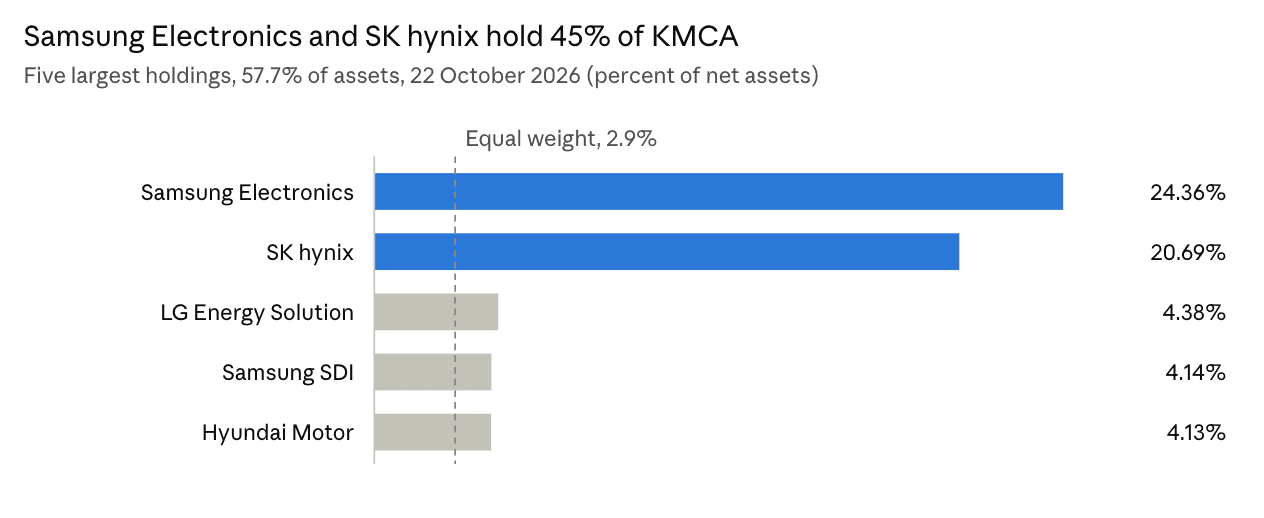
Weights move between months. Samsung Electronics fell from 7.57% of the fund at 31 July to 6.42% at 31 August, and SK hynix fell from 5.67% to 4.69%. With about $5 million in assets, each percentage point of weight equals roughly $50,000, so individual positions are small in absolute terms.
Korea market backdrop
The KOSPI gained almost 80% in 2025 and then reached a record close of 9,114.55 on 22 June 2026. It closed at 5,550.30 on 23 October, a fall of about 39% from that peak, and remains up for the year.
The path was volatile. Four July sessions show the range of daily moves.
KMCA carries semiconductor and battery exposure that moves with this volatility. PLUS ETF's research notes a session when Korea's market fell more than 7% while defense stocks rose, which is the diversification argument for holding KDEF beside broader Korean exposure. PortfoliosLab reports a 0.54 correlation between KMCA and KDEF, although KMCA's history since May 2026 is short.
Combining the two funds
Hanwha Aerospace sits in both portfolios, at 23.37% of KDEF and 5.01% of KMCA as of 31 August. The table shows the resulting exposure for different splits.
Both funds charge 0.65% a year, which costs AED 65 for every AED 10,000 invested and AED 650 for every AED 100,000. Both prices are in US dollars, and the dirham is pegged at 3.6725 to the dollar, so a UAE investor carries the won exposure without a separate dirham risk. The KOSPI's 2026 return of 31.7% in won against 42.7% in dollars implies the won gained about 8% against the dollar this year, which added to dollar returns.
Risks to weigh
Size is the first constraint. KMCA's $4.98 million in assets is small enough that a single large redemption or a wide spread affects results, and KDEF's assets have fallen by more than half from their peak. Concentration is the second constraint, with 23.4% of KDEF in one company and 61.0% of KMCA in 15 names. Korean market volatility is the third, as the July sessions show. Liquidity on ADX is the fourth, since ETF turnover on the exchange is about 0.8% of market value over six months.
Shariah screening is a further point for GCC investors. The materials reviewed for this article do not describe either fund as Shariah-compliant, which separates them from KWIN, so investors who require screening check each constituent and the issuer's documents before buying.
What to watch next
Three data points show whether the listings gain traction. The first is the asset level of KMCA, which starts at $4.98 million. The second is the share of ADX ETF turnover that the two funds capture, measured against the AED 203 million traded in the first half. The third is Hanwha's London and Frankfurt listings, which tell investors whether the white-label model scales beyond the US and Abu Dhabi.