

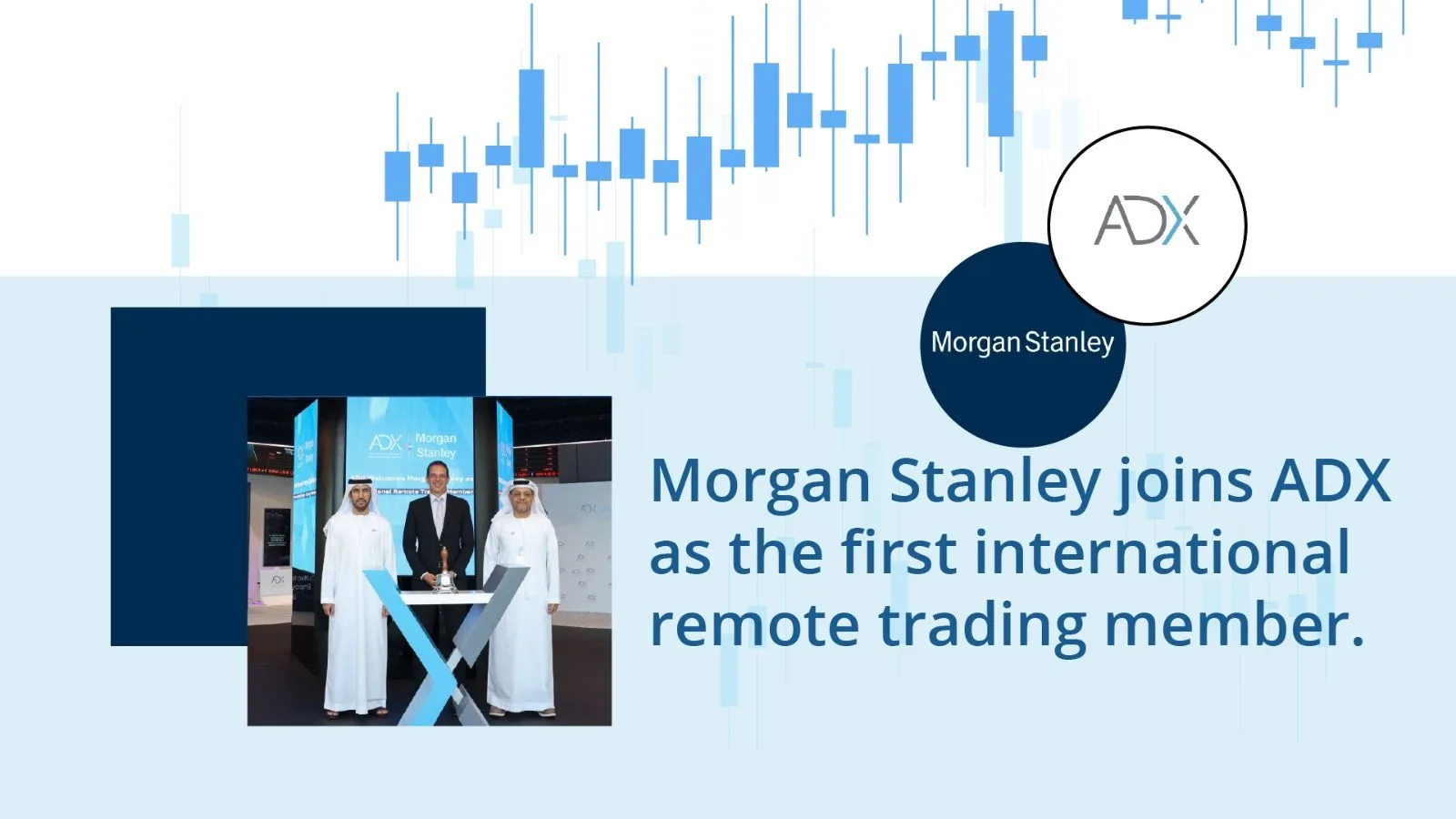
The Abu Dhabi Securities Exchange (ADX) has welcomed Morgan Stanley as its first international investment bank Remote Trading Member, granting the firm's clients direct access to ADX-listed securities. The move marks a pivotal step in ADX's global expansion strategy, deepening institutional connectivity between Wall Street and the GCC's second-largest exchange by market capitalisation.
From New York to Abu Dhabi: a partnership months in the making
The groundwork for this membership was laid in October 2025, when ADX held an investor roadshow in New York in direct collaboration with Morgan Stanley. The event brought together over 80 senior decision-makers from prominent institutional investors managing in excess of USD 10 billion in AUM, underscoring the depth of international appetite for Abu Dhabi-listed opportunities.
The roadshow coincided with a period of heightened trading activity on ADX. During the first nine months of 2025, net foreign investment reached AED 17.3 billion, up 23.3% from the same period in 2024, with foreign investors accounting for more than 41% of the value traded on the exchange.
That October event was the opening act. The confirmation of Morgan Stanley's Remote Trading Membership in May 2026 is the follow-through on a seven-month arc from a New York boardroom to direct operational integration with one of the Arab world's largest exchanges. Subject to final operational readiness, Morgan Stanley expects to begin trading as a remote member in the coming weeks.
"This marks a significant step in advancing our ambition to be a leading financial marketplace that drives opportunity and sustainable economic growth. This momentum is reflected in the strong foreign investor participation, with trading value exceeding 85 billion dirhams in the first quarter of 2026, up by 22% year on year."
Abdulla Salem Alnuaimi, Group CEO, ADX Group
What remote trading membership mean
Unlike traditional brokerage arrangements that rely on local intermediaries, remote membership gives Morgan Stanley direct market access to ADX, with trading conducted via the firm's global trading platform. The structure enhances execution quality, optimises order routing, and provides greater control across the end-to-end trade lifecycle. For global investors seeking exposure to ADX-listed equities and ETFs, this translates into tighter spreads, faster execution, and reduced operational friction.
The structure follows a proven international access model used by Morgan Stanley and is designed to meet growing client demand for efficient, transparent, and seamless access to ADX-listed opportunities. Remote memberships are selectively offered to global firms, a signal that ADX is prioritising quality of cross-border liquidity over volume.
ADX by the numbers: a market in accelerating growth
The backdrop to this announcement is a set of ADX market metrics that are difficult to ignore. Foreign investor trading value exceeded AED 85 billion in Q1 2026, up 22% year on year. Institutional participation rose to 78% of total trading value, and foreign investors accounted for 47.5% of transactions. In 2025, foreign investment on ADX rose by nearly 14%, and institutional trading increased by 10% year on year, a trend that 2026 has sharply accelerated.
Much of that foreign investor momentum is being channelled through a rapidly expanding ETF ecosystem, one that has grown faster than almost any other product segment on the exchange.
ADX's ETF ecosystem
ADX's ETF shelf has become one of the most ambitious in the region. From just 5 products in 2023 to 23 by April 2026, the exchange has built a thematic catalogue that few regional peers can match, with total ETF market capitalisation approaching AED 27 billion.
In December 2025, ADX became the first exchange in the Arab world to list US-domiciled ETFs, cross-listing KraneShares' CSI China Internet ETF (KWEB) and Global Carbon Strategy ETF (KRBN), adding nearly USD 10 billion in combined AUM. The pace continued in April 2026 with two further listings: the KraneShares AI & Technology ETF (AGIX), providing exposure to both public and private AI companies, and the KraneShares Wahed Alternative Income Index ETF (KWIN), the first Shariah-compliant ETF to be cross-listed from the US. KWIN's initial offering period attracted investors from more than 46 nationalities.
(Source: ADX)
Why this matters for GCC investors
For investors across the GCC, the convergence of Morgan Stanley's direct market access and ADX's expanding ETF catalogue represents a material improvement in market infrastructure. Historically, accessing globally relevant thematic products, such as Chinese technology, carbon credits, AI, or Shariah-compliant income strategies, required navigating international platforms or offshore accounts. ADX is systematically eliminating that friction.
The timeline from the October New York announcement to today's live membership formalisation also demonstrates an important point: ADX is moving at an institutional pace. The exchange is not merely announcing ambitions; it is executing them on a timeline that global partners can anchor to. That credibility is increasingly what differentiates Abu Dhabi from other regional exchanges competing for the same international capital.
The bottom line
Morgan Stanley's Remote Trading Membership is more than a symbolic headline. Formalised in May 2026 following a joint ADX-Morgan Stanley investor roadshow in New York last October, it represents a concrete improvement in execution infrastructure for global institutional capital seeking UAE exposure. Combined with an ETF shelf that has grown from 5 products to 23 in three years, spanning AI, carbon markets, Shariah-compliant income, and China internet, ADX is building a product and access framework that is increasingly competitive with the world's leading exchanges.