


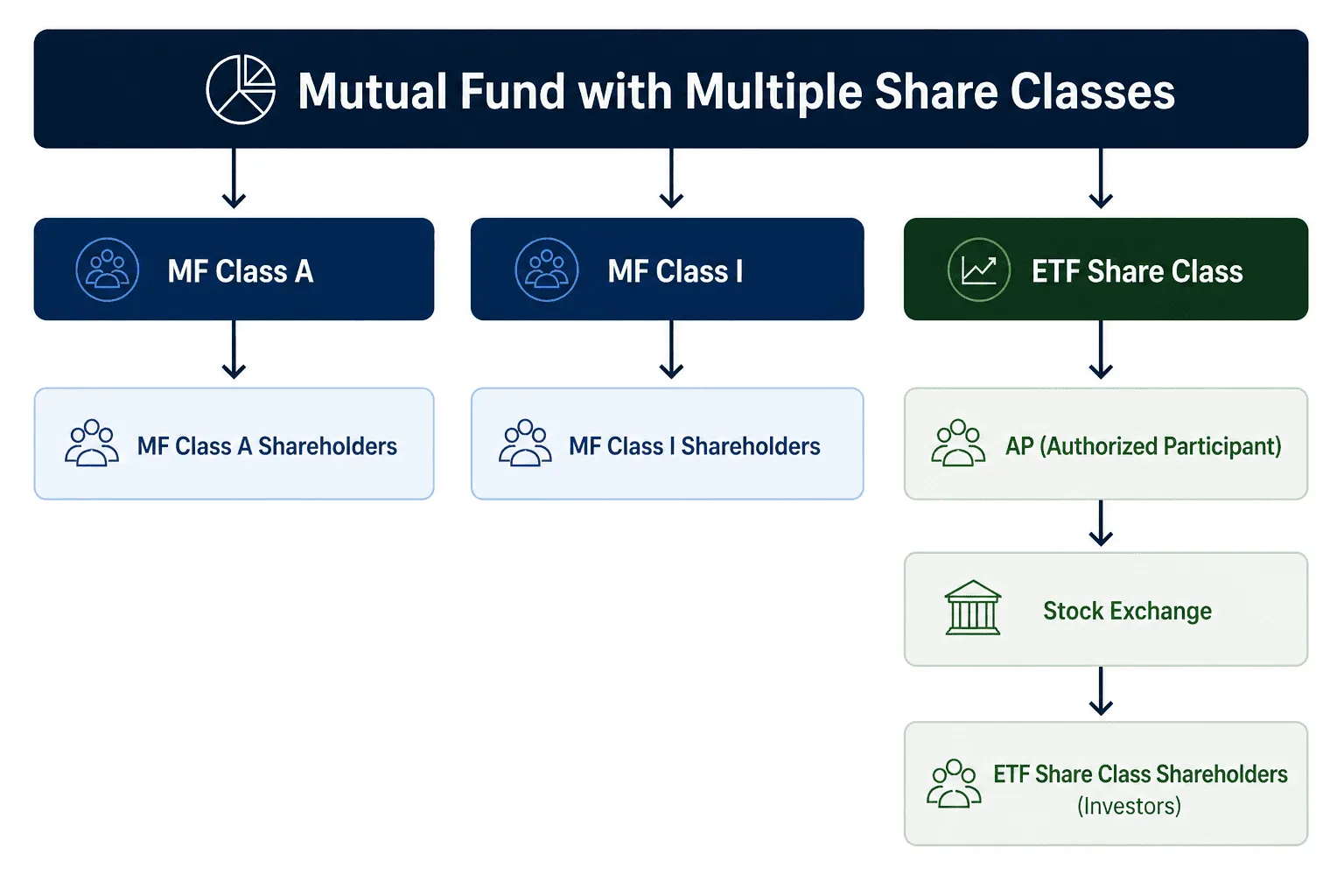
Nasdaq filed SR-NASDAQ-2026-029 amendment to its exchange rule book on April 7, 2026. The amendment is just a few added words, folding "Class ETF Shares" into the definition of an Exchange-Traded Product. These words are the last bit of plumbing that turn a long sought after structural change, the mutual-fund-with-an-ETF-share-class, into something issuers can now list and market makers can quote.
The backstory is short. Vanguard had a patent on the dual share-class structure for two decades. The patent expired in 2023, and roughly 80 asset managers filed applications with the SEC asking for the same thing: permission for a single fund to issue both mutual fund shares and ETF shares off the same portfolio, off the same NAV. Dimensional was the first non-Vanguard approval, granted last November. In March, the SEC's Trading and Markets and Corporation Finance divisions issued the broker-dealer trading relief that lets APs and market makers actually trade the shares. The Nasdaq filing this month is the listing-venue piece of the same machine. The structure is now operational end to end.
Why it's a bigger deal than the prior decade of ETF launches comes down to scale. US mutual fund assets sit around $20 trillion. ETF assets are about $13 trillion. The dual share-class structure is a wrapper retrofit: every dollar in a legacy mutual fund can, in principle, be made tradable on-exchange without forcing the underlying portfolio to be liquidated and re-launched. The tax efficiency of the ETF wrapper extends to the mutual fund holders sitting alongside. This is another major change to the US fund market since Rule 6c-11 in 2019.
The direct read for the GCC is that regional access to US equity exposure today runs through a narrow set of locally-listed ETF, Chimera's S&P US Shariah Growth ETF (USGRWTH) is one example, plus brokerage accounts pointed at US venues that need to wait until late into the UAE evening to find meaningful liquidity. The new structure expands the universe of ETFs that could eventually arrive on the ADX and other GCC exchanges.
ADX has been working through cross-listing arrangements with US venues for some time. Once a Dimensional or a Vanguard adds an ETF share class to a strategy with a 30-year mutual fund track record, that fund, long history, deep AUM, established methodology, becomes an attractive cross-listing candidate for local investors looking for stable investing products. Track record is hard to manufacture. Now there's a way to bring decades of it into a new wrapper without restarting the clock.
The active management piece is also worth understanding. The first wave of share class approvals, Dimensional included, covers active strategies. The GCC ETF market is majority passive and equity-index focused. If active US strategies eventually arrive via cross-listing, and there's no obvious reason they won't, given the AUM these managers will be looking to distribute globally, that's a real product expansion for the region.
The structural plumbing being live in the US means that the cross-listing pool of eligible ETFs is just about to increase. The first wave, when it arrives, will almost certainly be successful mutual fund names that are looking for new markets and new investors. The product set in the GCC will soon expand.