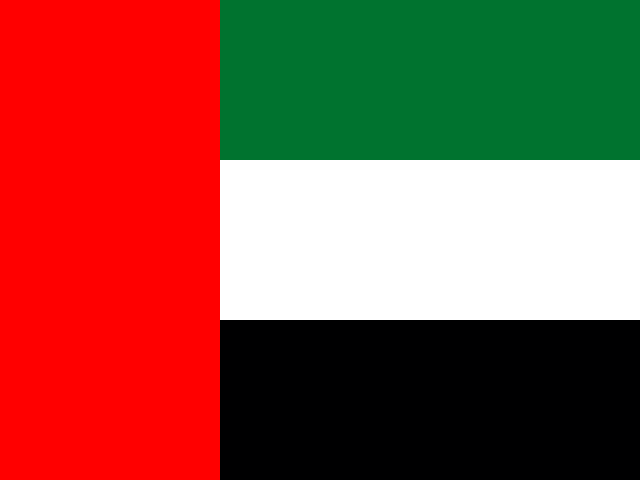

The United Arab Emirates has announced it will exit OPEC and the broader OPEC+ framework effective May 1, 2026, according to state news agency WAM. The decision marks a notable shift in the country’s long-standing participation in coordinated oil production agreements that have shaped global energy markets for decades.
The UAE has been part of OPEC since 1967, joining shortly after the organization’s formation in 1960. For much of that period, OPEC functioned as a mechanism for coordinating output among major oil-exporting countries, with the aim of stabilizing prices and managing supply.
The OPEC+ framework, introduced in 2016, expanded this coordination to include non-OPEC producers such as Russia. This broader alliance played a central role during periods of market stress, most notably during the COVID-19 demand shock in 2020, when coordinated production cuts were implemented to support prices.
Over time, however, differences have occasionally emerged among member states regarding production baselines, capacity expansion, and long-term strategy. The UAE has consistently invested in increasing its production capacity, targeting output levels above its assigned quotas under OPEC+ agreements.
The UAE stated it would continue to act “responsibly” in oil markets, emphasizing a measured approach to production increases aligned with demand conditions. The statement framed the decision as part of a broader evolution in energy policy aimed at enhancing flexibility while maintaining market stability.
Oil markets reacted immediately to the news. Brent crude briefly moved above $100 per barrel intraday (As of 2026-04-28, source: Bloomberg), reflecting heightened uncertainty around future supply coordination. The move was short-lived, with prices retracing as markets assessed the practical implications of the announcement.
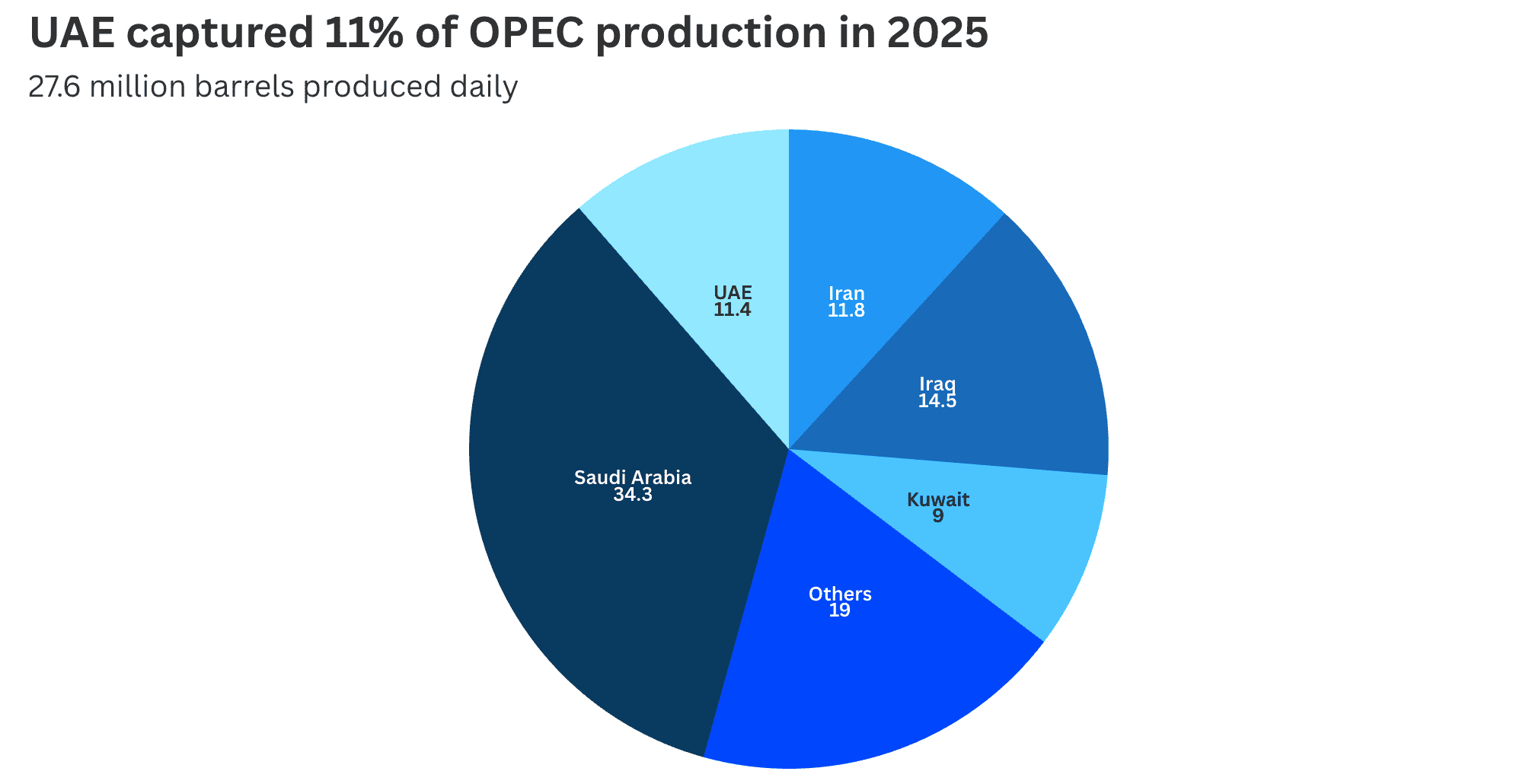
The UAE’s exit does not imply a withdrawal from global oil markets or a shift away from its role as a major exporter. Instead, it signals a move away from formal quota-based coordination toward a more independent production strategy.
Historically, OPEC quotas have acted as a constraint on output for countries with expanding capacity. By stepping outside the framework, the UAE may gain greater flexibility in aligning production with its own capacity investments and market outlook.
At the same time, the country’s statement suggests continuity in its broader approach. References to market stability and responsible production indicate that policy may still be influenced by global supply-demand dynamics, even without formal OPEC+ participation.
The announcement emphasizes a gradual approach rather than an abrupt shift. The UAE indicated that production increases would be implemented incrementally and in line with demand, suggesting that immediate supply shocks are unlikely.
From a historical perspective, the move represents one of the more significant structural changes within OPEC in recent years. While membership shifts have occurred before, the departure of a long-standing producer with growing capacity highlights evolving dynamics within global energy markets.
The longer-term impact will depend on how production policy evolves outside the OPEC+ framework and how other producers respond. For now, the UAE’s exit marks a transition from coordinated quotas toward a more autonomous approach, while maintaining a stated commitment to market stability.