


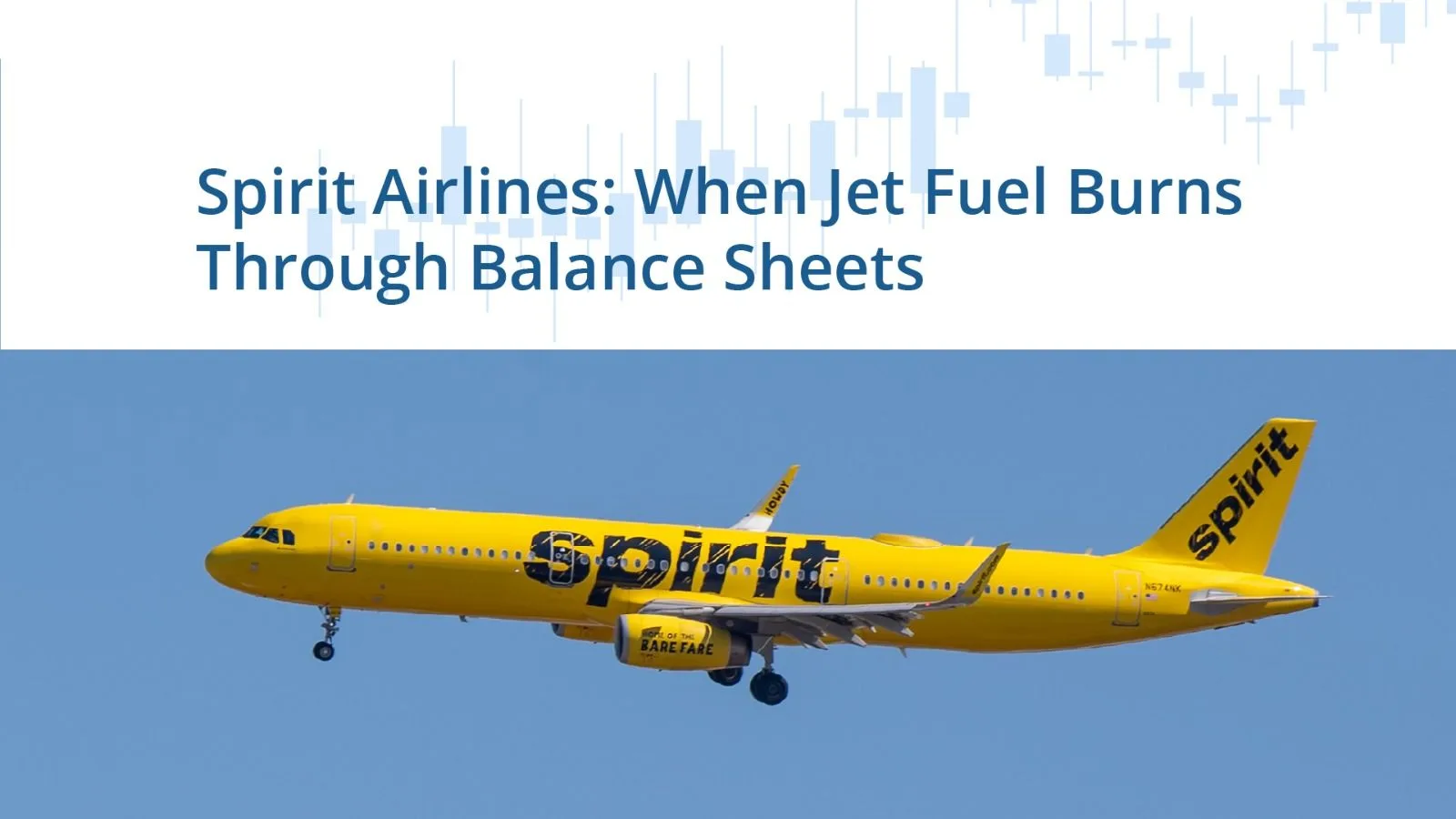
On Saturday, May 3, 2026, Spirit Airlines ceased operations, the first major U.S. carrier to go out of business in 25 years. Its restructuring plan had assumed jet fuel at $2.24 per gallon in 2026. By April's end, actual prices had reached $4.51 per gallon, leaving Spirit with no viable financial path forward. "Sustaining the business required hundreds of millions of additional dollars of liquidity that Spirit simply does not have and could not procure," said CEO Dave Davis on May 03.
Spirit had already lost more than $2.5 billion since the start of 2020 and filed for bankruptcy twice before the Iran war's fuel shock made a third act impossible. It is a cautionary tale, not an outlier; any airline running thin fuel-cost assumptions in a restructuring now faces the same structural vulnerability.
The Fuel Shock in Hard Numbers
The Iran war, which began in late March 2026, restricted roughly 20% of the global seaborne crude supply through the Strait of Hormuz. Jet fuel prices roughly doubled in regional spot markets within weeks. The IATA Jet Fuel Price Monitor reported a global average of $181.22 per barrel for the week ending April 28. The EIA's US Gulf Coast daily series peaked at $4.136 per gallon on April 6, up from $1.965 in December 2025, a 110% move in four months. At American Airlines, every one-cent rise in jet fuel costs the carrier $50 million annually. United's CEO disclosed that sustained elevated prices would add roughly $4.6 billion in costs for the year.
The GCC Paradox: Oil Wealth, Aviation Pain
Gulf carriers occupy a painful position at the centre of this crisis. Their home region produces the oil driving global fuel prices upward, yet they bear those same prices operationally while simultaneously losing transit traffic and tourism revenue. The Strait of Hormuz disruption has forced virtually all GCC carriers to suspend, reroute, or downsize eastbound and westbound services, adding 2-4 hours of flight time and millions in daily fuel burn on rerouted sectors.
"Despite the company's efforts, the recent material increase in oil prices and other pressures on the business have significantly impacted Spirit's financial outlook."
- Spirit Airlines Statement, May 3, 2026
Emirates has withdrawn A380 service from Copenhagen, Glasgow, Prague, and Osaka for the summer of 2026. Qatar Airways suspended A380 operations to Paris, Singapore, and Sydney through at least September 2026. Etihad reduced first-class availability across 31 routes. War-risk insurance has surged 50-500%, with widebody round-trips to Gulf destinations reported at up to $120,000 per flight. FlightAware recorded 1,847 flight cancellations in Middle East corridors in just the first three weeks of March 2026, a 203% increase versus March 2025.
The key distinction between GCC carriers and LCCs like Spirit is sovereign ownership. State backing provides liquidity that no private low-cost model can replicate when fuel prices double in six weeks. Emirates Group's reported cash position of AED 56 billion ($15.2 billion) as of September 2025 is the clearest example that reserves buy operational time that Spirit never had.
What Passengers Are Already Paying
Fare increases are no longer theoretical. Air India has already added $50-$85 per ticket in jet fuel surcharges on long-haul routes. A CBS News analysis of Cirium aviation data found that average fares jump 23%, roughly $60 per round-trip, when Spirit exits a route, based on historical precedent. Air cargo rates have risen 70%, adding 10-20 days to lead times in pharmaceuticals, automotive, and e-commerce as freight shifts to sea routes. Spirit alone had 9,000 flights and 1.8 million seats booked through the end of May at the time of its shutdown.
JETS ETF: Aviation Stress in a Single Ticker
The U.S. Global Jets ETF (NYSE: JETS, TER: 0.60%) is the only pure-play aviation ETF in the U.S. market. Its top holdings are the four legacy U.S. majors Delta, United, American, and Southwest which account for roughly 50% of the portfolio, with international carriers and lessors making up the balance. This construction means JETS carries undiversified fuel-cost risk: when jet fuel doubles, every meaningful holding is impaired simultaneously. Since the Iran war began, JETS has tracked the inverse of the IATA fuel price monitor, with Spirit’s Chapter 7 filing adding a further sentiment compression across the LCC complex.
The JETS/TASI divergence one up 5.5% YTD on Aramco earnings, the other down on structurally elevated fuel costs is the most concise single chart of the oil-winner/aviation-loser split defining this crisis.
For investors, JETS works in both directions. As a short, it quantifies sector-wide fuel stress without taking single-carrier bankruptcy risk Spirit’s default being the precise illustration. As a long, it is a Hormuz resolution trade: if jet fuel retraces even 40–50% of its spike, airlines’ operating leverage delivers outsized earnings recovery. Paired against FLSA or KSA, JETS is the natural hedge leg for expressing the oil-winner/aviation-loser dislocation cleanly, without jurisdiction or currency risk.
Four Things This Crisis Has Confirmed
Fragile carriers don't survive commodity shocks.
Spirit's two prior bankruptcies and $2.5 billion in losses since 2020 made it structurally vulnerable long before the Iran war. The fuel shock didn't create the problem; it removed the last option to survive it. Any airline running thin margin assumptions in a restructuring is now living on borrowed time if prices hold at current levels. The LCC model, as built, cannot absorb a doubling of its single largest operating cost inside six weeks.
State ownership is the only real buffer in GCC aviation.
Emirates' AED 56 billion cash reserve, Qatar's government stimulus package, and Etihad's sovereign ownership give GCC carriers survival capacity that no private LCC can replicate. Route cuts and gauge downgrades, A380s swapped for 777s, first class pulled from 31 routes are operational choices, not distress signals. The carriers with the deepest state ties will emerge from the crisis with their networks largely intact. flydubai, with fuel at 25% of OPEX and a limited cash buffer, is the most exposed GCC name to watch.
The GCC oil paradox is a genuine ETF opportunity.
KSA is up 5.5% year-to-date despite the war because Aramco benefits from the same fuel spike crushing airlines. The TASI's reported P/E of 16.2x against a 5-year average of 18.8x is a documented valuation discount in a market where underlying earnings have not collapsed. GCC equities are trading at war discounts while their oil revenues are at war premiums, an asymmetry that history suggests closes when tensions ease. FLSA offers the same exposure at 0.39%, the lowest fee in the space. GULF adds a 4.1% dividend yield for income-oriented positioning. JETS, inversely, acts as the clearest barometer of aviation sector stress and has moved in the opposite direction to KSA through this crisis.
The hub geography endures beyond the crisis
Dubai, Doha, and Abu Dhabi sit at the intersection of Europe, South Asia, and Africa. That position is not a brand, not a subsidy, not a temporary advantage, and cannot be relocated or replicated. The 1,847 cancellations in the first three weeks of March and the suspension of A380 services are short-run adjustments. When Hormuz pressure eases, the connecting traffic model that built these carriers returns with it. The carriers now accelerating transitions to fuel-efficient A350s and 787s are simultaneously reducing their structural exposure to the next shock. The question for investors is not whether GCC aviation recovers. It is whether they positioned themselves during the discount or waited until after it closed.