

Virtu Financial (NYSE: VIRT) has launched block trading indications for 245 of the most liquid stocks on the Saudi Exchange, with State Street Investment Management conducting the first transaction on the service. Virtu announced the launch of its POSIT network for Saudi-listed equities on September 28, 2026, 20 days after announcing the service for equities listed on the Abu Dhabi Securities Exchange. Virtu says buy-side traders use the global POSIT product to minimize information leakage and reduce market impact. The announcement was datelined in London and Riyadh.
How Virtu's POSIT Block Trading Works in Saudi Arabia
Saudi Exchange members and their institutional clients gain access to Virtu's established global network for sourcing block liquidity, with Al Rajhi Capital serving as Virtu's regional partner. Virtu says members and clients are also offered aggregation capabilities when they access POSIT, which the company describes as a way to further enhance workflow for investors.
Virtu uses the Saudi Exchange's fully electronic Negotiated Deals facility to complete block trades sourced through POSIT. According to the company, the facility gives exchange members greater flexibility to execute large transactions on the platform. Trades settle on a T+2 basis through the Securities Depository Center Company, known as Edaa, which is the standard settlement cycle for Saudi Exchange trades. Firms that are not direct members receive connectivity, brokerage and post-trade services from Al Rajhi Capital. Rob Boardman, CEO of Virtu Execution Services, EMEA, credits the Saudi Exchange and the local partners Al Rajhi Capital and Arqaam Capital for the initiative.
Separately, Virtu describes POSIT Alert as a global and anonymous block indication network that delivers block liquidity each day to subscribers' desktops in 38 countries. According to Virtu, buy-side traders use the product to maximize liquidity, minimize information leakage, and reduce market impact by matching at the midpoint without negotiation. This describes the global POSIT Alert product; the Saudi announcement does not specify the pricing mechanism for individual Saudi transactions.
State Street Executes First POSIT Trade in Saudi Arabia
State Street Investment Management conducted the first transaction on the platform, providing an initial example of the service being used after launch. Graham Sorrell, Head of EMEA and APAC Equity and Currency Trading at State Street Investment Management, said block liquidity can lower the implementation cost of equity transactions, which benefits clients.
Boardman said deploying POSIT to Saudi listed securities enhances the appeal and accessibility of Saudi equity capital markets to global institutional investors. Mohammed Al-Rumaih, CEO of the Saudi Exchange, said the integration reflects the market's increasing connectivity with international investors. Neither the announcement nor the accompanying coverage quantifies any cost savings.
Virtu Expands POSIT From Abu Dhabi to Saudi Arabia
The Saudi launch follows Virtu's September 8, 2026 announcement with the Abu Dhabi Securities Exchange (ADX). The two firms described the ADX launch at the time as the first phase of POSIT facilitating block trading indications for Middle Eastern and North African equity securities. The two launches extend Virtu's POSIT block trading indications offering to two Gulf equity markets, while Virtu has not announced additional GCC markets.
Virtu Stock Performance
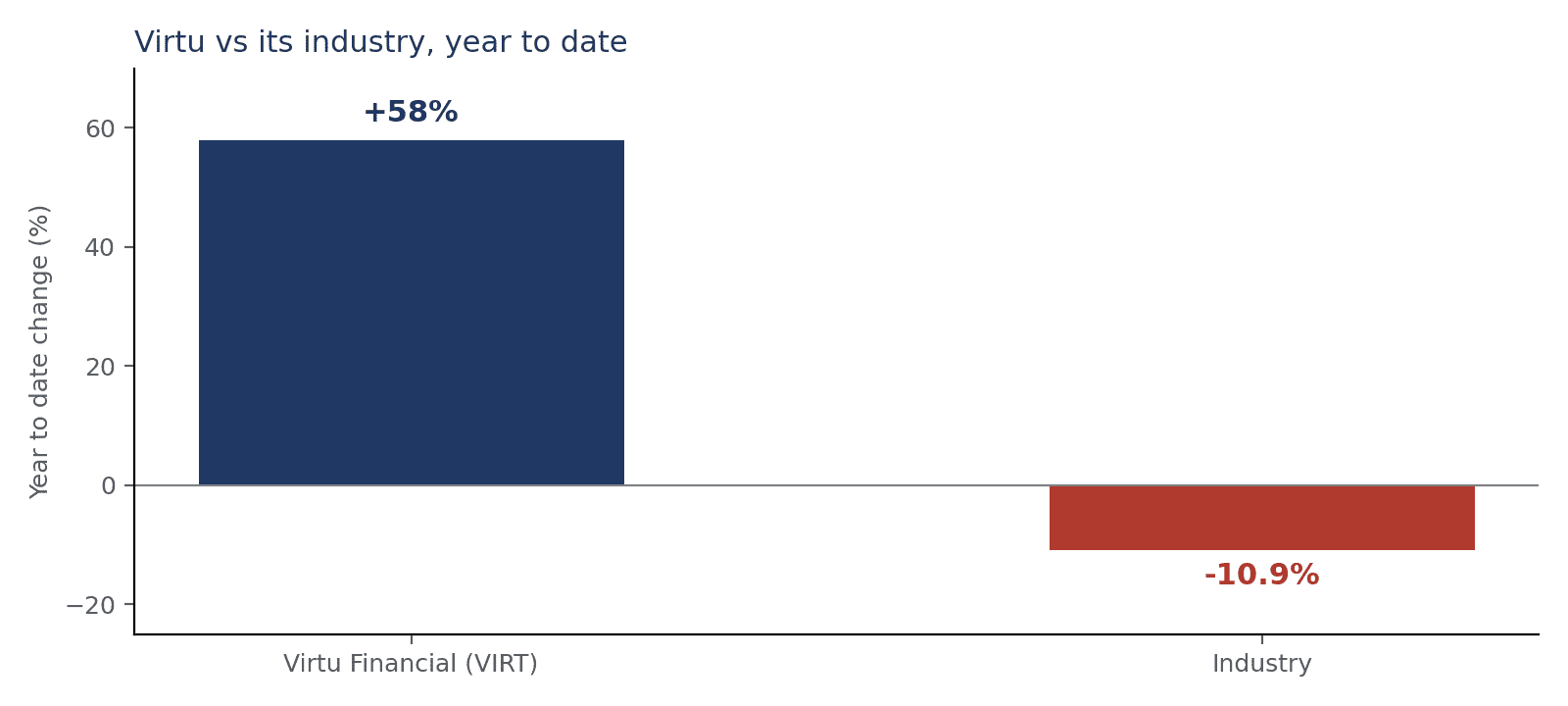
On September 28, Virtu shares were down 2.68%, while State Street shares were down 0.89%. A Zacks Investment Research report cited in the source material said Virtu shares were up 58% year to date, versus a 10.9% decline for its industry.
The launch could expand Virtu's addressable execution-services opportunity and potentially attract more institutional order flow into POSIT. However, Virtu has not disclosed any revenue expectation for the Saudi service.
Potential implications for Saudi ETFs
ETFs that hold Saudi stocks may need to trade the underlying shares to facilitate creations, redemptions and portfolio rebalancing. Products in this group include the iShares MSCI Saudi Arabia ETF (KSA), the Albilad MSCI Saudi Equity ETF (9412) and the Al Rajhi MSCI Saudi Equity ETF (9413). In principle, greater access to block liquidity and potentially lower execution costs could benefit funds trading larger positions in Saudi equities. The potential relevance for each ETF will depend on its exposure to the 245 securities covered by POSIT and how the additional liquidity channel affects execution. Tracking difference, trading costs, and premium or discount to NAV can help assess changes in ETF trading conditions over time.
Bottom line
Virtu's Saudi POSIT launch adds a new channel for institutional investors to source block liquidity across 245 of the most liquid Saudi Exchange securities. With State Street Investment Management completing the first transaction and the service operating through the exchange's electronic Negotiated Deals facility, the rollout strengthens the infrastructure available for large Saudi equity trades. For Saudi ETFs, the potential benefit will depend on their exposure to the covered securities and whether greater access to block liquidity translates into more efficient execution over time.