

Saudi Arabia’s ETF market is beginning to move beyond simple index replication. The clearest example is the SAB Invest Saudi Quant ETF (9402), which became the Kingdom’s first quantitatively driven ETF when its strategy was overhauled on May 5, 2025.
The fund itself dates back to 2011, when it operated as the SAB Invest MSCI Tadawul 30 Saudi ETF. In May 2025, SAB Invest replaced the passive MSCI Tadawul 30 approach with a Shariah-compliant quantitative strategy based on the S&P Saudi Arabia Shariah Domestic Total Return Index. SAB Invest describes it as Saudi Arabia’s first quantitative ETF, while its 2025 annual report calls it the first ETF of its kind in the GCC.
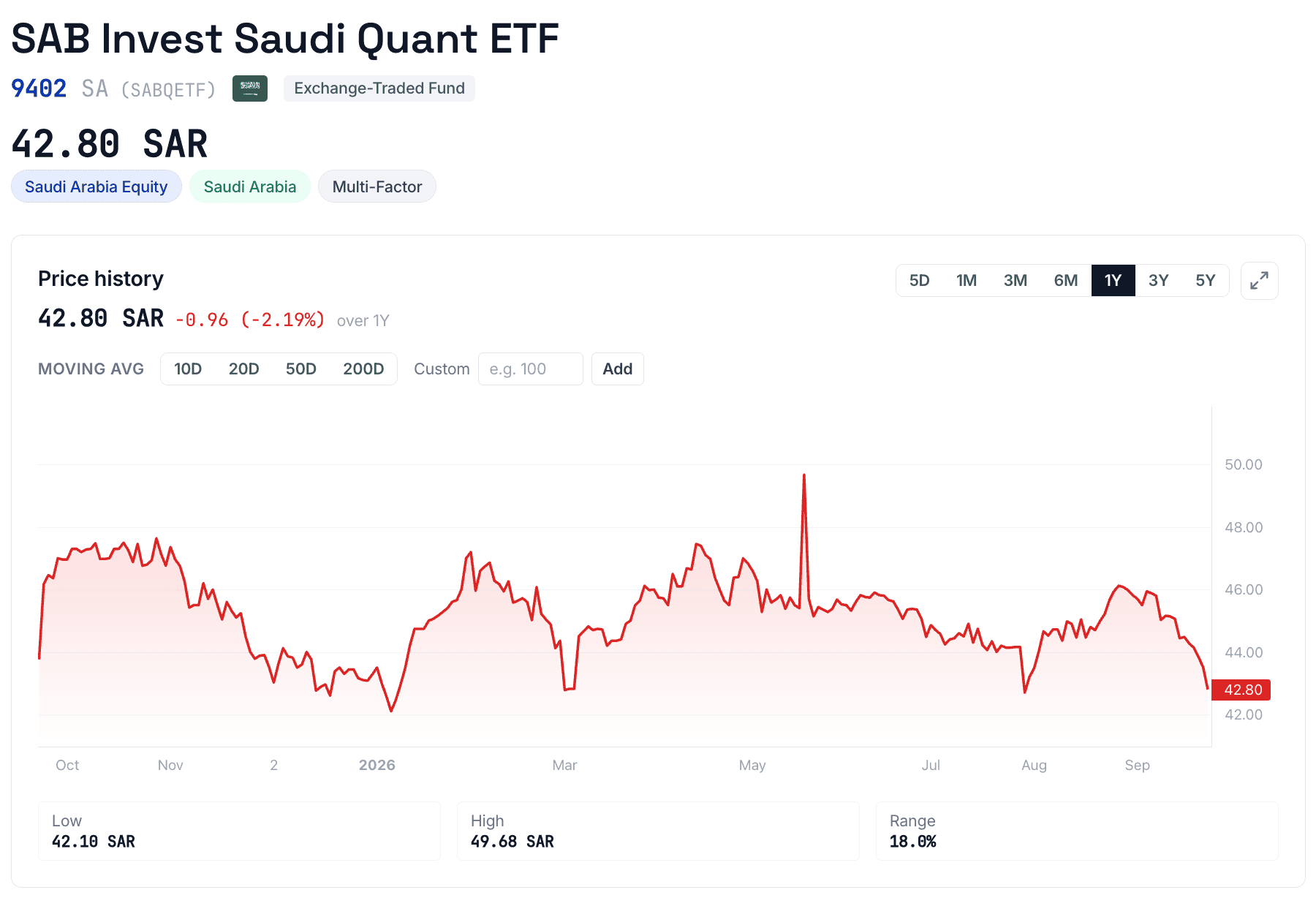
The early numbers are encouraging, although the live quant track record remains short. For the 12 months to June 30, 2026, the fund returned -0.21% against -1.74% for its benchmark, an excess return of 1.53 percentage points. During the first half of 2026 it gained 4.39% against 3.72% for the benchmark.
For a Saudi ETF market still dominated by conventional index products, 9402 provides an unusually clean test of whether systematic factor investing can add value inside a locally listed, Shariah-compliant wrapper.
SAB Saudi Quant ETF at a Glance
Source: SAB Invest and Saudi Exchange.
What Makes It a Quant ETF?
The fund does not simply hold every benchmark constituent according to its market capitalization.
SAB Invest applies multi-factor models, quantitative methods and mathematical algorithms to determine how securities from the S&P Saudi Arabia Shariah Domestic universe should be weighted. The issuer says the model focuses particularly on value and momentum, seeking companies that combine attractive valuations with stronger price characteristics. The portfolio is then rebalanced monthly.
That puts 9402 somewhere between conventional passive indexing and discretionary active management. The investment universe comes from an index and the process is rules-based, but the model is allowed to deviate from market-cap weights in an attempt to improve the return profile.
The fund's stated objective is to remain consistent with the S&P Saudi Arabia Shariah Domestic Total Return Index while limiting tracking error to 3%. That means the strategy is designed to make controlled factor tilts rather than take large active bets against the Saudi market.
SAB Invest says the model was adapted from an HSBC quantitative framework associated with more than $34 billion in global assets, although that figure refers to the broader model family rather than assets in the Saudi ETF itself.
The Fund Was Reinvented in 2025
The 2011 inception date can be misleading when assessing the strategy.
Until May 5, 2025, ticker 9402 followed the MSCI Tadawul 30 Index as a conventional passive ETF. The 2025 restructuring changed the benchmark, introduced quantitative factor selection and converted the fund from conventional to Shariah-compliant.
That means five-year and ten-year performance figures should not be interpreted as evidence that the current quant model has worked over those periods.
The cleaner evaluation period begins after May 2025.
Performance Since the Quant Strategy Took Hold
Source: SAB Invest Q2 2026 factsheet. Figures may differ slightly due to rounding.
The evidence so far points to modest outperformance rather than a dramatic break from the market. Over the year to June, the ETF lost less than its benchmark. During H1 2026, it also finished 67 basis points ahead.
For context, TASI gained about 2.9% during the first half of 2026, compared with the ETF's 4.39% NAV return. That comparison is less exact because TASI is a broad market price index while the ETF and its official benchmark incorporate different universes and dividend treatment. The S&P Shariah total-return benchmark remains the correct measure of the quant model's performance.
What the Model Actually Owns
The portfolio remains recognizably Saudi, but the weighting process produces a broader mix than a top-heavy mega-cap index.
As of June 30, banks represented 34.22% of the equity portfolio, followed by materials at 17.94%, energy at 12.94% and telecommunications at 9.18%. Those four sectors accounted for 74.28% of invested assets. Insurance contributed another 4.76%.
Source: SAB Invest interim financial statements.
A market-cap portfolio naturally gives Saudi Arabia's largest banks and energy companies heavy influence. A value-and-momentum model can redistribute some of that weight toward smaller companies when their factor scores become more attractive.
Monthly rebalancing also means today's holdings should not be treated as static long-term convictions. The model can alter weights as valuations and momentum change.
Assets Have Grown Far Faster Than Performance Alone Can Explain
One of the more striking developments has occurred in the fund's size.
At June 30, 2025, shortly after the quant conversion, 9402 held just SAR22.89 million in net assets with 510,000 units outstanding. By December 31, assets had reached SAR374.92 million and the unit count had jumped to 8.74 million.
That represents an increase of roughly 1,538% in AUM in six months. The unit count expanded more than seventeenfold, demonstrating that the jump was driven primarily by creations and new capital rather than market appreciation.
By June 30, 2026, AUM had climbed to SAR391.36 million, while units remained unchanged at 8.74 million. The Saudi Exchange reported SAR386.05 million in assets on September 21.
That growth may prove more important for the Saudi ETF market than a few percentage points of performance. It suggests that a differentiated domestic strategy can attract materially more assets than the small passive vehicle that preceded it.
Liquidity Has Improved, But Trading Still Needs Watching
Nukoud data showed a three-month average daily volume of about 974 units, despite the fund having more than SAR400 million in assets.
Saudi Arabia has attempted to address that issue through formal market making. In May 2026, SAB Invest became the first registered ETF market maker on the Saudi Exchange, with 9402 as the first ETF supported under the arrangement. SAB said the objective was tighter bid-ask spreads and more consistent two-way pricing.
A Saudi Exchange snapshot on September 21 showed a SAR43.52 bid and SAR43.54 offer, equivalent to a spread of roughly 0.05% at that moment. That is tight, although one intraday quote should not be confused with an average execution cost. The same session recorded only 12 trades and 3,126 units of volume.
There was also a gap between the exchange price and NAV. The ETF closed at SAR43.53 against a reported NAV of SAR44.17 on September 21, a discount of roughly 1.45%. That makes market price versus NAV an important metric to monitor alongside the headline management fee.
The 0.75% Fee Sets a Higher Bar
The fund charges a 0.75% annual management fee.
That is easier to defend if the quantitative model consistently generates excess return after costs. A plain market-cap ETF does not need to outperform its benchmark. A factor strategy whose purpose is partly to improve portfolio construction faces a different test.
So far, the live evidence is positive: +1.53 percentage points against the benchmark over the year to June 2026 and +0.66 percentage points during H1. The sample remains too short to establish whether that advantage is persistent.
Factor performance can also rotate sharply. Value and momentum can work well together in some markets, but both can lag when leadership changes suddenly. Monthly rebalancing reduces the time the portfolio remains tied to stale signals, yet it can also raise turnover and transaction costs.
Shariah screening adds another structural difference. Financial leverage, business activity and other compliance filters narrow the investable universe, meaning 9402 should not be expected to behave exactly like TASI or an unrestricted Saudi equity portfolio.
Saudi Arabia Now Has a Live Quant Experiment
The most interesting feature of SAB Saudi Quant is therefore not its 2011 history. It is what has happened since May 2025.
A small passive MSCI Tadawul 30 ETF was converted into a Shariah-compliant systematic portfolio, its assets rose from SAR22.9 million in June 2025 to nearly SAR400 million, and its first full year under the quant approach finished 1.53 percentage points ahead of its official benchmark.
A full three-year quant record would show whether value and momentum can continue adding excess return across different Saudi market regimes rather than during a single cycle. Tracking error, turnover, market-price discounts and secondary-market liquidity will matter alongside returns.
For the Saudi ETF industry, 9402 is already significant for another reason: it shows that locally listed products no longer have to choose between plain index replication and traditional active funds. Quantitative portfolio construction has entered the Tadawul ETF market, and there is now enough live data to start judging whether the model is earning its place.