

The ETF industry's next growth phase is starting to look less like a contest between passive funds and stockpickers, and more like a migration of investment strategies into a different wrapper.
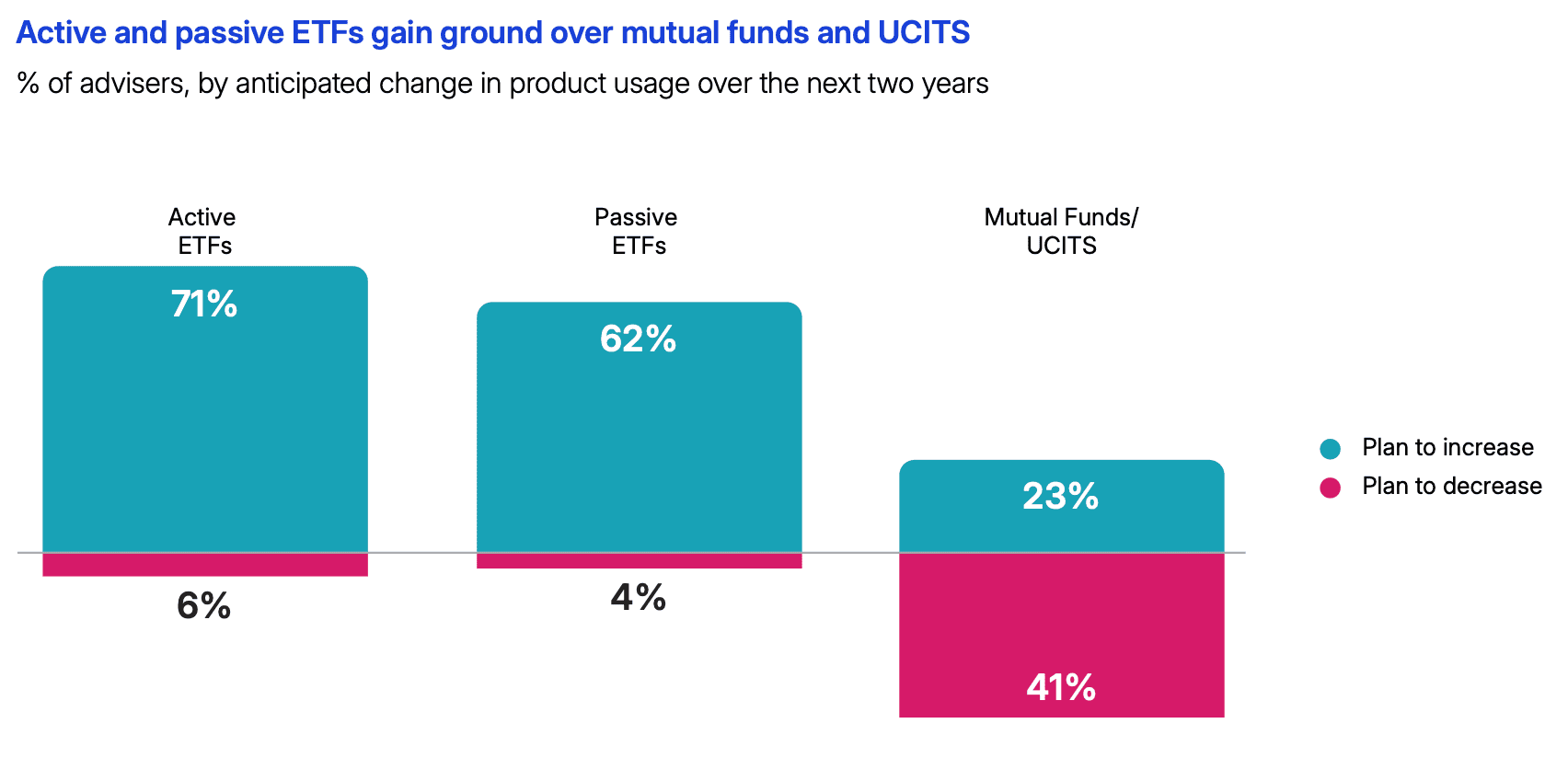
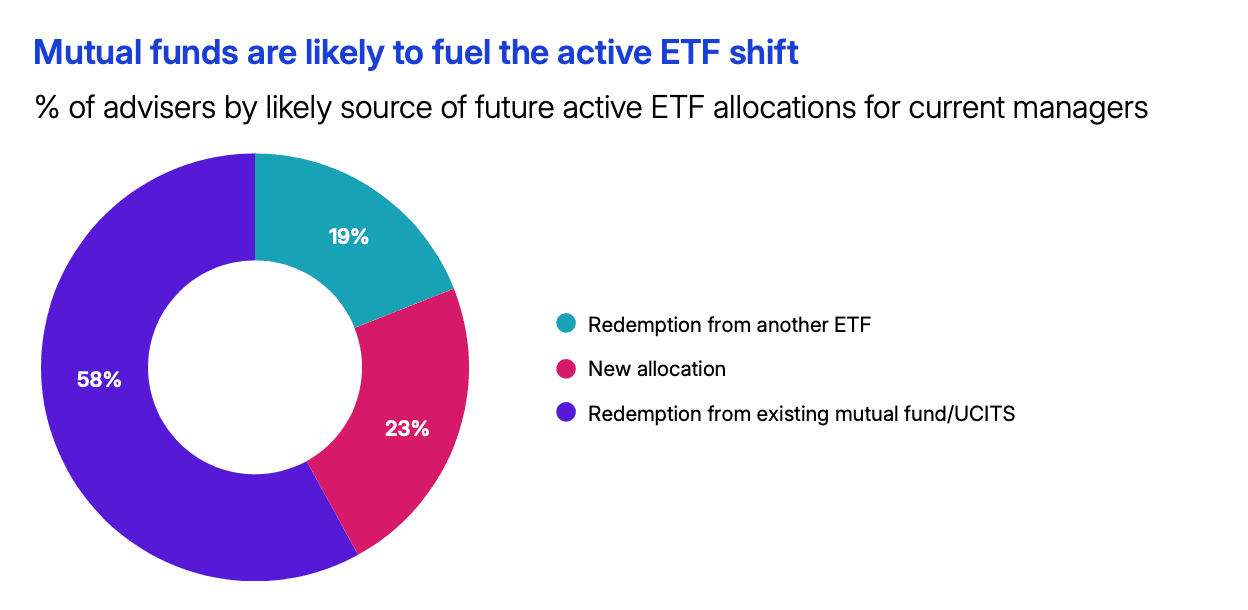
MSCI's 2026 ETF Intelligence Report found that 71% of advisers expect to increase their use of active ETFs over the next two years, compared with 62% for passive ETFs. Only 6% expect active ETF use to decline. More strikingly, 58% said a new active ETF allocation from a manager they already use would most likely replace an existing mutual fund or UCITS holding rather than represent fresh money.
The survey was conducted in April and May 2026 among 525 advisers and investment decision-makers across the U.S., Europe and Australia. The report focuses on 450 respondents in the U.S., U.K., France, Germany and Italy, providing a useful view into where ETF demand is moving in two of the world's largest fund markets.
The flows since then have moved in the same direction. Global active ETF assets reached a record $2.59 trillion at the end of July, up 35.6% from the end of 2025, while year-to-date net inflows reached $590.46 billion. The broader U.S. ETF market held a record $16.36 trillion by the end of August, while European ETF assets approached $4 trillion.
Active ETFs Are Taking Share From Mutual Funds
MSCI's strongest finding is that active ETF growth increasingly looks like substitution rather than purely new demand.
Among respondents, 41% expect to reduce mutual fund or UCITS use during the next two years, against 23% expecting to increase it. In the U.S., the share planning to reduce mutual fund use rises to 62%. When advisers were asked where a future active ETF allocation from an existing manager would come from, 58% chose an existing mutual fund or UCITS position, 23% said new money and 19% another ETF.
Half of respondents said they would be likely to move from an existing mutual fund or UCITS strategy into an active ETF version if one became available. Among advisers involved directly in mutual fund or UCITS selection, the proportion willing to consider an ETF share class rose to 85%.
That shift has already become visible in actual flows. U.S.-listed active ETFs attracted $63.16 billion in August alone, taking 2026 inflows through August to $529.96 billion, according to ETFGI.
Thematic ETFs Lead the Search for New Products
Advisers are also asking ETF issuers to move beyond conventional market-cap exposures.
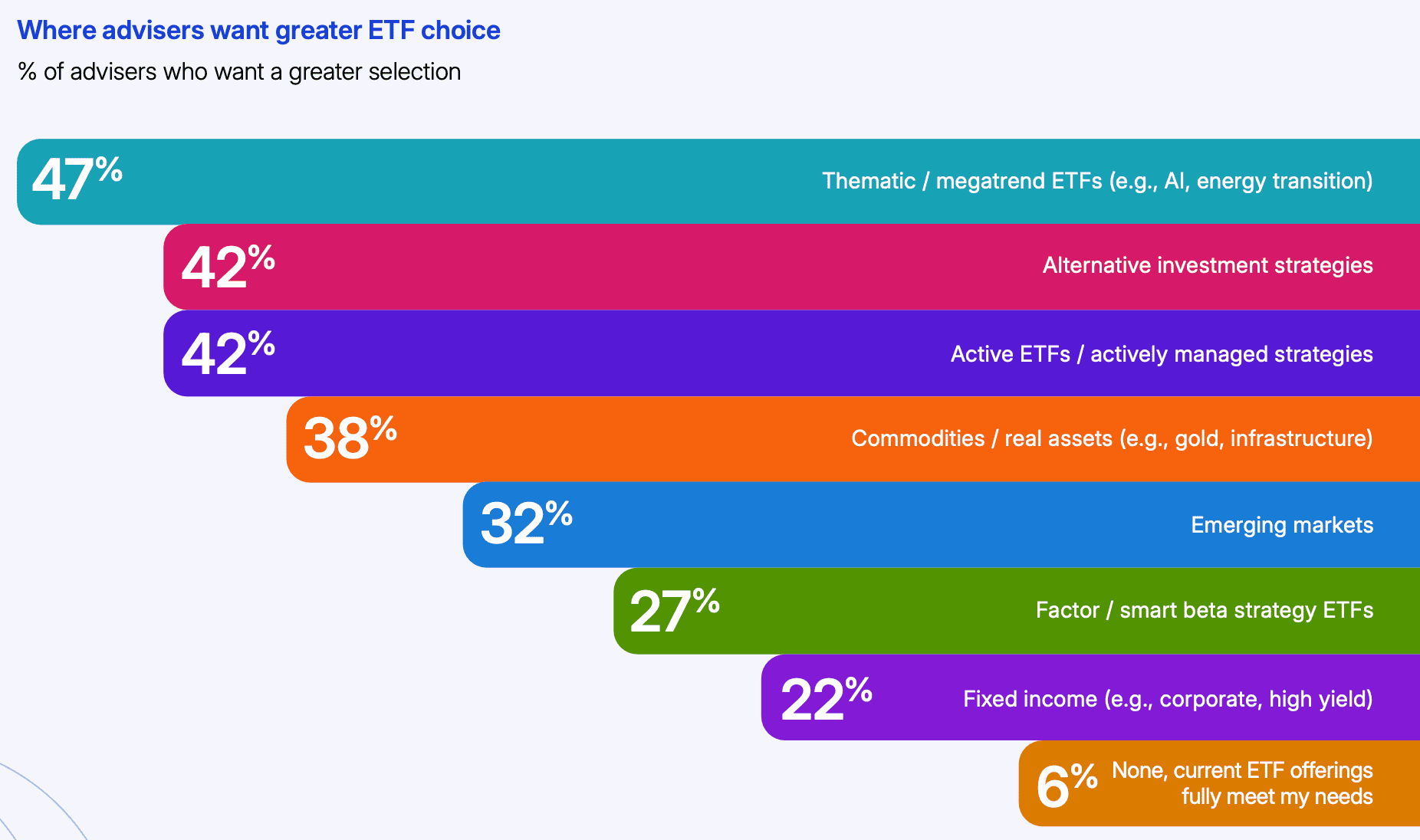
47% want greater choice in thematic or megatrend ETFs, including areas such as artificial intelligence and the energy transition. Alternative strategies and actively managed strategies follow at 42% each, while 38% want more commodity and real-asset products. Emerging-market ETFs attract 32%.
The gap between current use and preferred use is particularly wide in thematic investing. 61% prefer active ETFs for thematic strategies, compared with 41% currently using them. Emerging markets show a similar gap, with 52% preferring an active approach against current active ETF usage of 35%.
Geography matters as well. U.S. respondents currently keep an average 79% of equity exposure at home, compared with 32% among European respondents. Yet 47% of U.S. respondents and 44% of European respondents expect to increase international allocations over the next two years. Across the combined sample, 39% expect their foreign-equity exposure to tilt more heavily toward emerging markets.
For GCC ETF issuers, that combination is relevant. Demand is clustering around areas where Gulf exchanges are already adding products: global themes, emerging markets, commodities and specialist strategies rather than another layer of plain-vanilla developed-market beta.
Cheap Still Matters, But Investors Will Pay for Scarcity
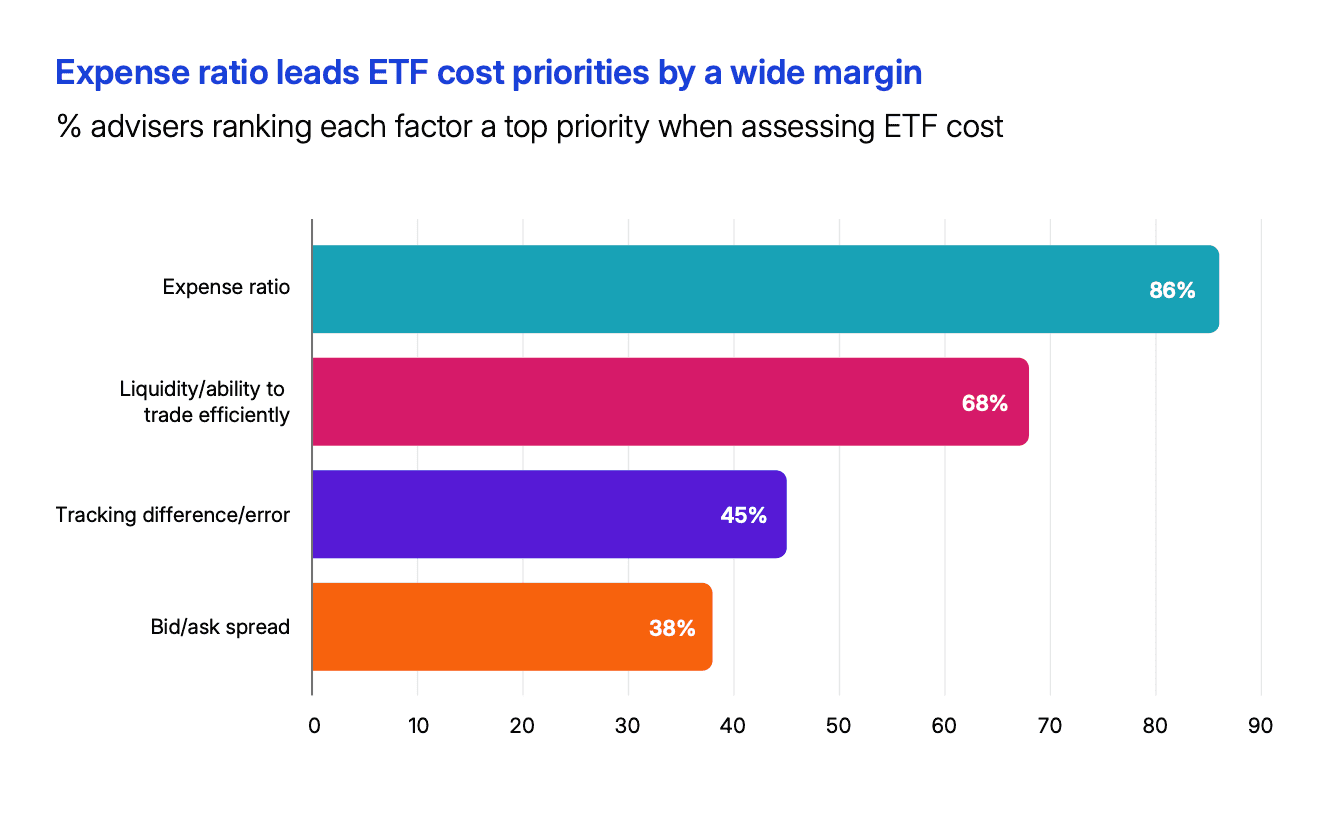
Price remains the first filter. 65% of advisers rank fees among their leading criteria when selecting between similar ETFs, while 86% rank the expense ratio as a top consideration when assessing ETF cost.
Yet the report shows a clear distinction between commoditised beta and harder-to-build exposure. Only 12% are willing to pay a higher fee for core beta. That rises to 58% for difficult-to-access exposures and 48% for thematic, active or semi-active, and alternative strategies.
Source: MSCI ETF Intelligence Report 2026.
A new S&P 500-style fund has to compete heavily on fees, spreads and scale. A locally accessible quantum, AI infrastructure, China internet or GCC Shariah strategy can justify a different fee discussion because the investor is paying partly for access.
Liquidity Is Becoming as Important as the Headline Fee
MSCI's survey also challenges the idea that ETF cost can be reduced to the total expense ratio.
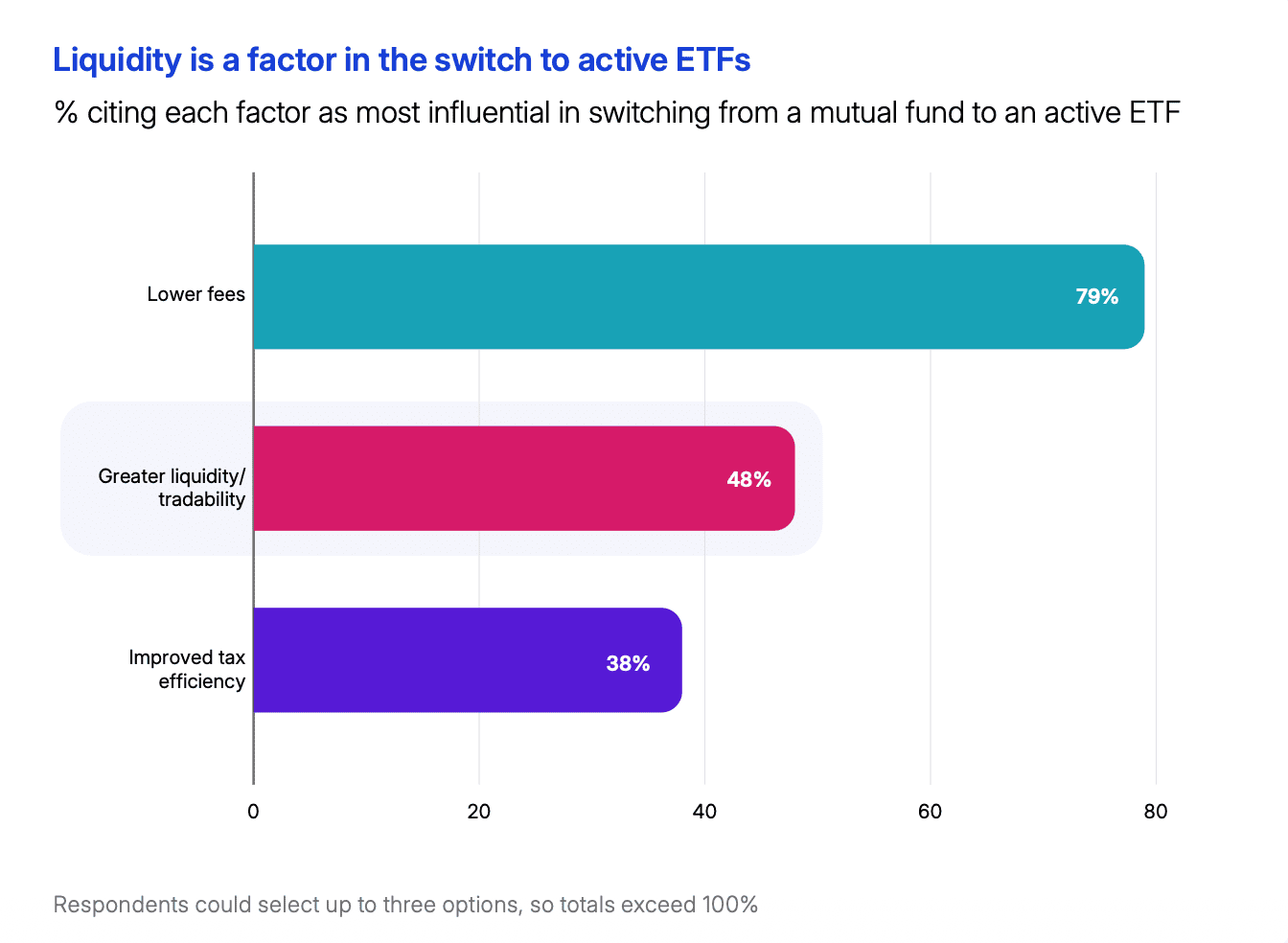
While 86% identify expense ratios as a top cost priority, 68% cite liquidity and efficient trading, ahead of tracking difference or tracking error at 45% and bid-ask spreads at 38%. Separately, 42% rank liquidity among their top three criteria when choosing between similar ETFs.
This is particularly relevant for GCC-listed ETFs, where a low management fee can coexist with relatively thin secondary-market trading. ADX has been working directly on that problem. ETF trading value reached AED155 million in Q1 2026, up 228% year on year, and the exchange removed daily price limits on ETFs from August 3 to improve price formation and liquidity. ADX had 24 listed ETFs by June 23.
Saudi Arabia's ETF market remains smaller but is also expanding. Saudi Exchange data show ETF assets of SAR9.15 billion as of September 1, with SAR86.60 million traded during August across 27,636 transactions.
Private Markets Reveal Where the ETF Wrapper Gets Tested
The sharpest tension in MSCI's report appears around private assets.
87% of respondents already invest in private or less-liquid assets, and 49% are open to accessing them through an ETF. Yet only 16% believe private markets are a good fit for an ETF structure, while 58% describe them as a poor fit.
The concern is mechanical. An ETF trades throughout the day while its underlying private holdings may trade infrequently and depend on periodic valuations. 62% identify liquidity mismatch as a concern, while 50% cite valuation transparency and pricing accuracy. Another 44% point to the lack of a track record.
Source: MSCI ETF Intelligence Report 2026.
That debate is already relevant in Abu Dhabi. KraneShares Public-Private AI & Technology ETF (AGIX) was listed on ADX in April and invests across listed AI companies and selected private holdings. As of September 17, the U.S. fund had $1.11 billion in net assets, with private holdings valued at about $47.5 million, or 4.27% of NAV, including Anthropic, Apptronik and Ayar Labs.
AGIX therefore gives GCC investors a live example of the question MSCI's respondents are debating. The ETF structure can widen access to private companies, but pricing, liquidity and valuation discipline become more important as the private allocation grows.
What the Report Means for GCC ETFs
MSCI's survey does not include GCC advisers, so its percentages should not be treated as evidence of local investor preferences. The regional relevance lies in the direction of product development.
The U.S. and Europe show a market moving toward active management, narrower themes, international exposure and harder-to-access strategies, while investors remain sensitive to fees and increasingly attentive to liquidity. The Gulf is beginning to build the product shelf needed to test many of those same ideas.
ADX has expanded to 24 ETFs, including thematic, cross-listed and Shariah products, while Saudi-listed ETF assets have crossed SAR9 billion. The next challenge is therefore less about adding ticker symbols and more about whether new funds can build sustained assets, secondary-market depth and clear differentiation.
MSCI's survey points to the same conclusion from a much larger market: investors appear willing to pay for differentiated exposure, and increasingly willing to change the investment wrapper, but liquidity, cost and structural fit still determine whether an ETF earns a lasting allocation.