


July marked a turning point for AI investing, not because artificial intelligence fell out of favor, but because investors began distinguishing between the companies building AI and those already profiting from it.
For much of the past two years, nearly every company associated with artificial intelligence moved in the same direction. Whether it was semiconductor manufacturers, memory suppliers, cloud infrastructure providers, data center operators or enterprise software companies, investors viewed AI as one broad investment theme.
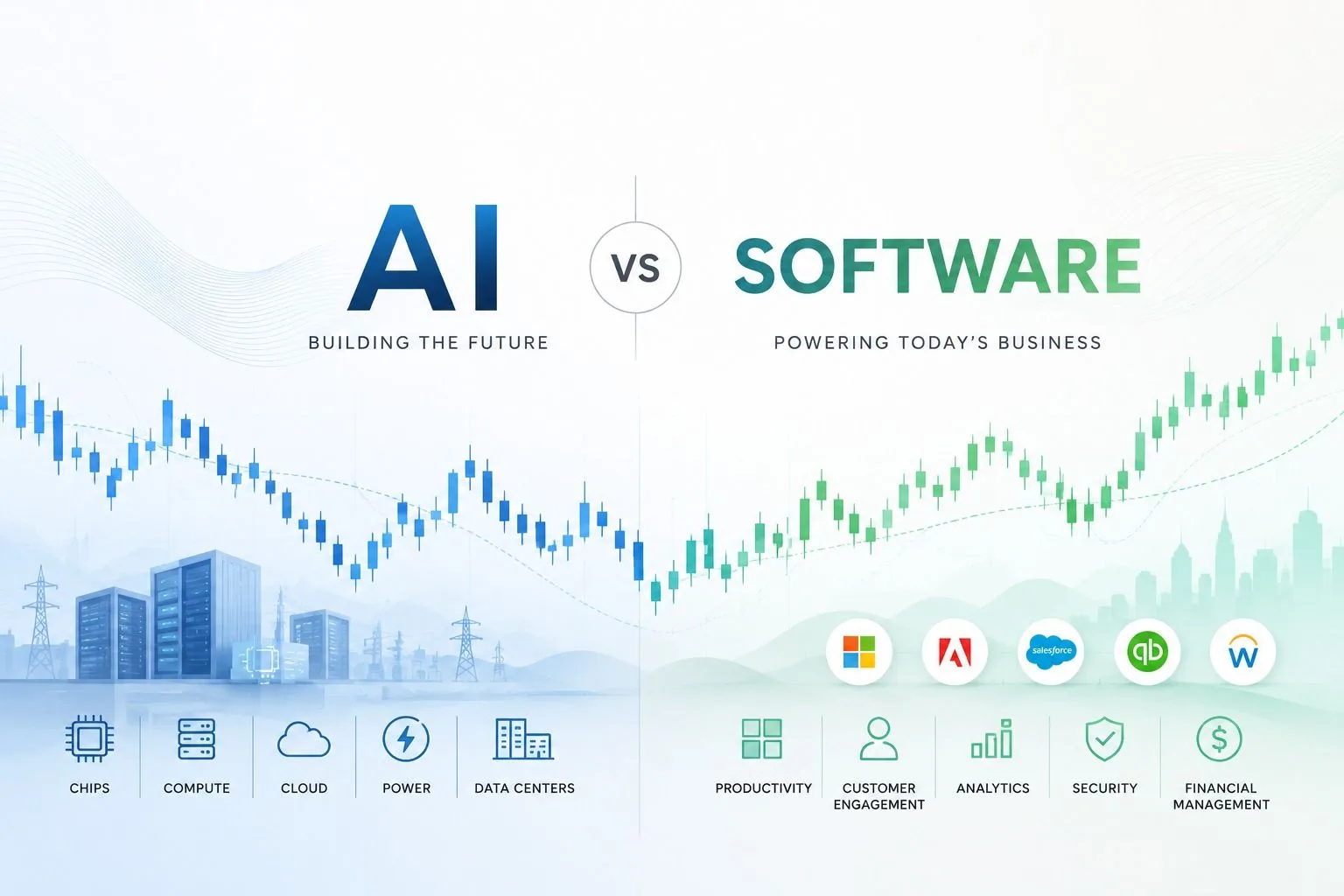
In July, instead of abandoning AI, investors rotated aggressively within the sector, moving capital away from highly capital-intensive infrastructure companies and into profitable software businesses that are successfully monetizing artificial intelligence today.
Time will tell whether this rotation proves to be a lasting trend, a dead-cat bounce, or simply a recalibration between expensive AI stocks and undervalued, cash-generating software companies. To track this shift, investors can compare the iShares AI Innovation and Tech Active ETF (BAI), which focuses on leading AI companies, with the iShares Expanded Tech-Software Sector ETF (IGV),listed in the US, and the KraneShares Artificial Intelligence ETF (Ticker: AGIX) and the Lunate Boreas Data and Infrastructure ETF (AIPOWR) listed in Abu Dhabi.
It Wasn't an AI Crash
Despite headlines suggesting AI stocks were under pressure, the broader market told a different story. The S&P 500 remained close to record highs, while the Nasdaq experienced only a modest pullback. Nvidia, widely considered the poster child of the AI boom, declined just over 5% during the period before finishing the month virtually unchanged.
The real weakness was concentrated in a specific segment of the AI ecosystem. Companies tied to AI infrastructure including memory manufacturers, compute providers, power suppliers and data-center operators experienced sharp declines.
At the same time, enterprise software companies delivered some of the strongest returns in the technology sector.
The market was sending a clear message: investors still believe in AI but they are becoming more selective about where long-term value will be created.
The AI Value Chain Is Evolving
The first phase of the AI boom rewarded companies building the infrastructure needed to train and deploy increasingly powerful models. That included chip designers, memory manufacturers, cloud providers, power companies and data-center operators.
These businesses remain essential to the AI ecosystem, but they also require enormous amounts of capital. Building AI infrastructure demands billions of dollars in investment for chips, networking equipment, electricity and data centers, placing pressure on free cash flow even as revenues continue to grow.
The next phase of AI investing appears increasingly focused on businesses that are already converting those investments into recurring revenue. Enterprise software companies occupy that position. Rather than competing against AI, many of these businesses are embedding generative AI directly into products that millions of customers already use every day.
AI Is Becoming an Upsell, Not a Threat
Only a year ago, many investors believed generative AI would replace traditional software companies. Recent earnings suggest the opposite may be happening.
Microsoft continues expanding Copilot throughout Microsoft 365 and Azure.
Adobe has integrated Firefly AI across Creative Cloud.
Salesforce continues rolling out AI agents through Agentforce.
These companies already have established customer relationships, recurring subscription revenues and mission-critical software embedded throughout global enterprises. Instead of losing customers to AI, they are using AI to increase the value of their existing platforms while generating higher recurring revenue. For many businesses, replacing enterprise software is not simply a technological decision it is an operational, regulatory and financial challenge.
This creates significant switching costs that continue to support the competitive position of established software providers.
Infrastructure Still Matters
The recent market rotation should not be interpreted as the end of AI infrastructure spending. Global technology companies continue investing hundreds of billions of dollars annually in new data centers, networking equipment and computing capacity. However, history suggests that businesses requiring enormous capital investment do not always generate the highest shareholder returns. Large infrastructure projects often experience increasing competition, pricing pressure and declining returns as capacity expands.
Meanwhile, businesses that own customer relationships, software ecosystems and recurring revenue models frequently capture a greater share of long-term economic value. The AI investment landscape may be following a similar path.
What is July Reminding Investors?
For ETF Investors, these ETFs are worth tracking: BAI and AGIX that track the leading AI companies globally and which suffered in July. AIPOWR which tracks the AI Infrastructure companies, and IGV, which tracks the leading software companies like Adobe and Salesforce outperformed the AI ETFs in July.
July suggest that AI may not be a single investment theme. Different parts of the AI value chain can perform differently depending on where investors believe future profits will be generated. The recent rotation may simply reflect a recalibration between high-flying AI stocks and undervalued software companies.
Infrastructure-focused ETFs like the Lunate Boreas and Data Infrastructure ETF (AIPOWR) listed on the Abu Dhabi Stock Exchange, provide exposure to the companies building the foundation of artificial intelligence, including semiconductors, memory, compute and power.
Software-focused strategies offer exposure to businesses integrating AI into enterprise applications and generating recurring revenues from adoption. IGV ETF is a great way to get exposure to cash flow generating software companies.
Both segments remain important, but they are increasingly driven by different investment fundamentals. Understanding where an ETF sits within the AI value chain is becoming just as important as having AI exposure itself. Until the picture becomes clearer, investors may benefit from maintaining exposure to both segments.
The Nukoud View
Artificial intelligence remains one of the defining investment themes of this decade. What changed in July was not investor confidence in Ai, it was investor expectations regarding where future returns will be generated. The first phase of the AI rally rewarded companies building the infrastructure. The next phase may increasingly reward businesses that transform that infrastructure into recurring revenue, strong cash flows and sustainable profitability.
For investors, the AI opportunity is becoming more sophisticated. Rather than choosing between infrastructure and software, diversified exposure across the AI ecosystem may provide a more balanced way to participate in one of the most significant technological transformations of our time.