
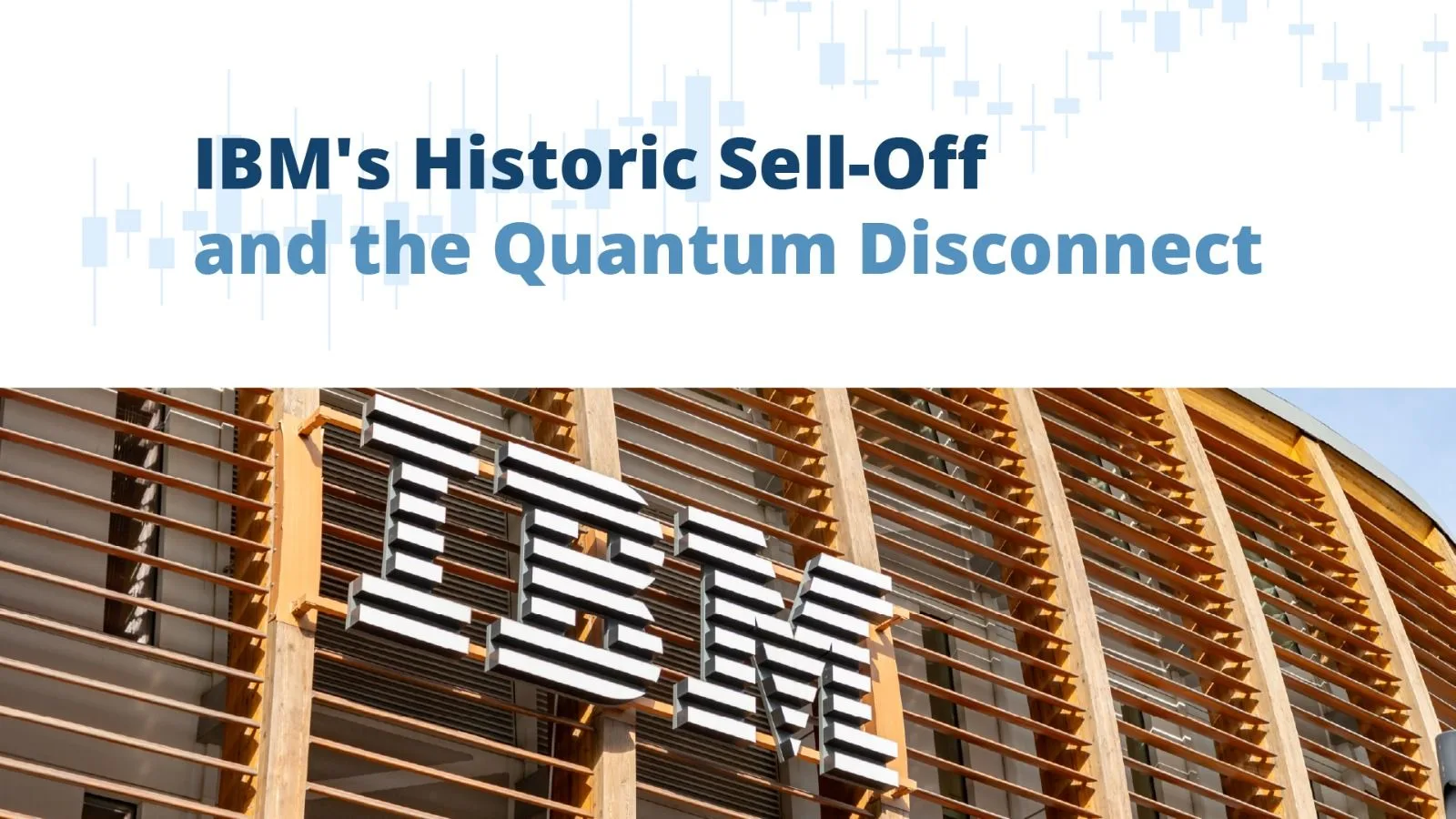
International Business Machines (IBM) just suffered its worst trading day in nearly six decades. Yet its quantum computing ambitions shaped both the optimism that preceded the sell-off and the long-term narrative management is now using to rebuild investor confidence. On July 14, 2026, IBM shares plunged as much as 26% intraday after the company pre-announced weaker-than-expected preliminary second-quarter results, wiping out roughly $70 billion in market value in a single session. Weeks earlier, a separate quantum-related announcement had helped lift IBM's market value by an estimated $26 billion, highlighting the disconnect between long-term quantum optimism and near-term earnings reality.
The Biggest One-Day Decline in IBM's History
IBM opened sharply lower and touched an intraday low before paring losses into the close. The move ranks as the steepest single-day decline in IBM's trading history, surpassing the 23.7% drop of Black Monday, October 19, 1987, and the worst since exchange records began in 1968.
Return profile as of July 14, 2026:
The Drivers of IBM's Weak Quarter
The trigger was an unscheduled letter from CEO Arvind Krishna, released before the market open and ahead of IBM's scheduled July 22 earnings call, disclosing preliminary Q2 figures that missed consensus by a wide margin.
By segment, Software grew 5% (Red Hat up 11%), and Consulting was roughly flat. The damage was concentrated in Infrastructure, which fell 7% as IBM lapped last year's z17 mainframe launch. Krishna attributed the shortfall to three compounding issues:
AI infrastructure crowding out software budgets, clients redirected quarterly capex toward servers, storage, and memory (DRAM/HBM) in the final weeks of June to lock in supply-constrained hardware ahead of expected price increases.
Execution failures: "Numerous large deals failed to close on the timelines we expected," Krishna said, admitting IBM underestimated the scale of the capex reprioritization.
Caught between two worlds, IBM is neither a hyperscaler capturing the AI infrastructure boom nor immune to it, leaving core Red Hat, consulting, mainframe, middleware, and enterprise software lines exposed to the same spending pullback.
Krishna also pointed to rapidly evolving cybersecurity concerns that distracted customers during the quarter and contributed to delays in software spending. Separate market reports linked some of those concerns to Anthropic's Mythos model, although IBM did not identify it specifically.
Market Reaction: An IBM Problem, Not a Macro One
The broader market remained resilient, with the Nasdaq Composite rising about 1% on the day following softer-than-expected inflation data. That suggested investors viewed IBM's sell-off as company- and sector-specific rather than a broader signal for the technology sector.
HSBC had cut IBM to Reduce from Hold the day before (July 13), lowering its target to $191 from $231 on valuation grounds, a call that predated the warning but landed in the same news cycle and amplified the sell-off's narrative.
Where Does Quantum Actually Fit In?
Quantum computing sits on both sides of IBM's July. In the weeks before the crash, IBM shares had rallied roughly 11%, adding about $26 billion in market value after the US Commerce Department detailed a $2 billion CHIPS and Science Act initiative for domestic quantum computing. IBM secured the single-largest allocation: a $1 billion federal grant matched by $1 billion of its own capital to build "Anderon," billed as America's first dedicated 300mm quantum chip manufacturing foundry, in Albany, New York. Analysts continue to frame quantum as a long-term, multibillion-dollar opportunity. According to Evercore ISI, IBM's cumulative quantum "book of business" already exceeds $1 billion and continues to grow each quarter, while the firm estimates quantum computing could generate up to $850 billion in economic value by 2040.
In the July 14 letter itself, Krishna leaned on quantum again, this time as reassurance rather than catalyst, reaffirming IBM's plan to invest $10 billion over five years to deliver "Starling," pitched as the first large-scale, fault-tolerant quantum computer, by 2029.
The tension is straightforward: quantum revenue is not going to show up in a Q2 income statement. It is, as several analysts have put it, a distant remedy for an immediate crisis, a long-dated call option on future computing demand that cannot offset a capex-driven software slowdown happening right now. So "IBM down 26%? It's part of quantum" cuts both ways: quantum optimism helped inflate the stock into the crash, making the drop look steeper by comparison, and quantum is now the forward-looking story management is using to rebuild confidence without changing the fact that this quarter's miss is about AI-hardware spending crowding out software, not about quantum's progress.
The Bottom Line
IBM's full second-quarter report on July 22 should clarify three open questions: whether Software and Red Hat momentum reasserts itself, how large the pipeline of slipped deals actually is, and whether the infrastructure pullback was a one-quarter air pocket or the start of a structural shift toward AI hardware. Until then, most sell-side commentary is urging caution on position sizing rather than conviction in either direction. What is reasonably clear: this is a customer-spending and execution story first, and a quantum story only at the margins. Quantum remains too far from commercialization to rescue the current quarter, even as it anchors IBM's longer-term pitch to investors.