

A couple of weeks ago, I had the pleasure of meeting Mazen Wathaifi, CEO of the Amman Stock Exchange (ASE). Our conversation gave me a fresh perspective on Jordan’s capital market and inspired me to explore it further and share what I learned here.
The Amman Stock Exchange (ASE) is a mature frontier cash-equities market: credible regulation, central securities depository and exchange infrastructure, an established listed base, and unusually high non-Jordanian ownership; but still too small, concentrated and intermittently liquid to qualify as an emerging market. Its 2025 rebound was exceptional; the priority now is to convert that cyclical momentum into durable, free-float-adjusted liquidity and a larger investable universe.
Market architecture
ASE should not be viewed as a single, undifferentiated “main market” in the manner of some GCC exchanges. Its cash-equity ecosystem combines a Regular Market, classified into First and Second Market segments, with an OTC/Unlisted Securities Market, a restricted-trading regime for specified compliance breaches, and listed debt and rights-issue instruments.
Since October 2025, ASE has introduced an important refinement: Restricted Trading. Rather than automatically transferring certain non-compliant issuers to OTC, ASE may suspend trading and then permit trading to resume, subject to restrictions determined by the ASE Board, within the company’s existing First or Second Market classification. The regime can apply to, among other cases, late financial reporting, rejected financial statements, insolvency proceedings or appearance on the Companies Control Department’s suspended-companies register.
|
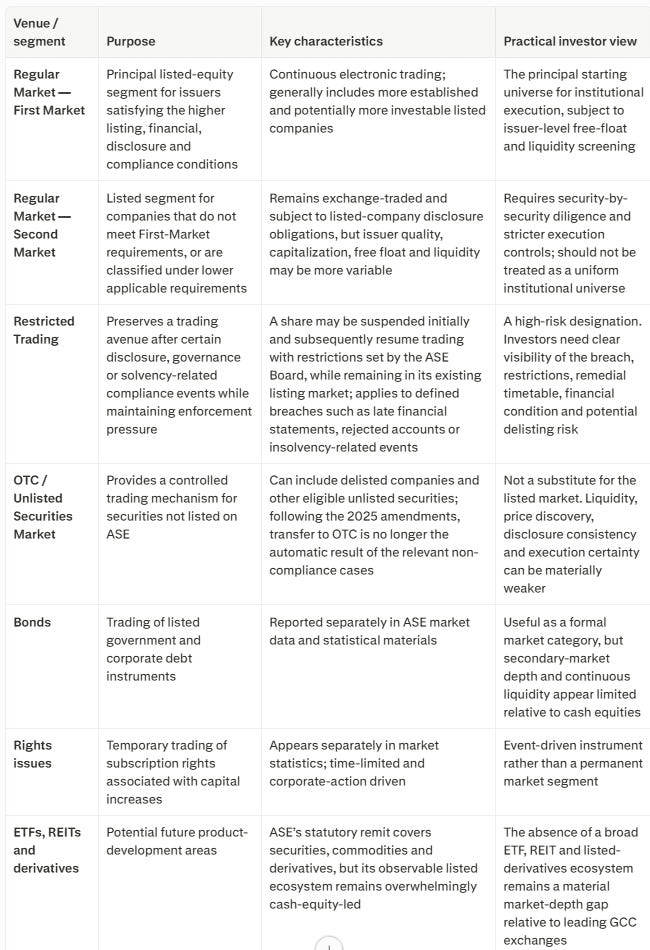
The present architecture therefore distinguishes between listing status and compliance status. First and Second Market determine the issuer’s regular listed-market classification; Restricted Trading is a compliance and investor-protection overlay; and the OTC Market is principally a venue for unlisted securities rather than a routine destination for companies that miss a disclosure deadline. This distinction matters for institutional investors because a company’s exchange segment alone does not reveal its current trading eligibility, disclosure standing or execution risk.
From a market-development perspective, the 2025 Restricted Trading reforms are constructive. They aim to preserve an investor exit mechanism while avoiding automatic migration of affected companies into a less transparent OTC environment. The credibility of the approach will depend on timely issuer disclosure, visible trading flags, clearly defined restrictions and cure periods, disciplined escalation for persistent breaches, and a transparent record of issuers returning to full compliance
Listed instruments and liquidity
ASE’s listed universe is predominately ordinary shares. It had 159 listed companies reporting audited 2025 accounts, compared with 162 shares traded in 2024. The market spans financials, services and industrials, with financials structurally dominant in turnover.
Instrument mix
|
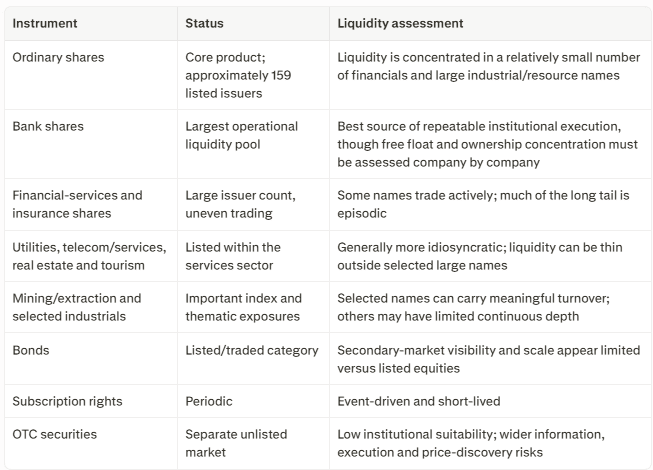
The 2025 turnover profile shows why liquidity is the central issue.
Financials generated approximately JD 892.5 million of trading value, including JD 643.8 million in banks, out of total annual exchange trading of roughly JD 2.17 billion.
In other words, the exchange’s most executable segment is bank-led, while much of the rest of the issuer base remains relatively thin.
Liquidity is meaningful at the exchange level but not broad enough for large international allocations. Annual trading value was JD 2.165 billion in 2025, equivalent to roughly JD 8.7 million per trading day assuming 250 trading days; that is a significant improvement from 2024 but modest for global emerging-market mandates.
The ASE General Index, free-float weighted, rose 45.1% in 2025, while ASE20 rose 47.2%, which likely improved domestic risk appetite and turnover but also sets a demanding valuation base for the next period.
Liquidity profile by investability tier
|
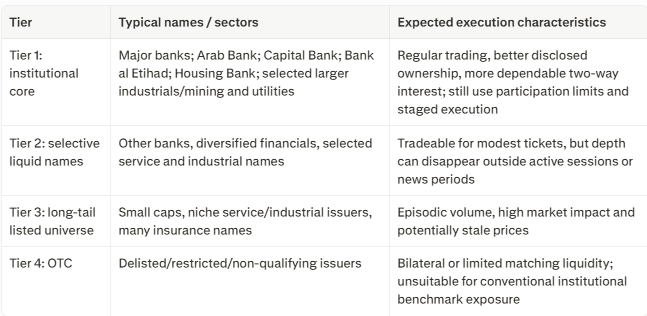
The relevant operating conclusion is that ASE should be treated as a basket of liquid names surrounded by a large illiquid tail, not as 159 equally investable securities. A portfolio manager should impose name-level screens for average daily value traded, trading days, free float, foreign-ownership headroom, settlement reliability and corporate-action risk before treating a share as executable.
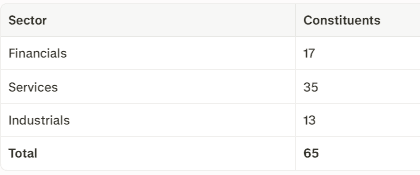
Now , the ASEGI captures 97% of the free float with its 65 components.
|
Free float and ownership
ASE uses a technically sound free-float-adjusted index methodology. For index purposes, it defines free float as listed shares less shares held by directors, investors owning more than 5%, and government ownership; the resulting free-float factor is reviewed at rebalancing. Individual constituent weights are capped at 10%, preventing the ASE index from being dominated by one very large issuer. I personally like this method!
This is important: non-Jordanian ownership is not the same as free float. A foreign strategic investor, parent company or state-related entity can hold stock but not provide available trading float.
|
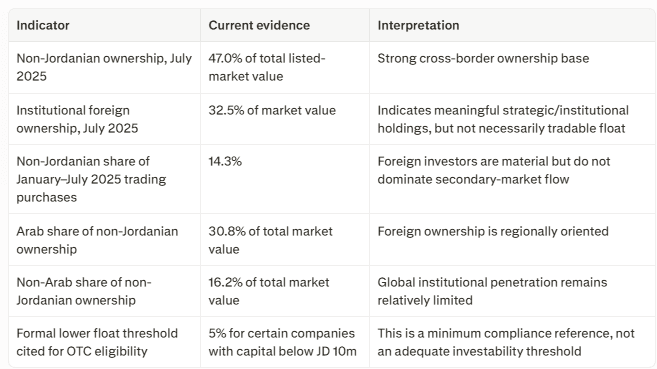
High foreign ownership in financials and industry - 49.1% and 51.8%, respectively, as at July 2025 - suggests that parts of ASE are already internationally held. But potentially restrictive blocks, family/group holdings, government stakes and thin public float reduce the portion of total market cap available for index funds and active foreign managers to buy without price impact.
Free-float policy implications
ASE should publish a regular, machine-readable issuer-level dataset showing:
Total issued shares and free-float shares.
Free-float-adjusted market capitalization.
Domestic institutional, domestic retail, Arab institutional, Arab retail and non-Arab ownership.
Strategic/government/insider holdings and foreign-ownership headroom.
Three-, six- and twelve-month average daily value traded.
Percentage of trading days with no trade, bid–ask spread and order-book depth.
This would transform “market capitalization” into an investability measure that index providers and institutional allocators can actually use.
Mature-frontier status
“Mature frontier” is the correct description, provided it is not confused with an emerging market classification.
|
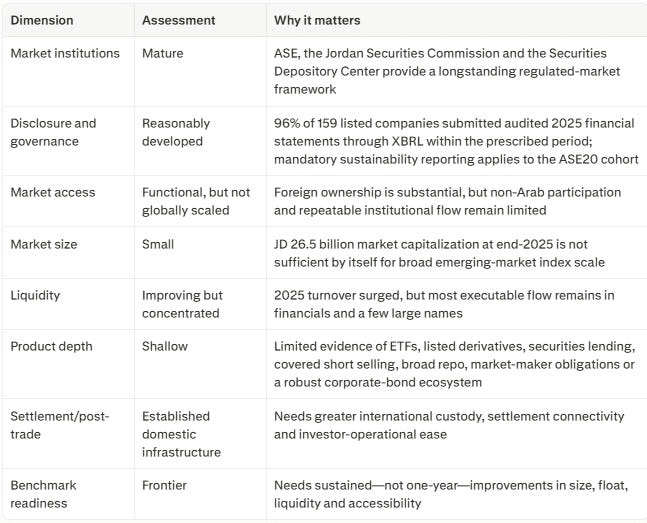
ASE’s 2025 result was remarkable: market capitalization increased 50.1% to about JD 26.5 billion, its highest year-end level since 2007. That performance supports a mature-frontier narrative but does not, by itself, satisfy MSCI or FTSE requirements. Index providers require a durable population of sufficiently large, liquid, free-float-adjusted securities, alongside low-friction foreign access and predictable institutional execution.
Path to developing market
Strictly speaking, no Amman-listed company can currently be said to “satisfy MSCI Emerging Markets criteria” on its own. MSCI classification is both market-level and security-level, and Jordan remains a frontier market with material operational-access issues. For FTSE Secondary Emerging eligibility, the current public data do not provide enough same-date free-float market-cap and liquidity data to certify any individual ASE issuer; the most plausible candidates are the largest, most liquid names below.
|
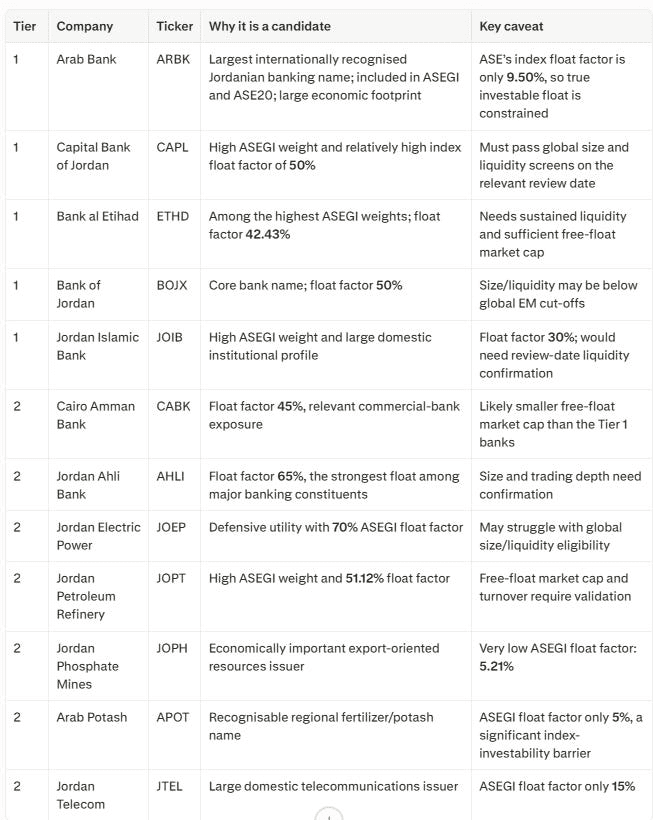
The figures in the table are ASE’s current Q3 2026 free-float-related index factors, which also incorporate the effect of the index’s 10% individual-weight cap. They are not necessarily raw corporate free-float percentages. Still, they are a useful first-pass indication of which names have potentially investable ownership structures.
Assuming “developing market” means emerging-market-class capability, not a formal guarantee of FTSE Russell or MSCI reclassification, ASE needs a coordinated 5–7 year program. A credible target is to become a stronger frontier-plus / pre-emerging market by 2030–31, with a formal emerging-market upgrade being a stretch objective rather than a promise.
Years 1–2: make liquidity measurable and executable
Publish an institutional liquidity dashboard at issuer level: ADV, median spread, depth at best five levels, days traded, turnover velocity, free float, foreign headroom and securities-lending eligibility.
Introduce a formal market-maker regime for a defined eligible universe, initially the 15–25 most liquid shares. Obligations should include maximum spreads, minimum displayed size, minimum presence, auction participation and transparent rebates/fee incentives.
Redesign trading economics around liquidity: maker–taker or tailored market-maker incentives, lower costs for displayed liquidity, institutional block-trade and negotiated-trade facilities, and efficient closing auctions.
Establish securities lending and borrowing, regulated covered short selling and a central collateral model. These are essential for hedging, price efficiency and genuine two-sided institutional flow; they should start with liquid equities and conservative borrowing limits.
Standardize investor operations: English-first disclosures, XBRL data APIs, corporate-action timetables, beneficial-owner/custody procedures and an investor-relations code aimed at foreign institutions.
Years 2–4: build the investable universe
Increase free float through secondary sell-downs, not merely new primary issuance. Encourage government-related entities, founders and strategic owners to sell meaningful stakes in already listed and newly listed companies.
Set a quality threshold for new principal-board listings: ideally 15–25% true public float, a sufficient number of public shareholders, audited IFRS track record, governance quality, and a credible liquidity plan. Formal rules need to reflect Jordan’s issuer base, but the goal should be a materially larger float than bare legal minima.
Create an SME/growth board with a clear graduation path, nominated advisers, proportionate disclosure and investor safeguards—rather than using the Second Market as a catch-all. This can produce future principal-board candidates while protecting the integrity of the institutional segment.
Target 8–12 larger new listings across five years, especially in telecom/digital infrastructure, renewable power, logistics, healthcare, education, tourism, food, pharmaceuticals, export manufacturing and private financial-services platforms.
Develop listed funds and ETFs: a Jordan broad-market ETF, a Jordan dividend/banks ETF, Shariah-compliant ETF, fixed-income/sukuk fund and possibly a regional Jordan/GCC thematic product. ETFs need authorized participants, market makers and transparent creations/redemptions—not just listing.
Build a credible local-currency debt and sukuk curve. Sovereign benchmark issuance, repo, central-bank coordination and market-makers would provide collateral, duration instruments and a foundation for corporate issuance.
Years 4–7: create international relevance
Improve international post-trade connectivity through global custodians, clearer omnibus-account structures, standardized tax documentation and potentially an international CSD/custody link where economically viable.
Pursue cross-exchange order-routing and dual-listing arrangements, starting with ADX and selected GCC markets. The 2026 electronic link with ADX is a useful foundation, but it should be expanded into viable broker connectivity, shared investor education, corporate access and custody workflows.
Create derivatives only after cash-market depth is credible. The first instruments should be simple, centrally cleared and tightly risk-managed: ASE20 futures, liquid single-stock futures, and potentially currency/interest-rate hedges where legal and economic conditions support them. Launching options before underlying cash liquidity and securities lending exist would likely fragment, rather than deepen, the market.
Run an annual FTSE/MSCI gap assessment, published transparently, against size, free-float-adjusted market cap, securities-count, liquidity, foreign room, settlement, registration and competition criteria.
Build domestic institutional demand. Encourage pension funds, insurers, mutual funds and professionally managed retail savings products to allocate through transparent mandates. A large, steady domestic institutional bid is what makes market-making and primary issuance self-reinforcing.
Measurable 2031 targets
|
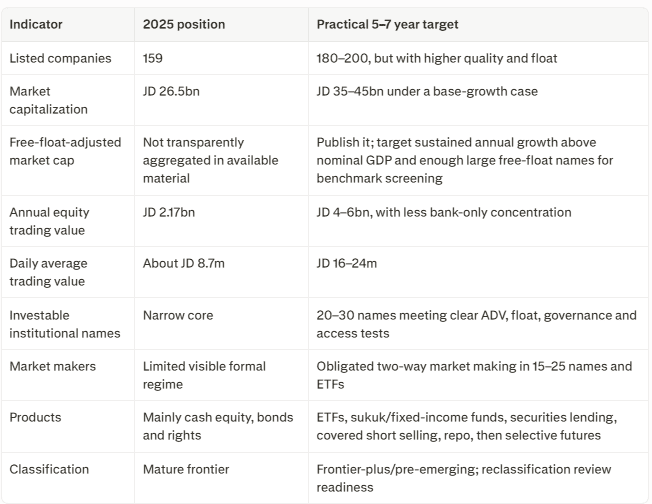
These targets should not be interpreted as a guaranteed MSCI Emerging Markets promotion. Index providers use relative thresholds that change with global market size and benchmark composition. However, meeting them would make ASE more investable regardless of its eventual label.