
Qatar’s liquefied natural gas exports have suffered an extraordinary disruption, but the shock is much less visible in the country’s equity ETFs. The reason is structural. QatarEnergy dominates the country’s LNG business, yet the state-owned company is absent from the listed equity market and therefore from the ETFs investors use to gain Qatar exposure.
Qatar exported only 18 LNG cargoes during the six months since the U.S.-Iran war began, compared with 509 in the same period a year earlier, according to ICIS data reported by Reuters on August 26. That 96% collapse cost Qatar an estimated $24 billion in gas sales, equivalent to roughly five months of national income based on 2025 figures. Before the conflict, Qatar supplied close to 20% of global LNG.
Yet the U.S.-listed iShares MSCI Qatar ETF, QAT recorded a NAV total return of only minus 5.80% year to date through August 24. QAT held $59.3 million across 33 securities on the same date.
The ETF Owns Qatar’s Banks, Not QatarEnergy
QAT tracks the MSCI All Qatar Capped Index, so its portfolio reflects Qatar’s investable listed market rather than the structure of the national economy. Financial companies represented 56.89% of the portfolio as of August 20.
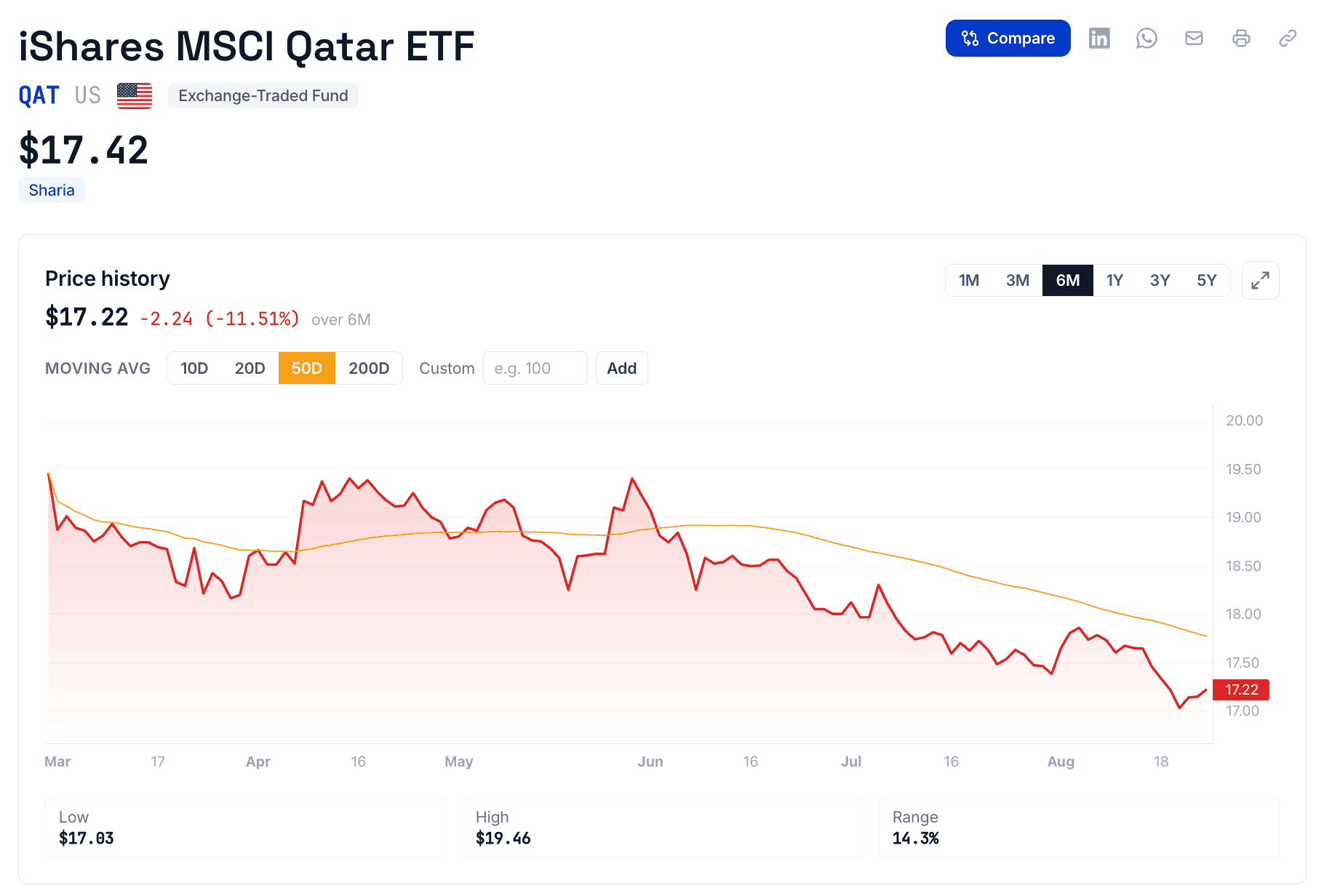
Qatar National Bank was the largest holding at 21.60%, followed by Qatar Islamic Bank at 14.93% and Industries Qatar at 6.17%. Qatar Gas Transport Company, or Nakilat, which operates LNG carriers, represented just 4.37%. QatarEnergy itself has no direct weight because it is not publicly listed.
iShares MSCI Qatar ETF Top 10 holdings
Source: Morningstar
That composition goes a long way toward explaining why a $24 billion LNG sales shock and a single-digit ETF decline can coexist.
Qatar’s Local ETFs Offer Different Versions of the Market
QAT is only one route into Qatari equities. The Qatar Stock Exchange also has two locally listed ETFs whose construction changes the exposure again.
QETF, founded by Doha Bank, tracks the QE Index and holds constituents according to their index weights. Doha Bank identifies QNB, Industries Qatar, Qatar Electricity & Water and Ooredoo among the portfolio’s major names. Its total expense ratio is capped at 0.50%.
The locally listed Al Rayan Qatar ETF, QATR, provides Shariah-compliant exposure instead. Its benchmark excludes companies that fail its Islamic screens, changing the weight given to banks and other sectors relative to QETF and QAT.
The common feature is more important in the current environment. None of the three ETFs directly owns QatarEnergy. Investors instead receive the second-order effects of Qatar’s hydrocarbon economy through banks, industrial companies, utilities, transport businesses and other listed equities.
Lower LNG receipts can still reach those companies through government spending, banking liquidity, investment and economic activity. The transmission, however, is indirect.
That makes Qatar a particularly useful example of the limits of country ETFs. The $24 billion LNG shortfall measures damage to the country’s dominant export industry, while QAT, QETF and QATR measure the performance of different baskets of publicly investable companies. For investors, understanding what sits inside the wrapper can matter as much as the country name printed on it.