
In July 2026, LQD, the iShares iBoxx $ Investment Grade Corporate Bond ETF, fell 2.58% through July 24. The iShares high yield fund, HYG, fell 0.93% over the same stretch.
The higher-rated fund lost more, which can be misleading until you check duration. Nukoud's explainer on why bond and sukuk ETFs fall when interest rates rise walks through it, and it is a good place to start when comparing sukuk ETFs vs bond ETFs.
Where the Structure Differs
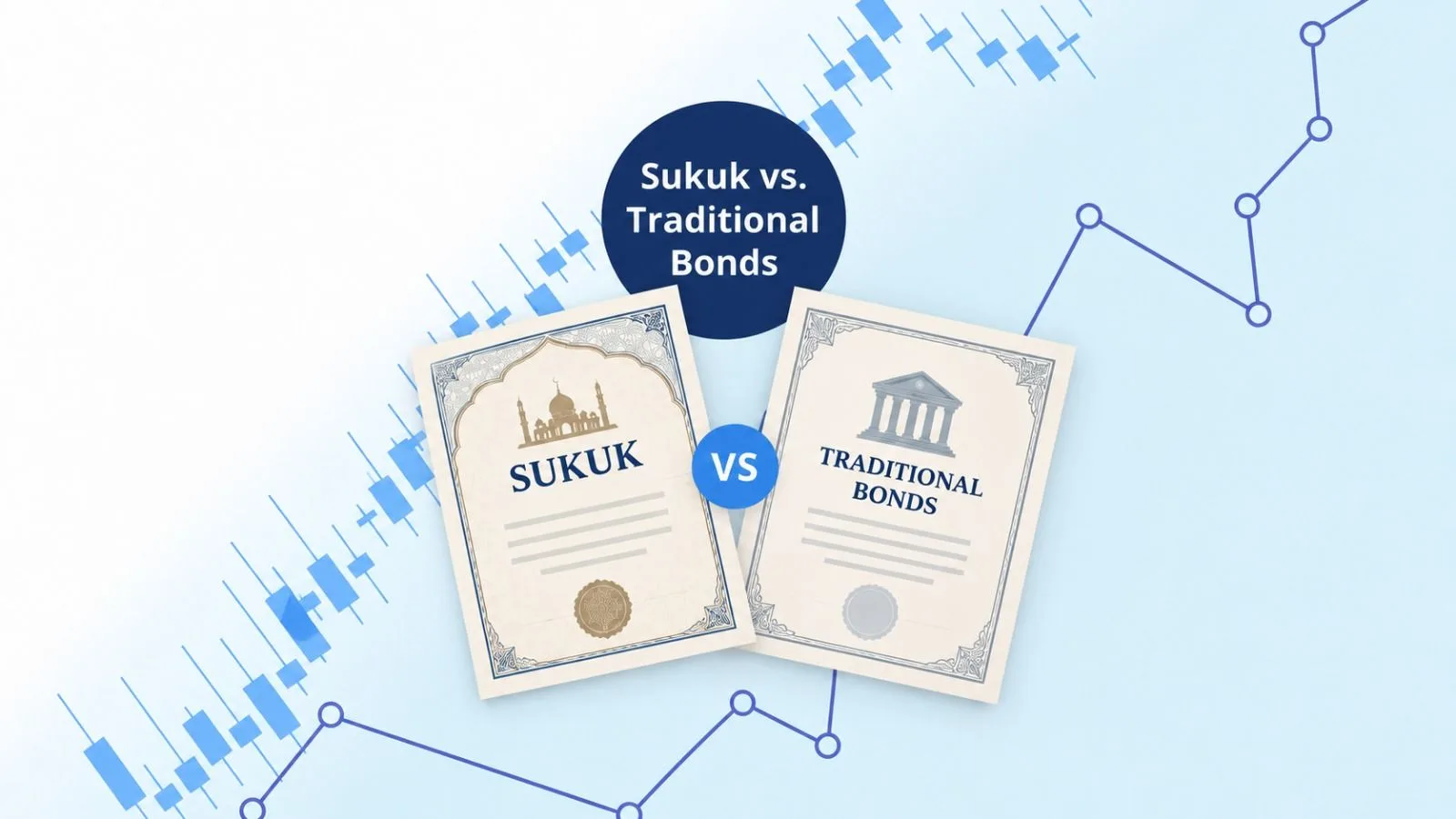
Conventional bonds usually pay fixed coupons until maturity. Many sukuk make periodic distributions based on profit-sharing, rental income, or other approved structures, and may rest on asset ownership or lease income rather than an interest-bearing loan.
A traditional bond or sukuk ETF, either way, has no single maturity date. It replaces holdings to keep a target duration or maturity profile.
On price risk, the two behave alike. Prices generally move opposite to yields, and duration estimates how much. The explainer's rule of thumb: for a one-point rise in yield, a fund with a 2-year duration could lose approximately 2%, a 5-year fund about 5%, an 8-year fund about 8%, and a 12-year fund about 12%. That excludes income, spread changes, fees, and convexity.
Its SEC-based example makes the point: a 10-year security with a 3% coupon drops from $1,000 to about $925 when market yield rises to 4%, and the issuer has not necessarily become less creditworthy.
LQD fell more than HYG mainly because of its longer duration, longer maturity, and lower coupon income. Its weighted average maturity is 12.83 years against 3.88 for HYG, and its weighted average coupon is 4.59% against 6.60%. HYG is not the safer fund, though.
The explainer notes that its issuers have weaker credit and more refinancing pressure.
What About Yield?
The Lunate JP Morgan Global Sukuk ETF, listed on ADX, shows an average yield to maturity of 4.91%. LQD's 30-day SEC yield is 5.44%, and HYG's is 6.51%. These are different measures, so treat them as a rough guide only. Income softens losses but doesn't stop price declines, though longer-term holders may benefit as the portfolio gradually rolls into higher-yielding securities.
For halal ETF yield beyond sukuk, Nukoud's GCCDIV coverage puts the index's indicative dividend yield behind Lunate's Shariah dividend ETF at 6.2% as of 8 May 2026, and says it is not guaranteed.
KWIN targets about 5% a year through options rather than sukuk or dividends, and that is a target, not a guarantee. Both draw income from equities, so their risk profile differs from that of a sukuk fund.
The GCC Sukuk Market
Nukoud's report on GCC sukuk markets, using Fitch data, says liquidity has weakened since the Iran conflict began. Fitch uses Bloomberg liquidity scores that run from 1 to 100. As of 23 March, 64% of Fitch-rated sukuk scored above 50, down from 82% in January 2025, and speculative-grade sukuk lost 15 points, nearly double the drop for investment-grade sukuk.
Across 52 sukuk-bond pairs from the same issuers, liquidity was similar in 50% of cases; sukuk were less liquid in 31% and more liquid in 19%. The report's conclusion: "The key variable is not the instrument type; it is issuer quality." Mohammad Nikkar of Arthur D.
Little Middle East put it this way: "The ongoing Iran conflict has paused but not broken GCC debt capital markets. This is not a liquidity crisis."
Sharia Compliance in Practice
Nukoud's guide to 79 Islamic ETFs tells investors to check the screening rules, the Shariah methodology, and whether qualified scholars reviewed the structure, custody, and trading mechanism. Islamic fixed income ETFs are a thin category: the guide calls fixed income "one of the weakest parts of the universe."
The sukuk theme lists eight Shariah-compliant sukuk ETFs: three listed in the UK, two in Saudi Arabia, two in the UAE and one in the US. Expense ratios on the theme page range from 0.40% to 0.75%.
Domicile and Listing
According to the explainer, US-listed bond ETFs may expose non-US investors to withholding and possible US estate-tax issues, while Irish UCITS funds can produce different tax and succession outcomes.
Locally listed sukuk ETFs may simplify UAE settlement and custody, though spreads, volume and market-maker support need checking.
Frequently Asked Questions
How Do Sukuk ETFs Generate Income Without Paying Interest?
Many sukuk make periodic distributions based on profit-sharing, rental income, or other approved structures, and may rely on asset ownership or lease income rather than an interest-bearing loan. Income can soften a price fall, but it does not prevent one when yields rise.
Why Do Sukuk and Bond ETFs Fall When Interest Rates Rise?
Prices generally move opposite to yields. In Nukoud's SEC-based example, a 10-year security with a 3% coupon drops from $1,000 to about $925 when market yield rises to 4%, even though the issuer has not necessarily become less creditworthy.
What Is Duration, and Why Does It Matter for Sukuk ETFs?
Duration estimates the price change for a move in yield. By Nukoud's estimate, the Lunate JP Morgan Global Sukuk ETF, with a 4.68-year duration, could lose about 4.7% for a one-point rise in yield.
How Many Sukuk ETFs Can I Choose From?
Nukoud's sukuk theme lists eight, all Shariah-compliant: three listed in the UK, two in Saudi Arabia, two in the UAE and one in the US.
Before You Pick
The explainer's checklist is effective duration, yield to maturity, average maturity, credit quality, credit spread, distribution yield, expense ratio, domicile, Sharia governance, and currency exposure. Many global sukuk are USD-denominated or priced off dollar benchmarks, which ties valuations to Federal Reserve expectations.
Its closing lesson: "Over a day, month or quarter, duration can matter more than the label attached to the security."
In the ETF Screener, filter by bond type, then put up to four funds side by side in Compare ETFs.