
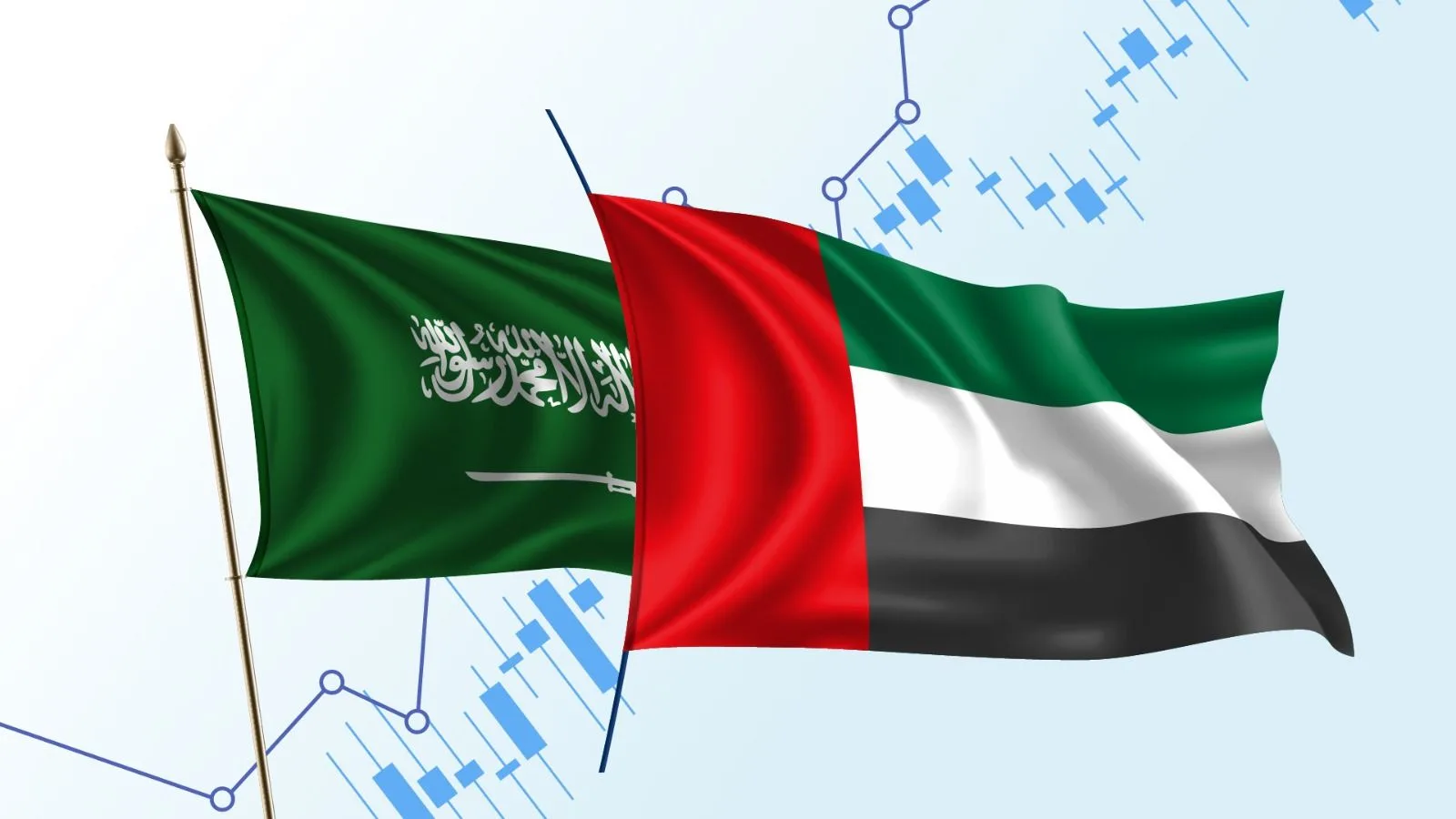
Economic diversification remains a key theme across the Gulf Cooperation Council (GCC), as regional economies expand activities beyond oil and gas. Saudi Arabia has reported a milestone under Vision 2030, with non-oil activities accounting for 55% of GDP for the first time. Meanwhile, the UAE’s latest economic data highlights the contribution of non-oil sectors to national output, alongside signs of weaker near-term growth. These developments offer investors insight into the changing structure of GCC economies and the sectors worth monitoring. For further context, readers can explore the latest GCC Market Monitor.
Saudi Arabia's Non-Oil GDP Reaches 55% Under Vision 2030
Deputy Minister of Finance Abdulmohsen Al-Khalaf says non-oil activities account for 55 percent of Saudi GDP for the first time. He made the remarks at the World Petroleum Congress in Riyadh and described the shift as structural, linked to progress since the launch of Vision 2030. The source gives no reporting period, so the 55 percent figure is an official statement rather than a dated statistical release.
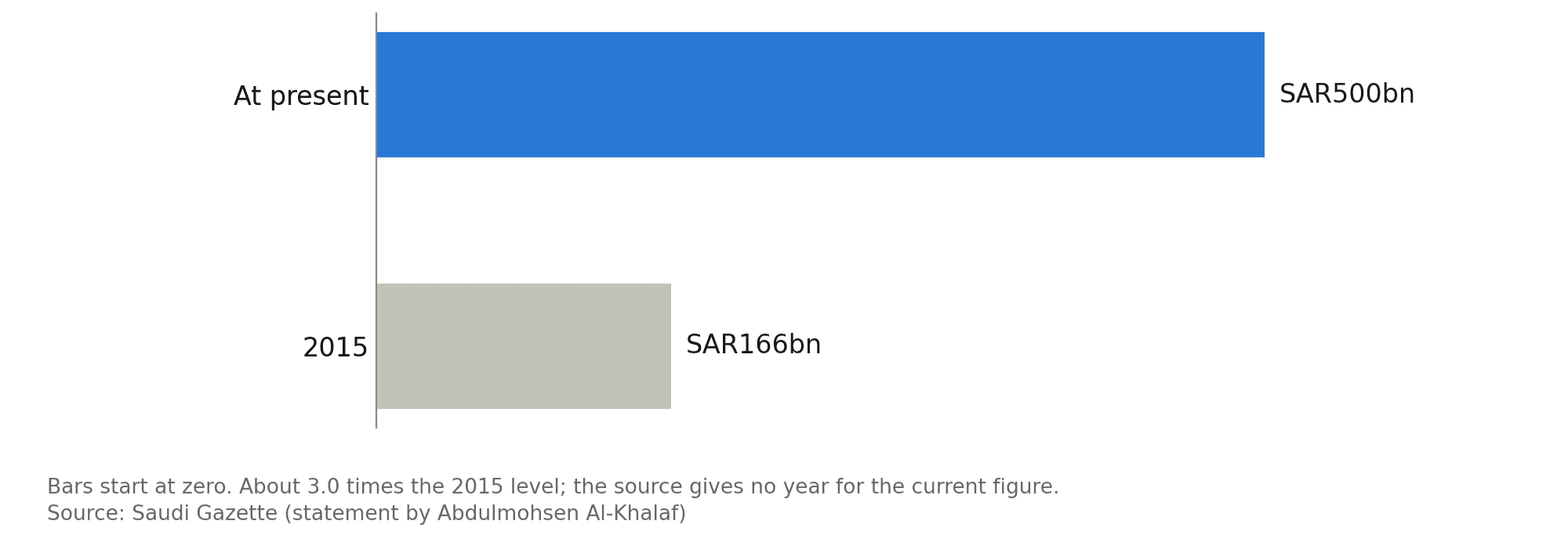
Al-Khalaf adds that non-oil government revenues rise from approximately SAR166 billion ($44.3 billion) in 2015 to around SAR500 billion ($133.3 billion) at present, roughly a threefold increase. He puts the unemployment rate among Saudis at approximately 6 percent, which he calls a record low, and names tourism, entertainment, sports, technology, artificial intelligence and data centers as expanding sectors.
Chart 1: Saudi non-oil government revenues rise about threefold since 2015
UAE Non-Oil GDP Reaches 79.2% as Economy Grows 0.4% in H1 2026
The Federal Competitiveness and Statistics Centre (FCSC) reports real GDP of AED 961.9 billion at constant prices in the first half of 2026, up 0.4 percent from the same period in 2025. Non-oil GDP grows 1.8 percent, which lifts the non-oil share to 79.2 percent from 78.1 percent a year earlier. Oil activities account for the remaining 20.8 percent.
The second quarter is weaker. Real GDP is AED476.9 billion, down 2.1 percent year on year, and non-oil activities contract 1.1 percent. The release notes that tourism, transport and trade are among the sectors affected by regional developments and disruptions to travel. The figures are preliminary, and the FCSC expects to publish an updated GDP series after it approves a comprehensive revision in the first quarter of 2027.
For context, the FCSC reports that real GDP grew 6.2 percent in 2025 and non-oil GDP grew 6.8 percent to AED 1.5 trillion. Full year 2025 and the first half of 2026 are different reporting periods, so the comparison shows only that a higher non-oil share and slower near-term growth can appear together.
UAE Economic Growth by Sector: Finance, Trade and Construction
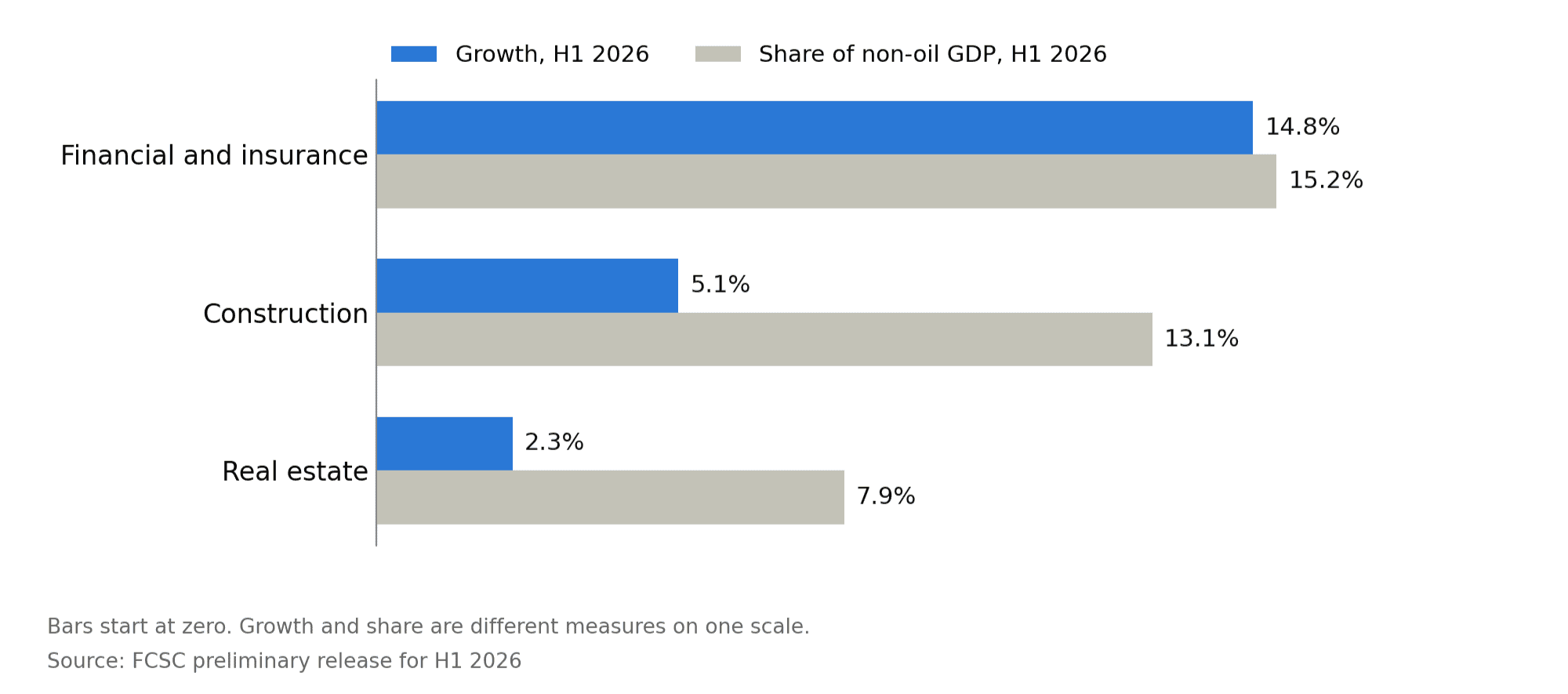
Financial and insurance activities record the fastest growth among the major activities in the first half of 2026 at 14.8 percent, followed by information and communication at 7.3 percent, health and social work at 6 percent, construction at 5.1 percent, government activities at 3.6 percent and real estate at 2.3 percent. Size tells a different story from speed.
Financial and insurance activities rank first on growth and second on contribution, which makes the sector central to the UAE non-oil picture.
Chart 2: Finance and Insurance Leads UAE Sector Growth in H1 2026
What Economic Diversification Means for GCC Investors
For GCC investors, the expansion of non-oil economic activity provides context for assessing listed companies and equity-market exposure. Saudi Arabia’s diversification efforts and the UAE’s sector-level developments may be relevant when evaluating funds investing in these markets. However, GDP trends do not necessarily translate into stock-market returns, and the relationship depends on factors such as company earnings, valuations and portfolio composition. Investors reviewing Saudi or UAE equity ETFs should assess their benchmarks, holdings, sector weights, fees and risks using current issuer factsheets.
The Bottomline
Saudi Arabia’s reported non-oil GDP milestone and the UAE’s latest sector data highlight the importance of monitoring economic diversification across the GCC. For investors, the key considerations are whether non-oil activity can sustain growth, how sector performance translates into corporate earnings, and whether listed equity funds provide meaningful exposure to these developments. GDP figures offer useful economic context, but investment decisions should also account for valuations, fund costs, portfolio composition, and regional risks.