
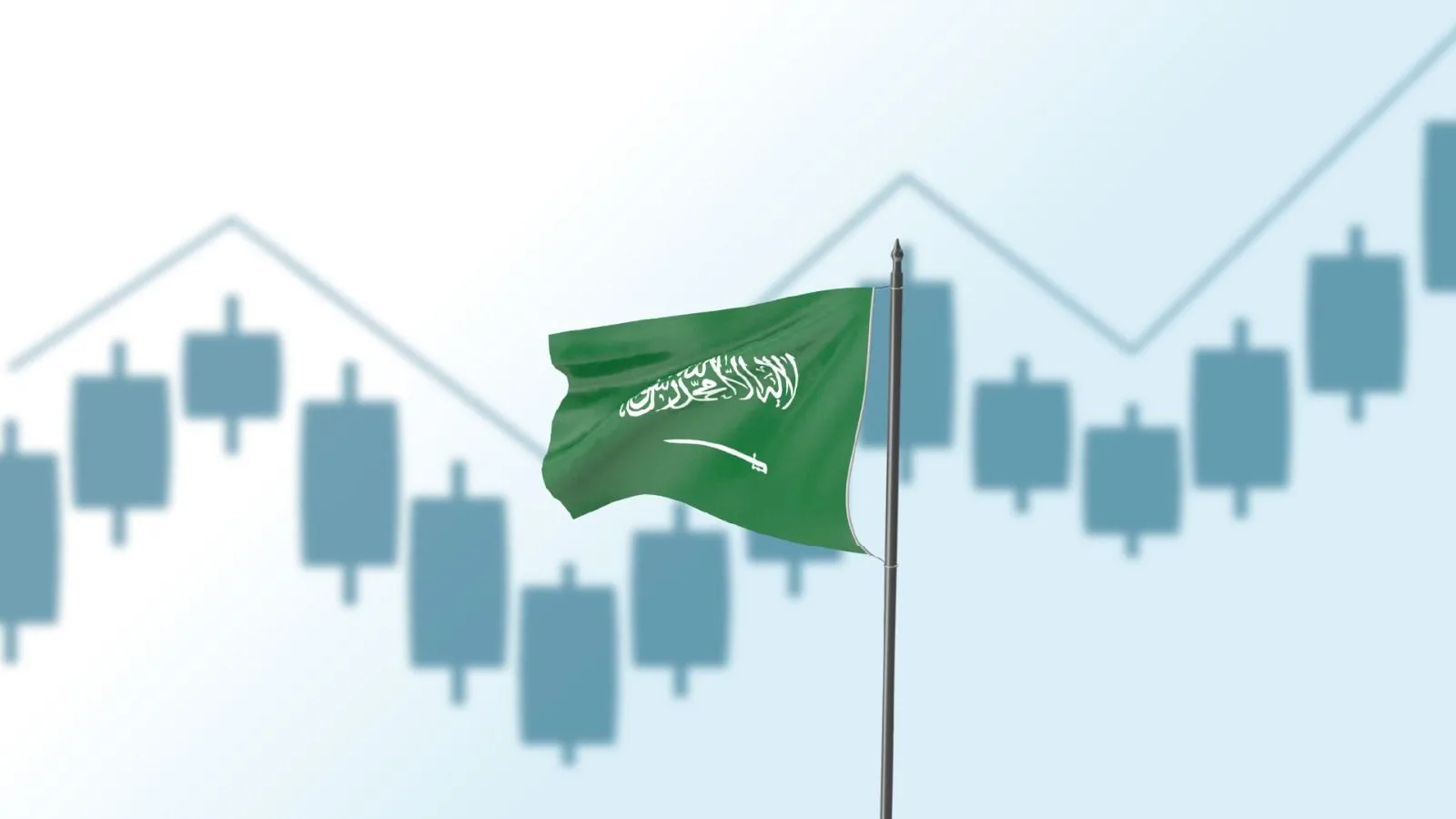
Saudi Arabia was the Gulf’s only equity market to record net foreign buying in the second quarter of 2026, extending a capital-inflow streak that began before the Kingdom removed a major barrier to international participation.
Foreign investors bought a net $1.6 billion of Saudi-listed shares during the three months to June. Every other Gulf Cooperation Council exchange recorded net selling, leaving the region with aggregate foreign outflows of $298.3 million after inflows of $1.47 billion in the first quarter.
The regional total masks a sharper split. Excluding Saudi Arabia, the other GCC exchanges suffered combined second-quarter outflows of about $1.9 billion, based on Nukoud calculations using Kamco’s figures. Dubai led the selling with $641.5 million, followed by Kuwait at $480.3 million and Qatar at $375.4 million. Abu Dhabi lost $187.3 million, while Oman and Bahrain recorded outflows of $161.3 million and $3.1 million respectively.
Saudi Arabia Has Captured More Than the GCC Total
The second-quarter inflow followed $2.6 billion of Saudi net foreign buying in the first three months of 2026. That puts the Kingdom’s estimated first-half inflow at approximately $4.2 billion.
Across the GCC, foreign investors bought only $1.2 billion during the same six-month period, down 83.1% from a year earlier. The comparison implies that Saudi Arabia absorbed enough foreign capital to offset roughly $3 billion of combined selling elsewhere in the Gulf. This is a calculation from Kamco’s quarterly data rather than a separately reported figure.
Part of the divergence reflects regulatory timing. From February 1, Saudi Arabia opened its Main Market to all categories of foreign investors, abolished the Qualified Foreign Investor framework and permitted non-resident investors to own listed securities directly. International ownership across the Saudi capital market had already exceeded SAR590 billion by the end of September 2025, including SAR519 billion in the Main Market.
The foreign-flow figures measure portfolio investment in listed equities. They should not be confused with foreign direct investment, which covers longer-term ownership of businesses and projects and is tracked separately.
Liquidity Strengthened Despite Lower Share Volumes
Saudi Arabia’s attraction was supported by deeper trading activity. The value of shares traded on the Saudi Exchange rose 11.5% quarter on quarter, from $77.5 billion to $86.4 billion, even as the number of shares traded fell 24.3%. Across the GCC, trading volume dropped 21.7% to 64 billion shares, while traded value increased 8.8% to $157.7 billion.
Saudi Arabia therefore represented nearly 55% of all GCC equity trading by value during the quarter. Five Saudi companies ranked among the region’s 10 most actively traded stocks. Al Rajhi Bank led with $6.9 billion of turnover, while Saudi Aramco recorded approximately $6 billion, close to Dubai-listed Emaar Properties. The top 10 securities together generated $36.2 billion, or 23.1% of total GCC trading value.
The shift toward higher-value trading suggests foreign institutions concentrated on large, liquid names rather than lifting the market indiscriminately. Saudi banks offer exposure to domestic credit growth and non-oil activity, while Aramco provides a liquid route into the Kingdom’s energy revenues.
For GCC investors, the flow data strengthens Saudi Arabia’s position as the region’s core equity allocation, but it also raises concentration risk. Foreign buying can reverse when oil prices, U.S. rates or regional security conditions change. The next test is whether inflows broaden beyond banks and large index constituents into industrial, consumer and mid-cap companies, which would provide stronger evidence that market-opening reforms are changing the depth of the Saudi market rather than producing a temporary liquidity advantage.