



Shariah ETF Flows Turn Positive as Equity and Sukuk Demand Offset Commodity Redemptions
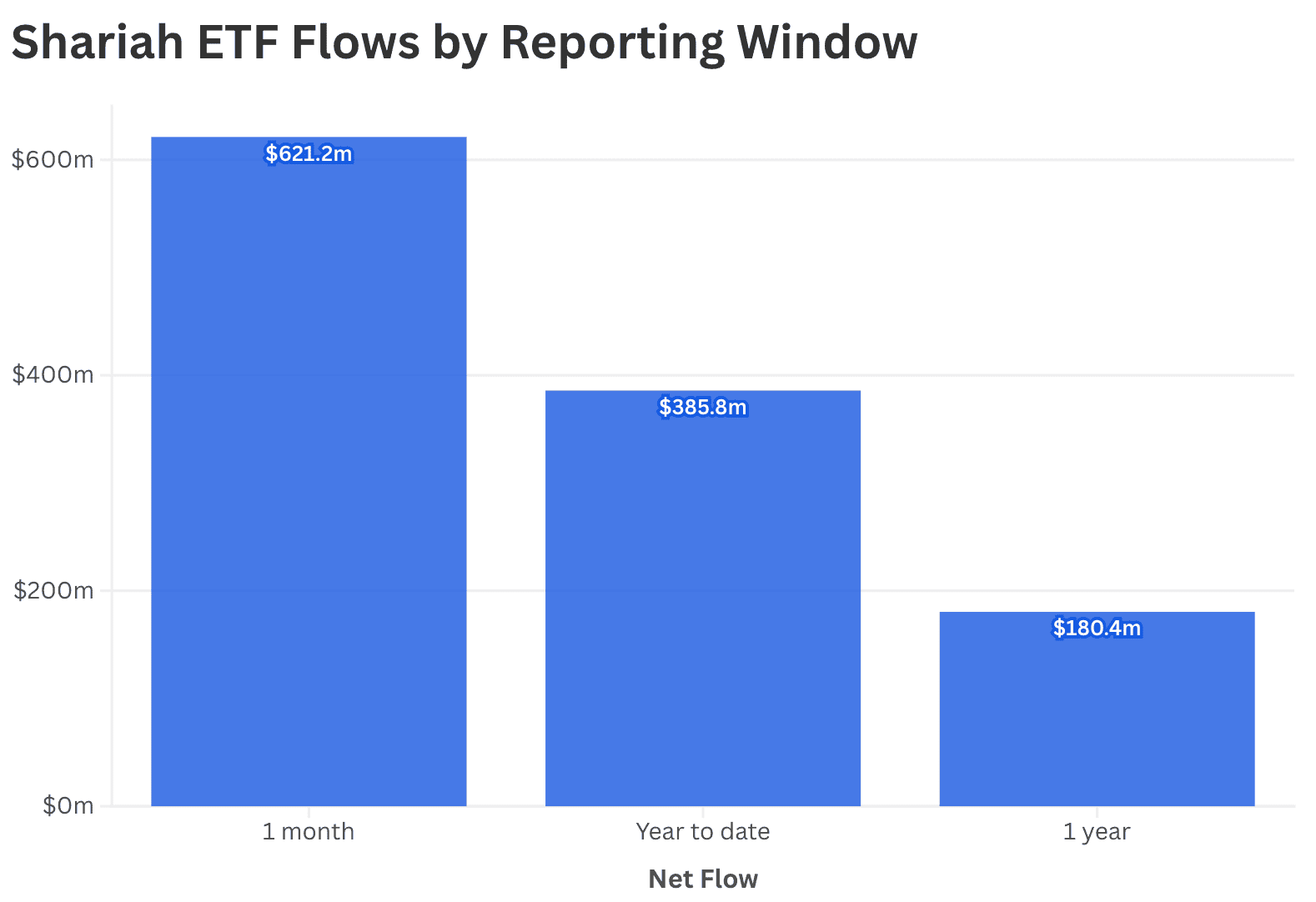
Global Shariah-compliant exchange-traded funds and products comprised 79 funds with US$60.09 billion in reported assets and recorded US$385.8 million of net inflows year to date. Equity funds attracted US$1.997 billion, while sukuk and fixed-income products added US$294.0 million. Commodity vehicles lost US$1.903 billion after precious metals retreated from their early-year highs.
$60.1bn Total AUM | 79 Funds Tracked | +$385.8m YTD Net Flow | +$621.2m 1-Month Flow | 39 / 20 Funds +/− YTD |
Market performance helps explain the divide. The S&P 500 Shariah Index returned 11.36% as technology shares led U.S. equities higher. Gold moved in the opposite direction after reaching US$5,595 an ounce in January, with inflation concerns and higher rate expectations weighing on prices during the second quarter.
The latest month produced a stronger result. Industry inflows reached US$621.2 million, including US$333.8 million into commodities and US$273.5 million into equities. Fixed income added US$13.9 million. Monthly inflows exceeded the year-to-date balance by US$235.4 million, showing how heavily earlier commodity redemptions had weighed on the headline figure.
Global Flow Overview
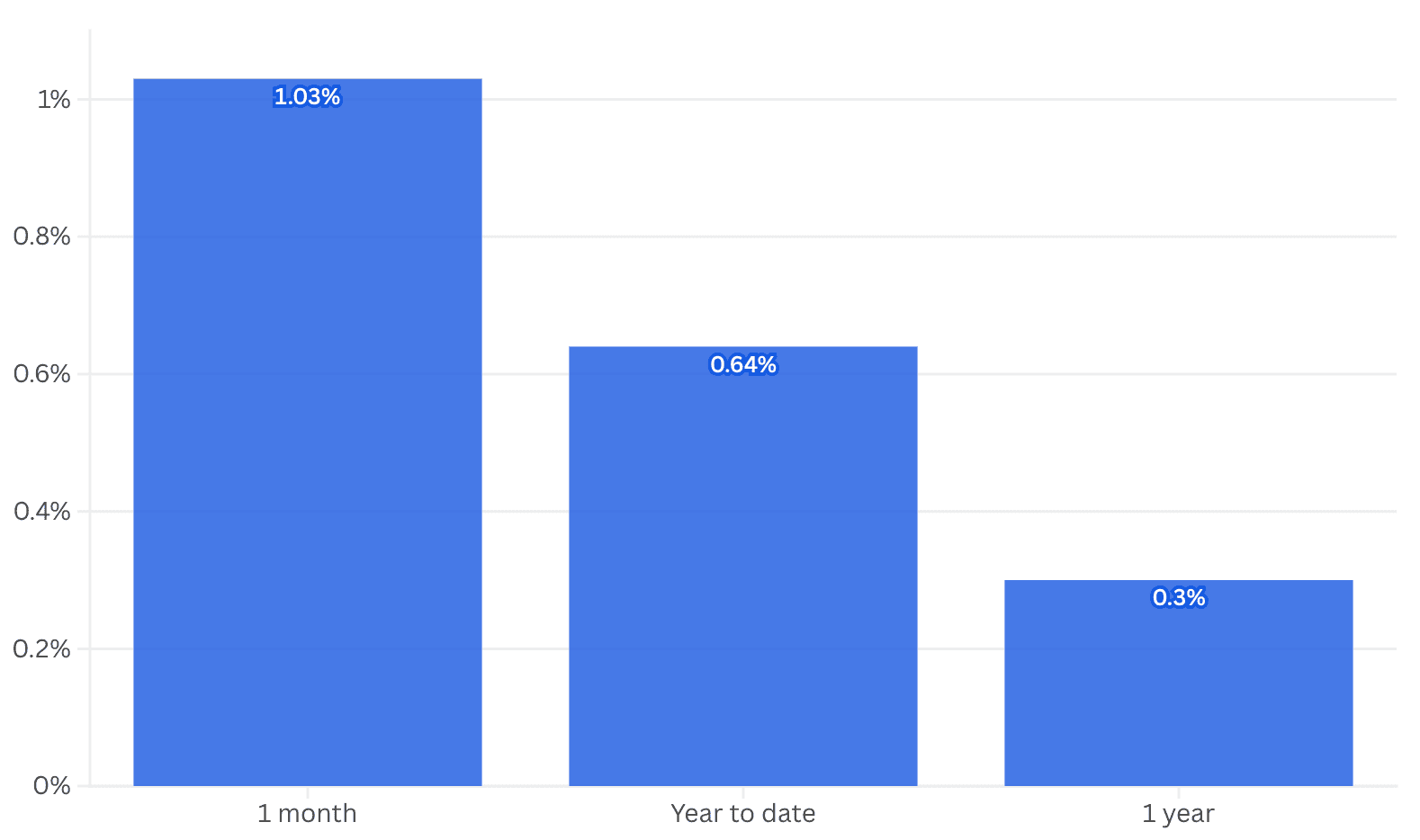
One-month inflows represented 1.03% of industry assets, compared with 0.64% year to date. Trailing one-year inflows were lower at US$180.4 million, or 0.30% of assets, leaving the longer-term picture much weaker than the latest month suggests.
Breadth was positive among funds reporting flows, with 39 funds receiving capital and 20 recording outflows, although a small number of products determined the result. SP Funds S&P 500 Sharia Industry Exclusions ETF, SPUS, gathered US$719.4 million, while Invesco Physical Gold, SGLD, lost US$685.9 million. Those positions nearly offset each other and reveal a rotation between exposures rather than broad-based growth across the market.
Equity inflows coincided with gains in technology-heavy Islamic indices. Commodity investors, by contrast, were reducing positions after gold’s earlier advance. The latest monthly rebound in metal funds suggests that part of that trade may be reversing.
Flow Breakdown by Asset Class
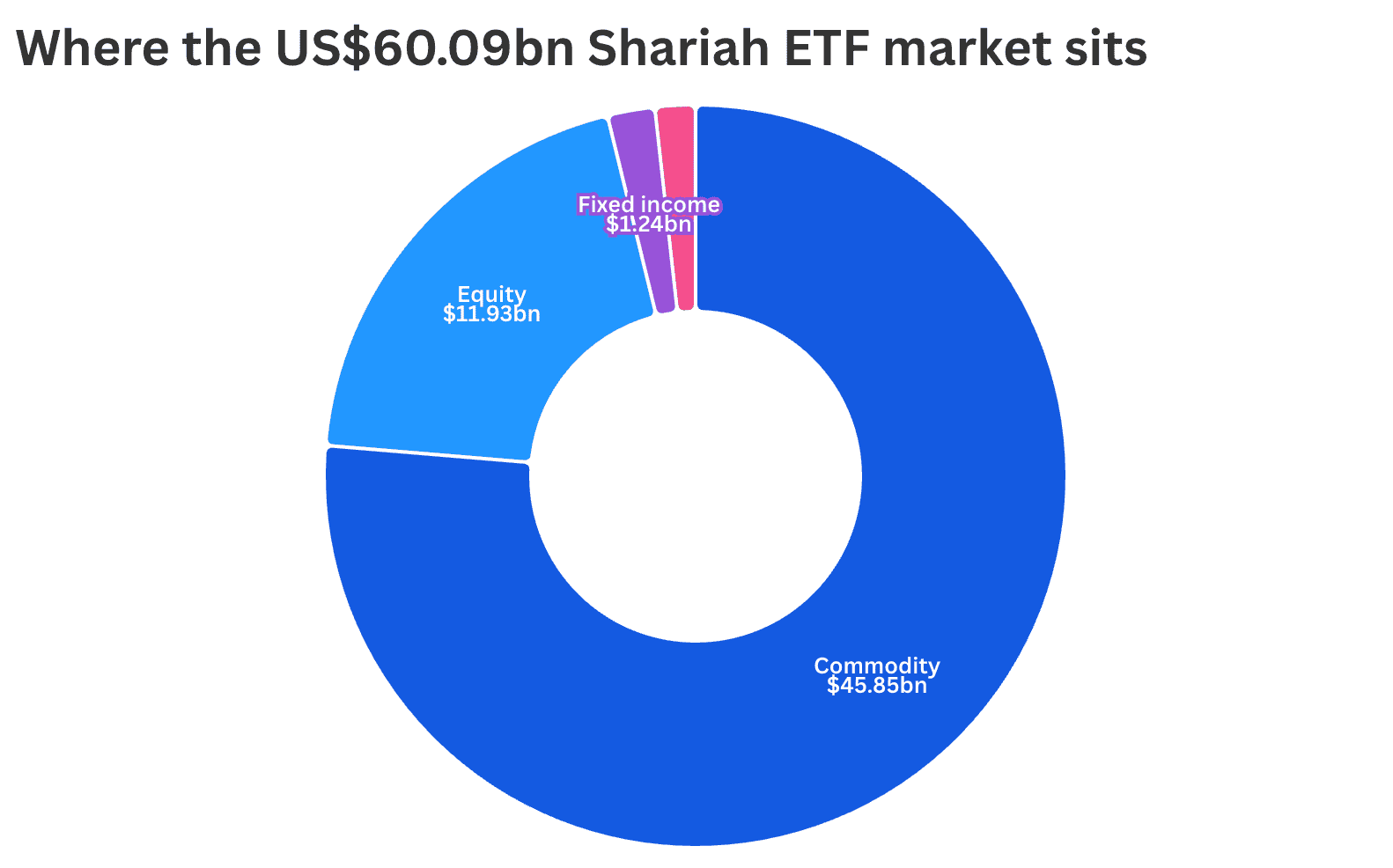
Commodity products remained the market’s largest segment, holding US$45.86 billion, or 76.3% of total assets. Their US$1.903 billion outflow equaled 4.15% of category assets.
Equities held US$11.93 billion but received US$1.997 billion, producing a flow rate of 16.73%. Fixed income attracted US$294.0 million against an asset base of US$1.24 billion, the highest category rate at 23.74%.
The industry therefore remained commodity-heavy by assets while new money favoured listed companies and sukuk. Alternative products held US$1.054 billion, although flow data for the segment were unavailable. Real estate lost US$1.6 million, although its US$3.7 million asset base was too small to influence the broader result.
Rising equity markets encouraged allocations to scalable global funds, while sukuk offered income during unsettled rate conditions. Gold’s correction placed older physical-metal products under pressure after the rapid increase in prices earlier in the year.
Equity ETF Flows
Equity funds gathered US$1.997 billion a year to date. Four products accounted for US$1.426 billion, or 71.4% of the category total.
SPUS led with US$719.4 million, followed by the iShares MSCI World Islamic UCITS ETF, ISWD, at US$383.8 million. The iShares emerging-markets fund added US$204.9 million, while its U.S. counterpart received US$118.1 million.
The allocations coincided with a strong first half for Shariah-screened U.S. equities. Islamic indices often carry substantial technology exposure because their screens remove much of the conventional banking sector. As of 2026-06-30, Microsoft represented 12.33% of the MSCI USA Islamic Index. Micron Technology held 7.79%, with Tesla at 7.08% and Advanced Micro Devices at 5.67%.
GCC investors also directed capital through different fund structures. SPUS is U.S.-domiciled, while ISWD, ISDE and ISUS use Irish Undertakings for Collective Investment in Transferable Securities structures. That distinction affects dealing access, distribution arrangements and tax treatment.
Sukuk & Fixed Income Flows
The seven-product sukuk and fixed-income segment recorded US$294.0 million of reported inflows, equal to 23.7% of category assets. Flow data were available for six products. SP Funds Dow Jones Global Sukuk ETF, SPSK, supplied US$223.6 million, or 76.0% of total inflows. The iShares USD Sukuk UCITS ETF, SKUK, added US$72.4 million.
Primary issuance also remained active. Global sukuk issuance reached US$62.4 billion in the first quarter of 2026, compared with US$52.6 billion a year earlier. GCC investment-grade spreads later moved back towards pre-war levels as geopolitical risk premiums eased.
Demand was visible in the UAE as well. The inaugural UAE Sovereign Retail T-Sukuk received AED445 million of orders and was nine times subscribed before trading began on Nasdaq Dubai in July. The transaction does not explain global ETF flows, but it reflects wider demand for accessible Shariah-compliant income products.
Commodity and Gold ETF Flows
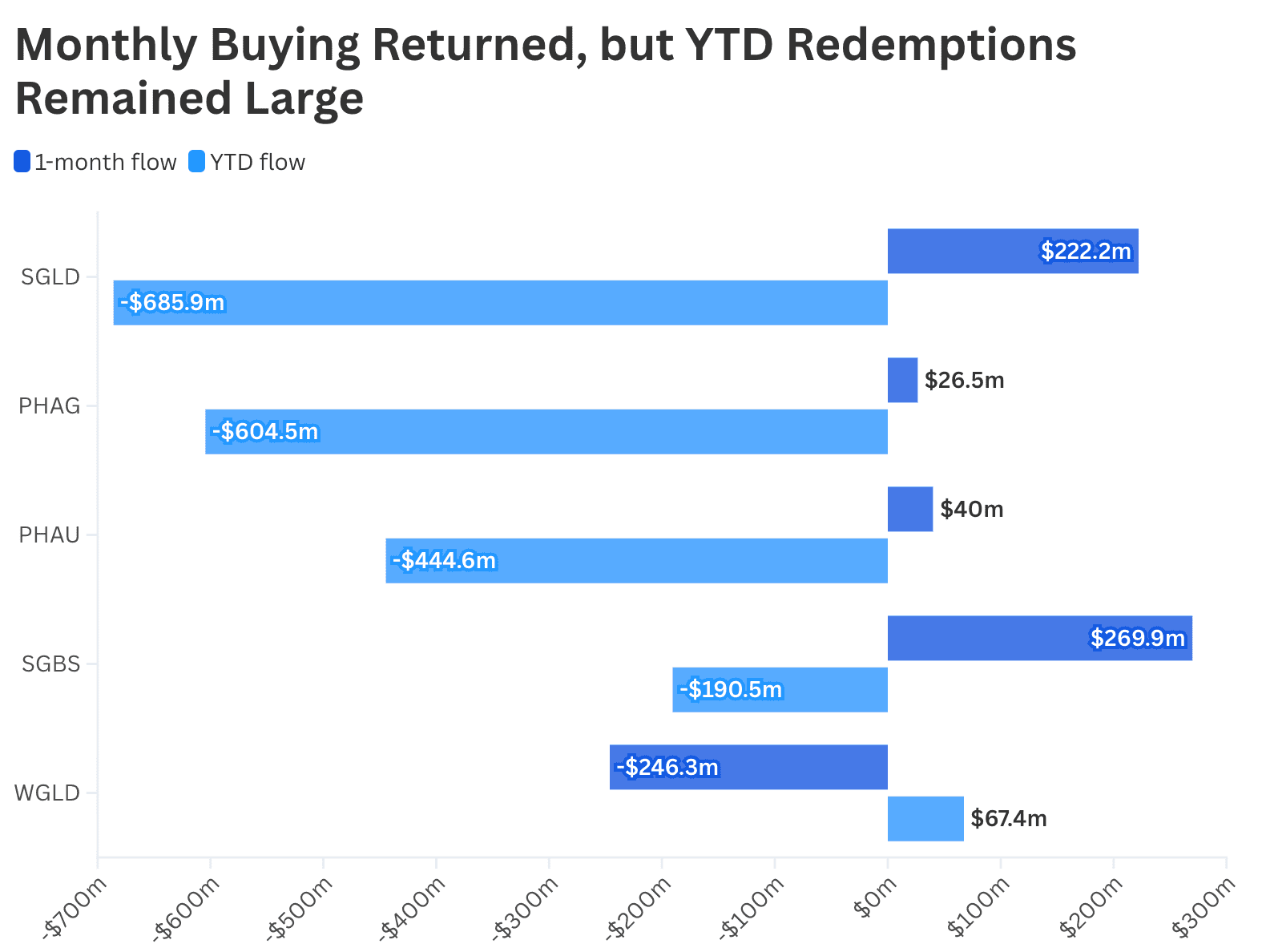
Commodity funds lost US$1.903 billion year to date and US$2.867 billion over one year. SGLD, WisdomTree Physical Silver, WisdomTree Physical Gold and WisdomTree Physical Swiss Gold generated combined redemptions of US$1.926 billion. Other products attracted enough capital to offset part of those withdrawals.
The outflows came as precious metals surrendered some of their early-year gains. Gold’s retreat accelerated during the second quarter as higher energy prices revived inflation concerns. Rising rate expectations increased the opportunity cost of holding a non-yielding asset. By late July, spot gold had fallen about 22% from the start of the conflict, while analysts surveyed by Reuters reduced their 2026 forecast for the first time since 2023.
Monthly flows later turned positive at US$333.8 million. SGBS and SGLD received US$492.1 million combined, while WisdomTree Core Physical Gold, WGLD, lost US$246.3 million. The result points to rotation between metal products rather than a uniform return to the category.
Flows by Issuer
SP Funds led issuer inflows with US$1.143 billion, supported by SPUS and SPSK. iShares gathered US$779.3 million through its global and regional Islamic equity range. Wahed added US$299.4 million.
Invesco lost US$791.8 million, while WisdomTree recorded US$1.149 billion of redemptions, largely through precious-metal products. SP Funds and iShares gathered US$1.922 billion between them, close to the US$1.941 billion withdrawn from WisdomTree and Invesco.
The small industry-wide inflow was therefore the residual of two large issuer groups positioned on opposite sides of the equity and commodity rotation.
Flows by Domicile
U.S.-domiciled products attracted US$1.322 billion, equal to 24.4% of their assets. Ireland added US$195.7 million as equity inflows offset withdrawals from Irish gold products. Canada received US$32.9 million, while Malaysia lost US$30.4 million. Saudi Arabia recorded an outflow of US$8.9 million.
Jersey lost US$1.149 billion because the domicile contains several WisdomTree physical-metal products. The result reflects product concentration rather than the behaviour of Jersey-based investors. A similar caveat applies to the U.S. figure, where SP Funds supplied much of the increase.
Saudi Arabia’s 11 funds held US$1.841 billion and lost 0.5% of assets. Local products therefore remained largely outside the main rotation, which centred on U.S. equity ETFs, Irish UCITS funds and Jersey commodity vehicles.
Largest Inflows
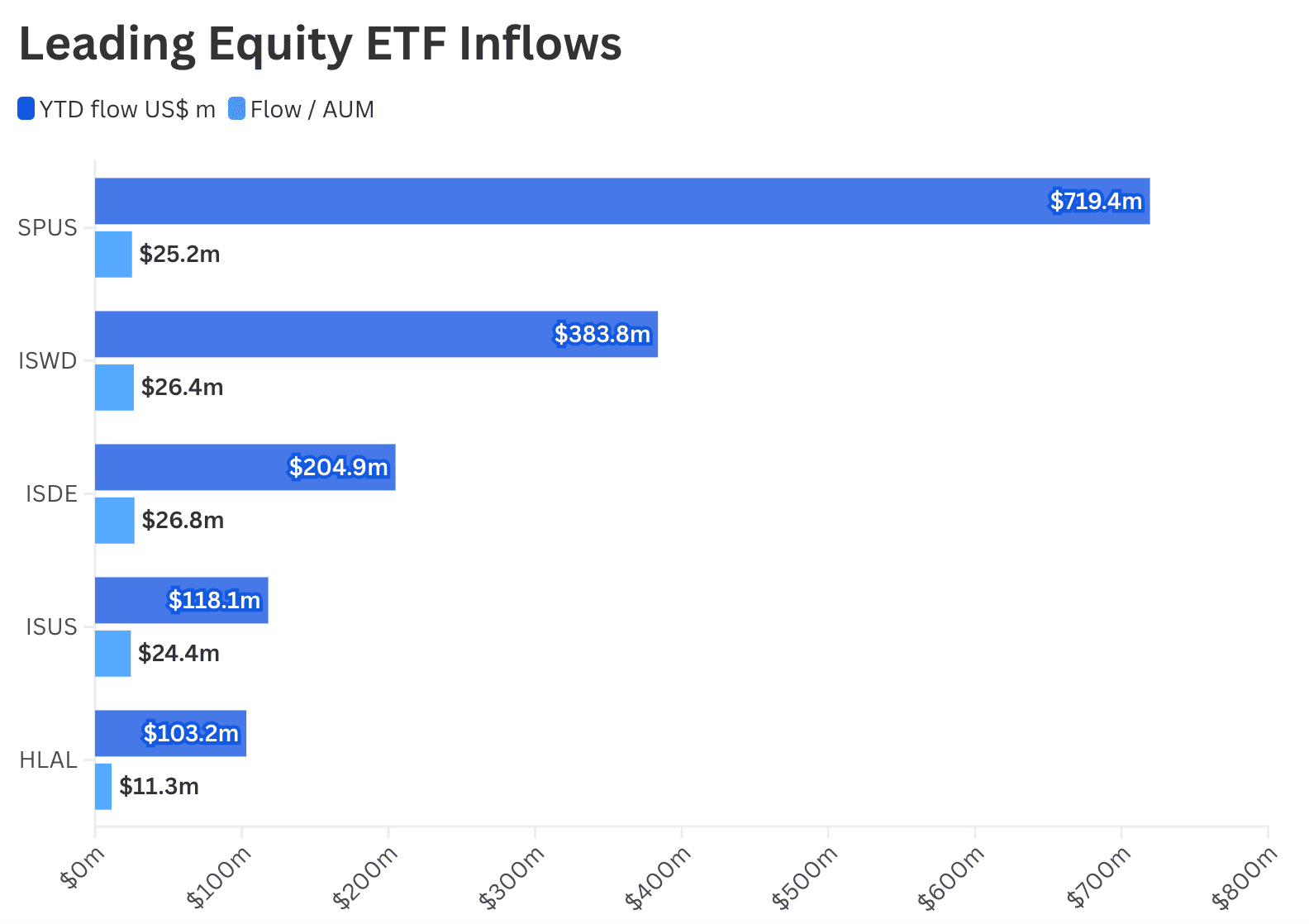
The five largest inflows favored broad portfolio exposures. SPUS received US$719.4 million, ISWD added US$383.8 million and SPSK gathered US$223.6 million. ISDE followed with US$204.9 million, while ISUS received US$118.1 million.
Four of the five funds were equity products. SPSK was the only fixed-income entry. SPUS alone represented 186% of the industry’s net inflow, showing how one large creation cycle can shape the headline result.
Largest Outflows
Precious metals accounted for four of the five largest outflows. SGLD lost US$685.9 million, WisdomTree Physical Silver shed US$604.5 million and WisdomTree Physical Gold recorded US$444.6 million of redemptions. SGBS lost a further US$190.5 million.
Invesco Dow Jones Islamic Global Developed Markets ETF, IGDA, was the only equity fund in the group, with an outflow of US$131.0 million. The pattern confirms that weakness remained concentrated in older commodity vehicles rather than spread evenly across Shariah exposures.
Conclusion
The next reporting period will show whether the monthly return to commodity funds can survive a less supportive rate setting. The Federal Reserve held its policy range at 3.50% to 3.75% on 2026-07-29, with three policymakers voting for an increase. Higher Treasury yields then placed renewed pressure on gold.
Those conditions could weigh on precious metals and longer-duration sukuk, while volatility in technology shares may test the equity products responsible for most of the year’s inflows.