
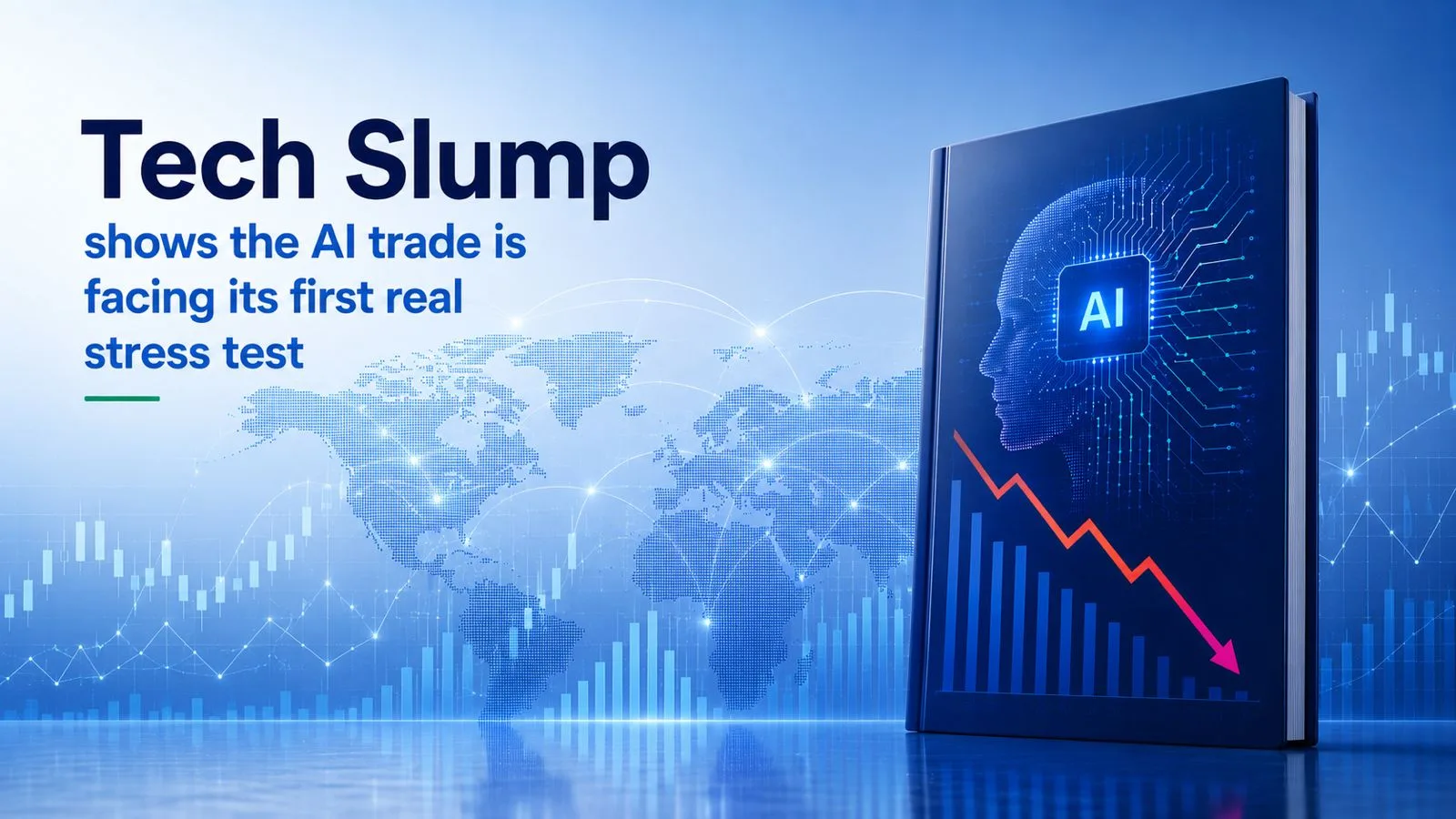
After months of investors treating artificial intelligence as the market’s most powerful growth engine, the trade is now facing a more uncomfortable question: what happens when the AI boom starts raising costs for everyone else?
Global equities fell to a two-week low after another selloff in technology shares, led by weakness in Apple, Asian chipmakers, and SoftBank. Nasdaq 100 futures slipped, Asian technology stocks sold off sharply, and South Korea’s Kospi triggered another trading halt after plunging as much as 9%.
This was the result of several pressure points hitting the same crowded trade at once.
Apple’s Price Hikes Change the AI Narrative
Apple was at the center of the latest concern. Shares fell after the company raised prices on Macs, iPads, and home devices, with Bloomberg reporting that rising component costs, especially memory chips, are starting to pressure consumer electronics.
That matters because Apple is one of the world’s largest and most powerful component buyers. If even Apple is passing higher costs to consumers, investors are right to ask how much pricing power the broader tech sector really has.
Demand from AI data centers has tightened supply across parts of the semiconductor chain, supporting the chip rally but also creating a cost problem for device makers.
That creates a more complicated version of the AI story. The same AI infrastructure boom that benefits memory producers and data center suppliers may also hurt consumer technology demand if higher costs are passed on to end users.
Market Performance: The Selloff Hits AI’s Core Winners
The pressure was visible across the stocks most closely tied to the AI hardware chain. Over the two-day period from June 22 to June 24, the damage was concentrated in semiconductors and AI-linked markets.
Micron Technology fell 13.4%, reversing some of the optimism that followed its strong results. SK Hynix dropped 10.7%, while Samsung Electronics declined 5.1%. Taiwan Semiconductor Manufacturing Company fell 5.2%, and Nvidia lost 4.6%. The iShares MSCI Taiwan ETF, a broader proxy for Taiwan’s technology-heavy market, declined 6.1%.
Micron’s recent results and Qualcomm’s AI revenue forecast still point to strong infrastructure demand. But the market is starting to separate beneficiaries from casualties. AI may lift data center suppliers, but it can also create bottlenecks, raise input costs, pressure consumer demand, and make valuations more fragile.
South Korea Shows the Risks of a Crowded AI Trade
South Korea was hit especially hard because its equity market has become heavily tied to the AI memory trade. Samsung and SK Hynix account for a large share of index exposure, making the Kospi behave less like a diversified market and more like a leveraged bet on semiconductors.
When the AI memory cycle is strong, South Korea can outperform dramatically. But when sentiment turns, the same concentration can amplify downside moves. The latest trading halt showed how quickly enthusiasm can become forced de-risking.
ETF Performance: Broad Tech Feels the Pressure
The selloff also showed up across ETFs, though the damage varied by exposure.
The Invesco QQQ Trust, which tracks the Nasdaq 100, fell 3.7% over the two-day period, while SPY declined 1.5%. The iShares Semiconductor ETF lost 1.2%, and the iShares MSCI South Korea ETF dropped 9.9%, reflecting the sharp pressure on Korean chipmakers. UAE-listed thematic ETFs were mixed, with AIPOWR down 3.3%, while QUANTM rose 1.0%. QUANTM has been the best performing ETF for the last month on the Abu Dhabi Stock Exchange as well, showing strong resilience to market dynamics.
The ETF performance highlights the difference between broad market exposure and concentrated thematic risk. SPY was relatively more insulated because it is diversified across sectors. QQQ was hit harder because of its large technology exposure. South Korea-linked exposure suffered the most because the market is heavily tied to the AI memory cycle.
SoftBank Adds Private-Market Risk to the Story
SoftBank added another layer to the pressure. Its shares tumbled after a report that OpenAI may delay its IPO until 2027. For SoftBank, OpenAI has become more than a private investment. It is a major part of the valuation story.
A delayed IPO means delayed transparency, delayed liquidity, and delayed proof of value. In a market already nervous about tech valuations, that was enough to trigger a sharp reset.
The AI Trade Is Becoming More Volatile
The broader message is that the AI trade is entering a more volatile phase, with investors still trying to determine both the direction of the opportunity and the true size of the market.
The first phase of the AI rally was built on companies linked to chips, data centers, cloud infrastructure, or AI software; those were treated as structural winners. The next phase is more uncertain. As spending accelerates across the ecosystem, investors are trying to assess how much of that incremental demand is sustainable, who ultimately captures the value, and how rising costs ripple through the broader technology sector.
AI remains the dominant investment theme, but the easy narrative has given way to a more complex one. From here, the market will focus less on exposure and more on execution, as investors look for clearer signals on demand durability, margin resilience, and the long-term payoff from the surge in AI-related spending.