
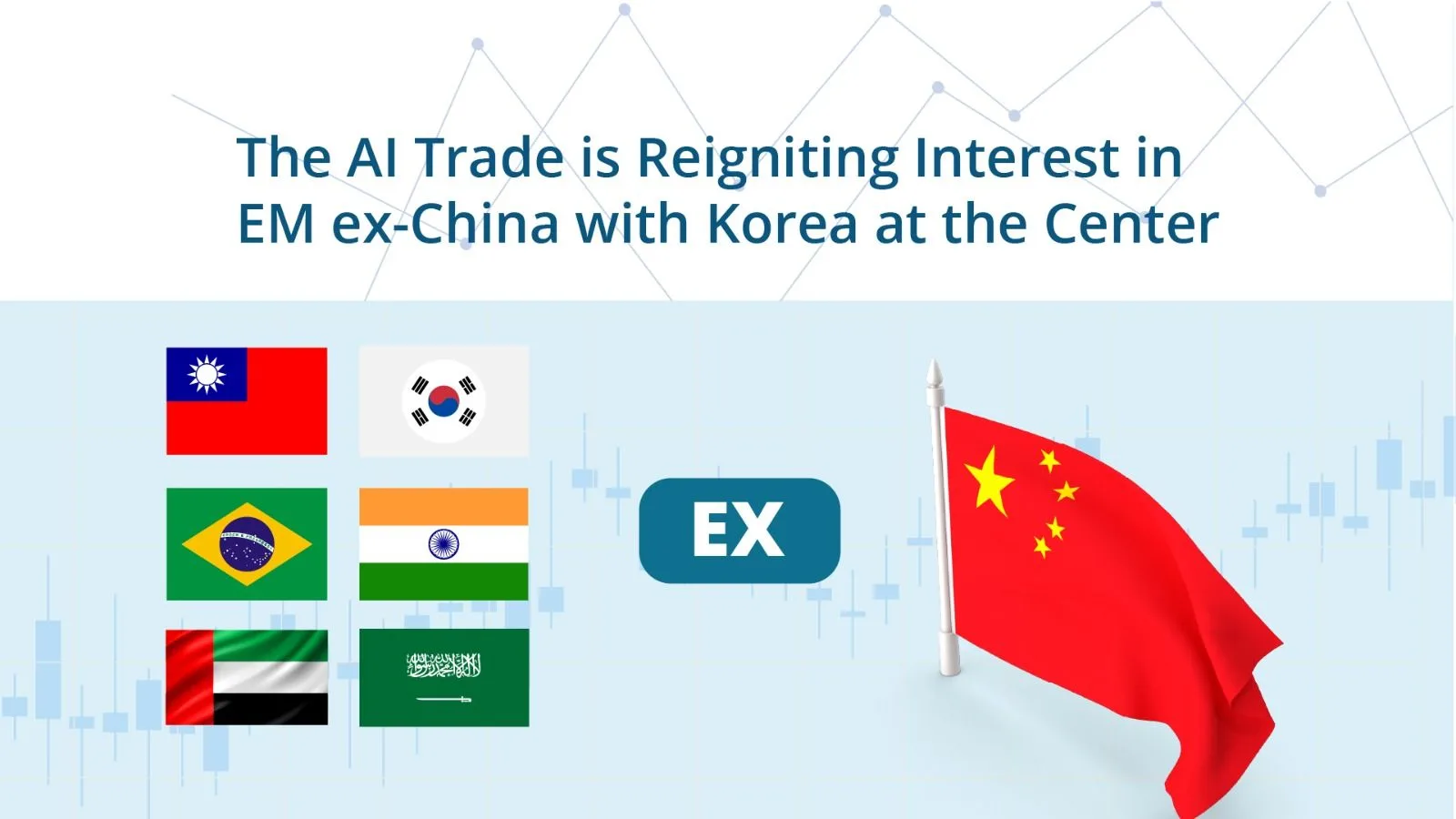
Investor interest in ex-China emerging-market ETFs is accelerating as geopolitical tensions, supply-chain shifts, and the global AI race force institutions to rethink how they allocate capital across emerging markets. For years, buying an emerging-market ETF effectively meant buying China. In many flagship EM benchmarks, China represented between 25% and 35% of total exposure, heavily influencing index performance, volatility, and geopolitical risk.
That concentration is increasingly becoming a problem for institutional investors because the MSCI Emerging Markets Index is no longer just a broad emerging-markets benchmark, it has increasingly become a concentrated technology and semiconductor trade with significant geopolitical exposure.
The index currently has a market capitalization of roughly $8.87 trillion across 1,203 constituents in 24 countries and trades at a forward P/E ratio of 14.16 with a price-to-book ratio of 1.83, making emerging markets appear relatively inexpensive versus many developed markets.
But beneath that diversification, performance is increasingly driven by a small group of technology giants. TSMC alone now represents roughly 12.7% of the benchmark, followed by Tencent at 4.7%, Samsung Electronics at 4.4%, Alibaba at 2.8%, and SK Hynix at 2.7%.
Sector exposure tells a similar story. Information technology represents roughly 24.5% of the index, followed by financials at 22.3% and consumer discretionary at 13.7%. As AI infrastructure spending accelerated globally, Taiwan and South Korea increasingly became some of the largest beneficiaries through semiconductor manufacturing, memory chips, AI servers, and advanced computing infrastructure.
Korea Is Emerging as a Major AI and Semiconductor Play
South Korea has become one of the clearest beneficiaries of the ex-China repositioning trend, particularly as investors search for AI and semiconductor exposure outside both the United States and China.
The iShares MSCI South Korea ETF (EWY), one of the main U.S.-listed vehicles for Korean equity exposure is up nearly 200% in 1Y, this shows how concentrated the trade has become. Its top holdings are dominated by AI-linked chip and technology names, with SK Hynix and Samsung Electronics together accounting for a major share of the index. Recent holdings data places SK Hynix and Samsung Electronics as the two dominant positions, followed by names such as Hyundai Motor, KB Financial, and SK Square.
That concentration matters because the performance has been extraordinary. SK Hynix has surged sharply over the past year on demand for high-bandwidth memory used in AI servers, while Samsung Electronics has also rallied as investors price in stronger memory-chip and AI infrastructure demand. Other major Korean holdings, including Hyundai Motor and financial-sector names, have also contributed to broader market strength.
As investors diversify away from concentrated China exposure, Korea is increasingly being viewed as a strategic middle ground: technologically advanced, deeply integrated into global supply chains, export-driven, and directly tied to the AI infrastructure buildout.
That dynamic is increasingly visible in ETF positioning. In many ex-China emerging-market allocations, South Korea now sits alongside India and Taiwan as one of the core country exposures, making Korea one of the main beneficiaries of the broader EM ex-China trade.
Taiwan
Taiwan represents one of the most direct AI infrastructure plays globally through companies such as TSMC, which remains central to advanced semiconductor manufacturing and AI chip production. TSMC is currently 57.20% of the the ETF and the information technology sector constitute more than 87% of total weight.TSMC has emerged as one of the most strategically important companies in the global AI revolution. The company is the world’s largest semiconductor foundry and manufactures the advanced chips that power artificial intelligence, cloud computing, smartphones, data centers, and high-performance computing systems.
TSMC’s leadership comes from its dominance in cutting-edge chip manufacturing technology, particularly at advanced nodes such as 3nm and 2nm. The company produces chips for many of the world’s leading technology firms including NVIDIA, Apple, AMD, Broadcom, and increasingly AI-focused infrastructure providers globally. This has benefited the Ishares MSCI Taiwan Index over the past 2 years and played an essential role in its 115% return over the past year.
India
India is less semiconductor-heavy than Taiwan or Korea, but more tied to domestic growth, financial deepening, telecom, infrastructure, and long-term consumption. The MSCI India Index is designed to track large- and mid-cap Indian equities and includes 164 constituents, covering around 85% of the Indian equity universe.
The index had a market capitalization of $1.39 trillion, with a forward P/E of 20.45 and a price-to-book ratio of 3.46, reflecting India’s premium valuation relative to many emerging-market peers.
Its largest holdings are HDFC Bank at 6.64%, Reliance Industries at 6.58%, ICICI Bank at 5.05%, Bharti Airtel at 3.66%, and Infosys at 2.90%, making the index far more diversified than Taiwan’s TSMC-heavy exposure.
That diversification is important: India’s appeal is not one company or one sector, but a broader structural story built around banking, energy, telecom, IT services, infrastructure, and consumer demand.
Brazil
Brazil is more tied to commodities, banking, energy, and domestic financial markets. The MSCI Brazil Index includes 46 constituents covering the large- and mid-cap segments of the Brazilian equity market, with financials representing roughly 36.6% of the index, followed by energy at 17.5%, materials at 13.7%, and utilities at 12.6%.
The market remains heavily concentrated around a handful of major companies including Vale at around 10.9%, Nu Holdings at 9.3%, Itaú Unibanco at 8.6%, and Petrobras’ preferred and ordinary shares together accounting for more than 15% of total index weight.
Brazil’s investment case is increasingly tied to a combination of commodity exposure, easing monetary policy, attractive valuations, and financial-sector dominance.
The country has also benefited from renewed interest in Latin America as investors search for value-oriented emerging markets trading at lower multiples than many Asian peers.
Earlier this year, the MSCI Brazil Index gained more than 19% during the first quarter as investors rotated back into commodity-linked and cyclical markets amid improving sentiment around interest rates and global growth expectations.
GCC
The Gulf is becoming increasingly relevant within emerging markets as regional exchanges deepen liquidity, IPO activity accelerates, and sovereign capital continues flowing into local financial markets. Saudi Arabia’s weight in emerging market indices has steadily increased since the IPO of Saudi Aramco, now approaching 4% of major emerging market benchmarks. More recently, Saudi local currency debt has begun entering the JPM GBI-EM index, further strengthening the Kingdom’s integration into global capital markets.
At the same time, the UAE continues to gain prominence as regional equity markets benefit from a strong IPO pipeline, improving liquidity, and sustained economic momentum. The continued growth of Abu Dhabi and Dubai as financial centers is increasingly positioning the UAE as a core destination for both regional and international investors.
What This Means for GCC Investors
The trend is directly relevant for GCC investors seeking emerging-market growth while reducing concentrated China geopolitical exposure.
Globally, ETFs such as the iShares MSCI Emerging Markets ex China ETF (EMXC), SPDR S&P Emerging Markets ex-China ETF (XCNY), and KraneShares MSCI Emerging Markets ex China Index ETF (KEMX) are increasingly being used by institutional allocators repositioning across emerging markets.
For GCC investors, the only non-China emerging markets ETF is the Chimera S&P India Shariah ETF (INDI) which offers GCC investors direct India exposure.
As Global investors chase the AI trade, EM ex China continues to gather momentum and China, especially the internet , is becoming cheaper and cheaper. Investors ought to capitalize on this momentum but be on the lookout for a potential rotation from EM ex China to China, as EM ex China valuations swell, and China gets cheaper.