


The artificial intelligence investment story is entering a new phase.
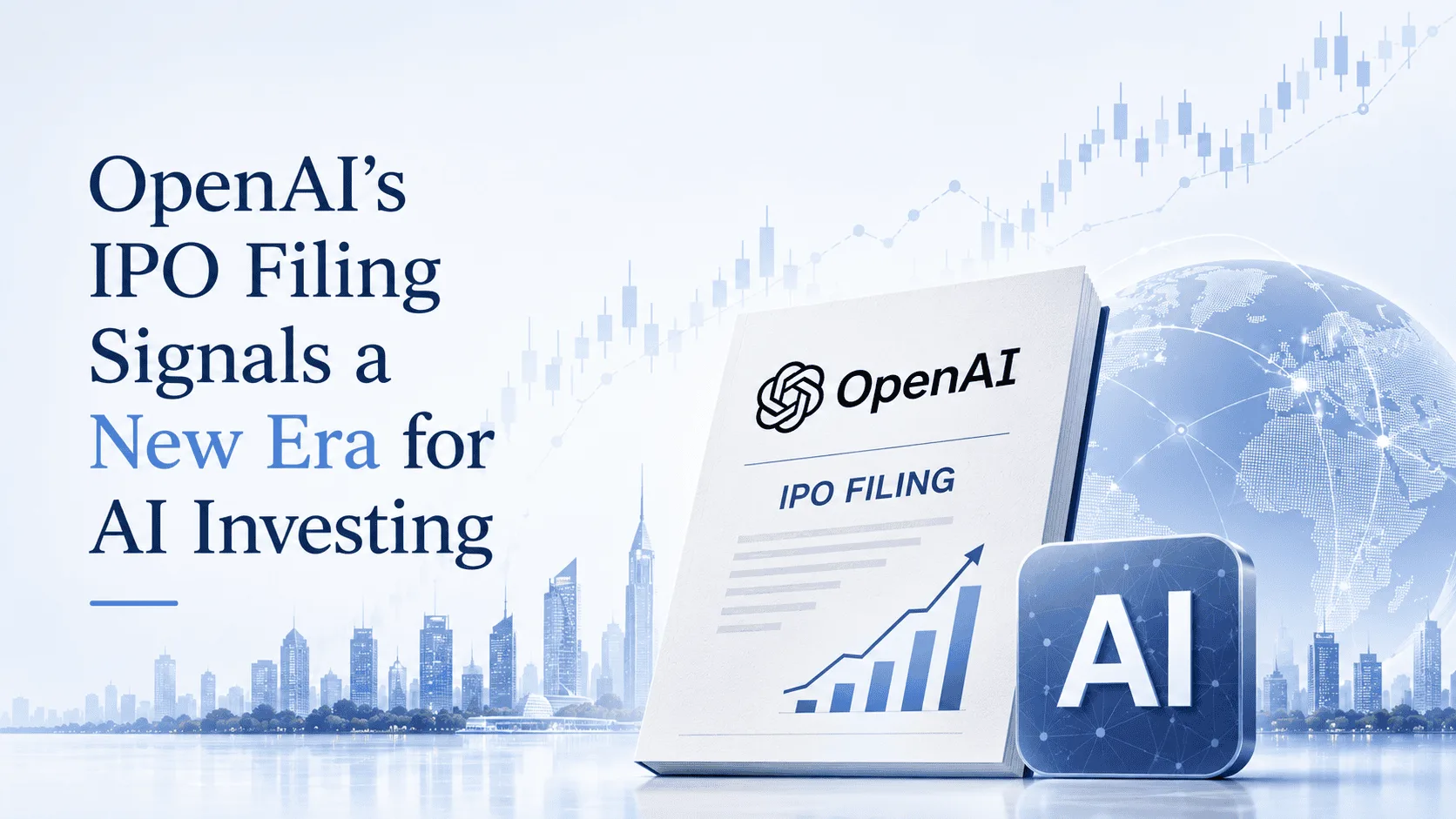
OpenAI, the company behind ChatGPT, has reportedly filed confidentially for a U.S. initial public offering, marking what could become one of the most anticipated technology listings of the decade. The filing comes shortly after Anthropic began its own IPO process, setting the stage for a landmark period in public markets as some of the world’s most valuable AI companies prepare to go public.
For years, exposure to frontier AI companies was largely reserved for venture capital firms, sovereign wealth funds, and institutional investors. Public-market investors could gain exposure to the AI theme through companies such as Nvidia, Microsoft, Alphabet, Amazon, and semiconductor manufacturers. Still, direct access to the developers of frontier AI models remained largely unavailable.
A Potenital Trillion-Dollar IPO
OpenAI, the developer behind ChatGPT, filed a confidential S-1 prospectus with the SEC in late May 2026, setting the stage for what could become one of the largest initial public offerings in capital market history. The company is targeting a public listing as early as September 2026 at a valuation range of $852 billion to over $1 trillion, with Goldman Sachs and Morgan Stanley serving as lead underwriters.
The filing arrived within days of Anthropic's own IPO submission on 1 June 2026, at a reported valuation of $965 billion. The near-simultaneous listings create a landmark moment for public market investors: direct, audited access to the two most prominent frontier AI companies in the world, neither of which has been accessible through mainstream equity markets until now.
Key Financial Metrics at a Glance
Timeline Note
OpenAI restructured from a capped-profit LLC to a Public Benefit Corporation in October 2025, removing a 100× investor return cap that had previously limited its attractiveness to conventional equity investors. This structural change was a precondition for a public listing.
Annualised Revenue Run-Rate (2023 - 2026)
The revenue growth trajectory is striking. From approximately $2 billion in annualised revenue at the close of 2023, OpenAI scaled to $6 billion in 2024, surpassed $20 billion by the end of 2025, and reached an annualised run-rate of $25 billion by March 2026, a more than 12-fold increase in roughly 26 months. CEO Sam Altman has publicly targeted $100 billion in annualised revenue by 2027.
Despite this, the company remains significantly loss-making. OpenAI generated approximately $13.1 billion in full-year 2025 revenue against an estimated $22 billion in expenditure, producing a net loss of roughly $9 billion. The company posted a negative 122% non-GAAP operating margin in Q1 2026, meaning it spent approximately $2.22 for every dollar of revenue earned that quarter.
Why Markets Are Paying Attention
OpenAI’s filing comes at a time when artificial intelligence remains one of the strongest structural themes across global equity markets. Since the launch of ChatGPT in late 2022, investors have poured hundreds of billions of dollars into AI-related companies spanning semiconductors, cloud computing, software, data centers, cybersecurity, and digital infrastructure.
Many analysts view the OpenAI and Anthropic IPOs as a major test of investor appetite for pure-play AI companies. If both companies achieve strong valuations and healthy public market demand, it could reinforce confidence that artificial intelligence remains the dominant growth theme for the coming decade.
The comparison many investors are making is not to a traditional software IPO but rather to landmark technology listings such as Google, Facebook, and Alibaba, which helped define entire investment cycles.
What It Means for GCC Investors
Across the GCC, demand for AI-focused investment products has grown significantly over the past two years. Investors have increasingly gained exposure to the AI theme through ETFs focused on semiconductors, hyperscalers, cloud infrastructure providers, AI software developers, and digital infrastructure companies.
Many of the companies already held within AI-focused ETFs stand to benefit from OpenAI’s continued growth. NVIDIA supplies the computing power behind much of the AI ecosystem, Microsoft remains OpenAI’s largest strategic partner, while cloud providers, networking companies, and data-center operators continue to benefit from rising AI demand.
The filing also reinforces a broader trend taking place across regional markets. Investors are increasingly looking beyond traditional sectors such as banking, energy, and real estate toward innovation-driven themes. The growth of AI, quantum computing, and technology-focused ETFs listed on regional exchanges reflects this shift.
GCC Access Point
AGIX is the only ETF listed on a GCC exchange (ADX) that provides direct pre-IPO exposure to Anthropic and post-merger SpaceX. GCC investors transact in USD during ADX trading hours. The fund's ability to hold private company stakes distinguishes it from index-only AI ETFs that are limited to publicly traded equities.
The Bigger Picture
Whether OpenAI ultimately achieves a trillion-dollar valuation remains uncertain. However, the significance of the filing goes beyond a single company.
The move signals that artificial intelligence is evolving from a private-market opportunity into a mainstream public-market asset class. As some of the world’s most influential AI companies prepare to enter public markets, investors are gaining new ways to participate in what many view as the defining technology transformation of this generation.
For GCC investors, the message is increasingly clear: artificial intelligence is no longer just a technology story. It is becoming one of the most important capital market themes of the decade.