


It is also one of the largest infrastructure investment themes globally and across the GCC, with the region's AI data centre pipeline alone carrying a combined project value exceeding $93 billion through 2030 (MEED, 2026).
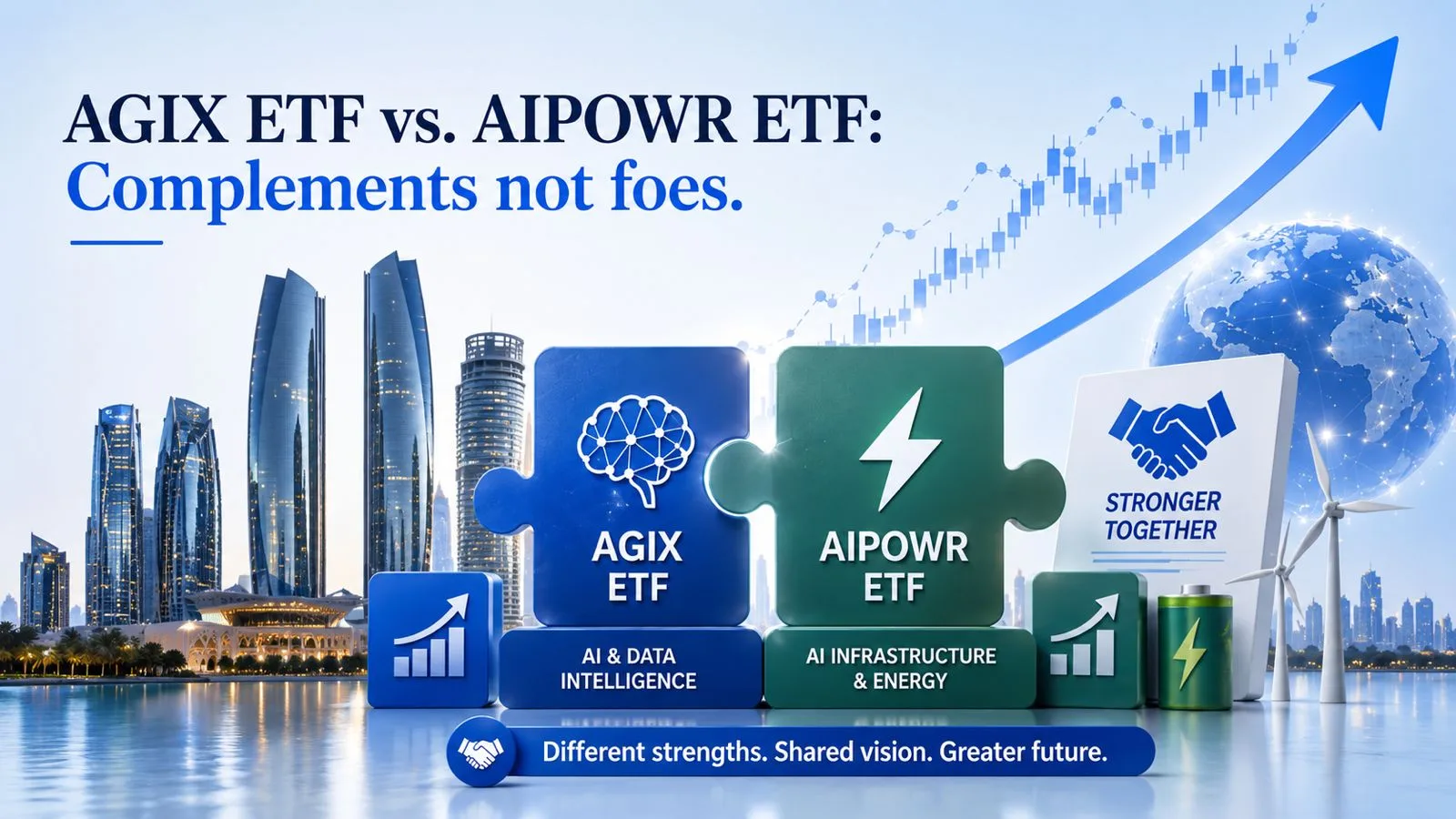
For investors, AI can be split into two major layers: AI intelligence and AI infrastructure.
The AI intelligence layer includes chips, cloud platforms, software, AI models, and applications. The AI infrastructure layer includes data centres, power grids, utilities, cooling systems, and the industrial equipment needed to support AI growth.
For GCC investors, this distinction matters because the region is investing heavily in AI compute, data centres, and power infrastructure. AGIX provides exposure to the AI intelligence layer, while AIPOWR provides exposure to the AI infrastructure layer. Together, they may offer a more complete way to invest in the AI value chain directly from ADX, without requiring an international brokerage account.
Overview of AGIX
The KraneShares Artificial Intelligence & Technology ETF, listed on ADX under the ticker AGIX, focuses on the AI intelligence layer. The fund invests in companies involved in semiconductors, cloud computing, software, and AI platforms, and uses the Solactive Etna Artificial General Intelligence Index as its selection guide within an actively managed structure.
Its key differentiator is exposure to selected private AI-related companies, including SpaceX, Anthropic, and Nuro, representing approximately 5.05% of NAV as of June 15, 2026, giving GCC investors access to assets usually unavailable through traditional public-market ETFs. With assets under management of approximately $981 million, AGIX has scaled rapidly since its July 2024 launch. AGIX is more growth-oriented and more sensitive to AI sentiment, technology valuations, and semiconductor cycles than a typical broad-market technology fund.
Overview of AIPOWR
The Lunate Boreas S&P AI Data, Power & Infrastructure UCITS ETF, listed on ADX under the ticker AIPOWR, focuses on the AI infrastructure layer. Launched on November 25, 2025, it was the first UCITS ETF globally to invest specifically in the physical backbone that AI requires, tracking the S&P Transatlantic AI-Related Data Center & Power Supply Infrastructure Index across 35 holdings in the US and developed European markets.
The fund invests in companies supporting data centres, power grids, utilities, cooling systems, and electrical equipment. Unlike a traditional technology ETF, AIPOWR has far greater exposure to industrials, utilities, and infrastructure companies, and currently carries assets under management of approximately $22.9 million.
AIPOWR may offer a more diversified and lower-cost way to access the physical buildout behind AI growth, with a TER of 0.49% versus AGIX's 0.99%.
Fund Snapshot at a Glance
Top Ten Holdings Comparison
The top holdings show how different the two ETFs are. AGIX is more concentrated in technology leaders, chipmakers, and AI platforms, including its private allocations to SpaceX and Anthropic, while AIPOWR includes cloud infrastructure companies, grid equipment manufacturers, utilities, and data centre infrastructure businesses.
There is some overlap in major cloud companies such as Amazon and Microsoft, but the investment purpose is different. AGIX owns them primarily as AI intelligence and cloud platform leaders, while AIPOWR owns them as part of the AI infrastructure and data centre ecosystem.
AGIX: Private Holdings (as of June 15, 2026)
AGIX and AIPOWR provide different AI exposures
The sector allocation highlights why AGIX and AIPOWR may work together in a portfolio. AGIX is heavily exposed to technology, while AIPOWR is concentrated in industrials, utilities, and real estate infrastructure, with near-zero overlap between the two.
Key takeaway: AGIX is a high-growth AI technology ETF. AIPOWR is an AI infrastructure ETF with greater exposure to the physical systems required to power AI.
Top Country Allocation Comparison
Geographic exposure reinforces the same complementary pattern. Both funds are anchored in the United States, but AIPOWR carries meaningfully greater exposure to continental Europe, reflecting its grid-equipment and utility holdings such as ABB, Siemens, and Schneider Electric, while AGIX's non-US exposure leans toward Asian semiconductor manufacturing hubs.
AGIX's non-US allocation is concentrated in Asian semiconductor supply chains (Taiwan, South Korea). AIPOWR's non-US allocation is concentrated in European grid and electrical-equipment manufacturers (Germany, Switzerland, Spain, Italy, France).
Fundamental Comparison
The fundamental and risk profile of the two funds is also different. AGIX is more exposed to high-growth technology companies and selected private AI ventures, with a shorter but stronger track record. AIPOWR is more exposed to industrial, utility, and infrastructure companies, with a shorter operating history that limits some standard risk metrics.
What a 50/50 AGIX and AIPOWR Allocation Would Look Like
A 50/50 allocation combines both sides of the AI investment theme: the companies building AI intelligence and the companies building the infrastructure required to support it.
A 50/50 allocation may appeal to investors seeking broad exposure to the AI megatrend without relying exclusively on technology stocks. AGIX provides the growth engine through AI semiconductors, software, cloud computing, and private innovation. AIPOWR provides the infrastructure backbone through data centres, utilities, power systems, and industrial equipment.
Together, they create a more complete AI allocation by combining the intelligence layer of AI with the physical infrastructure required to support its deployment at scale.
50/50 Portfolio Snapshot
50/50 Allocation by Investment Theme
AGIX Risks
AGIX is more exposed to technology valuations, AI sentiment, semiconductor cycles, and private-market pricing risk. Its 90-day annualised volatility of 33.88% and 70.8% technology weighting mean the fund may perform strongly during AI momentum markets, but it may also face larger drawdowns during technology corrections. It has already experienced a trailing 1-year drawdown of ‒19.87%.
AIPOWR Risks
AIPOWR is exposed to infrastructure execution risk, utility regulation, power-demand forecasts, industrial cycles, and project delays, alongside meaningful exposure to European industrial markets. While it carries a slightly lower 90-day volatility (31.88%) than AGIX, its short operating history since November 2025 means key risk metrics such as beta, correlation, and Sharpe ratio are not yet statistically meaningful.
Bottomline
AGIX and AIPOWR should not be viewed as identical AI ETFs. They represent two different layers of the same AI economy, and both are accessible directly from ADX without requiring an international brokerage account.
AGIX captures the intelligence layer: chips, cloud, software, AI platforms, and private AI companies, with a 66.85% trailing 1-year NAV return, a 94.05% cumulative return since inception, approximately $981 million in assets, and private exposure to SpaceX, Anthropic, and Nuro worth 5.05% of NAV.
AIPOWR captures the infrastructure layer: data centres, power, grids, utilities, and industrial equipment, with a 17.86% cumulative return since its November 2025 launch, 35 globally diversified holdings, a 20.54% weighted-average ROE, and a lower 0.49% TER.
A 50/50 allocation would give GCC investors exposure to both sides of the AI value chain through ETFs listed directly on ADX. For growth-oriented investors, AGIX may offer greater upside potential but higher volatility and concentration. For infrastructure-oriented investors, AIPOWR may offer a more diversified and lower-cost exposure to the physical buildout behind AI, albeit with a shorter track record.
For investors seeking a full AI allocation, the case for owning both is structural: AI needs intelligence, but intelligence needs infrastructure.