


OpenAI and Anthropic released new models on September 22, expanding their lineups around a shared theme: lower cost per task rather than raw capability. For GCC investors following AI-themed ETFs, the shift toward unit economics changes what is worth tracking.
OpenAI and Anthropic launch cheaper AI models
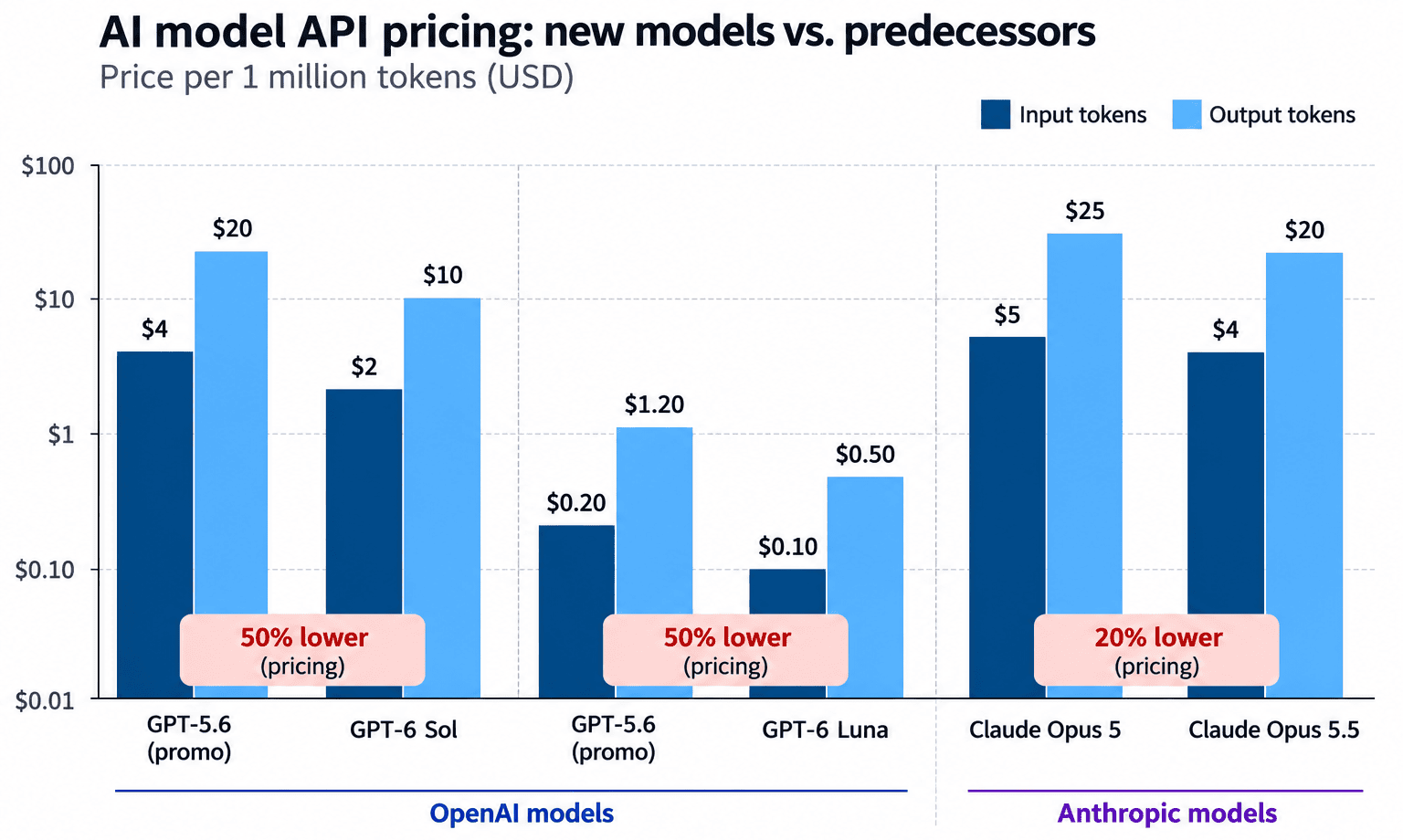
GPT-6 Sol and GPT-6 Luna join GPT-6 Astra, which OpenAI launched earlier in September for its most demanding workloads. Sol targets complex professional tasks including coding, and Luna is built for high-volume work such as extraction and summarization. Both were trained using methods similar to Astra's. OpenAI priced Sol at $2 per million input tokens and $10 per million output tokens, and Luna at $0.10 and $0.50, each about 50 percent below GPT-5.6 promotional rates. OpenAI also offers substantially lower pricing for cached inputs on both models.
Anthropic launched Claude Opus 5.5, the first model in its 5.5 family. List pricing is $4 per million input tokens and $20 per million output tokens, a 20 percent cut from Opus 5's $5 and $25. Cache reads fell 60 percent to $0.20 per million tokens. Anthropic says Opus 5.5 costs about 40 percent less than Opus 5 on typical workloads at default settings, reflecting lower token pricing and fewer tokens used per task. Anthropic also says the model generates output more than 30 percent faster than Opus 5. On Anthropic's reported coding benchmarks, Opus 5.5 matches GPT-6 Astra on Terminal-Bench 4.0 at about 40 percent of the cost per task and scores higher than Astra on FrontierCode v1.1 at roughly one-fifth of the cost per task. These are company-reported results, and benchmark setups and effort levels can vary. Anthropic says Opus 5.5 performs at the level of Claude Fable 5.1 on most work, and the model is available now on Anthropic's own platform along with Amazon Web Services, Google Cloud, and Microsoft Azure.
Why lower AI model costs matter for investors
Both releases also highlight the industry's growing focus on efficiency alongside capability. Anthropic describes Opus 5.5 as its first release since its call for pacing frontier development, while saying the model was evaluated by external groups including METR and Frontier Design. OpenAI similarly emphasizes efficiency and lower costs in its rollout of GPT-6 Sol and Luna.
Anthropic also emphasized safety and security in the release, highlighting evaluations in areas including biology and cybersecurity and safeguards designed to reduce risks such as prompt injection and large-scale extraction of model capabilities. As enterprise AI agents take on more autonomous work, that kind of governance layer is becoming part of the commercial pitch alongside price and speed.
How cheaper AI models could affect AI investments
Lower token prices and more efficient inference can reduce the cost of running AI across customer service, coding and document workflows, which could push more of that work from pilot projects into production. The effect is not uniform across the AI value chain, and it helps to think in three layers. Model providers can benefit from lower inference costs but may face greater price competition as rivals target the same enterprise workloads. Enterprise users of these tools get lower deployment costs and a stronger case for wider adoption. Infrastructure providers- the data centers, chips, networking, and power behind all of this- could see higher utilization if falling costs bring in enough new usage to offset the efficiency gains. For infrastructure investors, the key question is whether lower cost per task produces enough additional AI usage to outweigh the reduction in compute required for each task, and that relationship is not automatic.
AI ETFs relevant to GCC investors
The KraneShares Public-Private AI & Technology ETF (AGIX) provides exposure to both publicly listed and private AI and technology companies across the broader AI value chain. The fund invests at least 80% of its net assets in securities included in the Solactive Worldwide Artificial General Intelligence Index and also allocates to private AI companies. As of September 25, 2026, Anthropic accounted for 1.11% of the fund’s net assets, with a market value of approximately $12.93 million.
As of September 25, 2026, AGIX had net assets of approximately $1.167 billion, a NAV of $48.10, and an expense ratio of 1.00%. Its YTD total return was 24.53%, based on performance data through August 31, 2026. The fund is listed on Nasdaq and provides exposure across AI hardware, infrastructure and applications.
For the infrastructure side of the story, the Boreas S&P AI Data, Power & Infrastructure UCITS ETF (AIPOWR), listed on ADX, provides exposure to the infrastructure supporting AI adoption rather than the model developers themselves. The ETF tracks an index of 35 companies across the US and developed European markets involved in data centres, digital infrastructure, electricity generation and distribution, and power-supply infrastructure. Its holdings include companies such as Oracle, NextEra Energy, Siemens, ABB and Eaton.
Together, AGIX and AIPOWR illustrate two different layers of the AI investment ecosystem: AGIX has direct private-market exposure to Anthropic. At the same time, AIPOWR focuses on the data, power, and physical infrastructure required to support expanding AI workloads.
Which global ETFs offer exposure to OpenAI and Anthropic?
Beyond GCC-listed products, several global ETFs provide direct or ecosystem exposure to the AI model developers. The Alger 35 ETF (ATFV) has reported holdings in both OpenAI and Anthropic, while ARK's ARKK, ARKW, and ARKF ETFs have reported OpenAI exposure. AGIX has also reported a direct holding in Anthropic. Newer ecosystem-focused ETFs provide exposure to companies linked to OpenAI or Anthropic, although ecosystem exposure should not be confused with direct ownership of the AI labs.
What to watch next
Anthropic said Sonnet 5.5 and Haiku 5.5 will follow in the coming weeks. Their release will provide another test of whether the cost and efficiency improvements extend beyond the flagship Opus tier and into broader enterprise workloads. It is also worth watching how quickly GCC-listed companies disclose their own use of these cheaper model tiers, since model and API costs falling by 20 to 50 percent at the headline pricing level could affect the economics of AI deployments and technology budgets.