
The tokenization of exchange-traded funds (ETFs) has long been pitched as the next frontier in market infrastructure. That future is arriving faster than many expected.
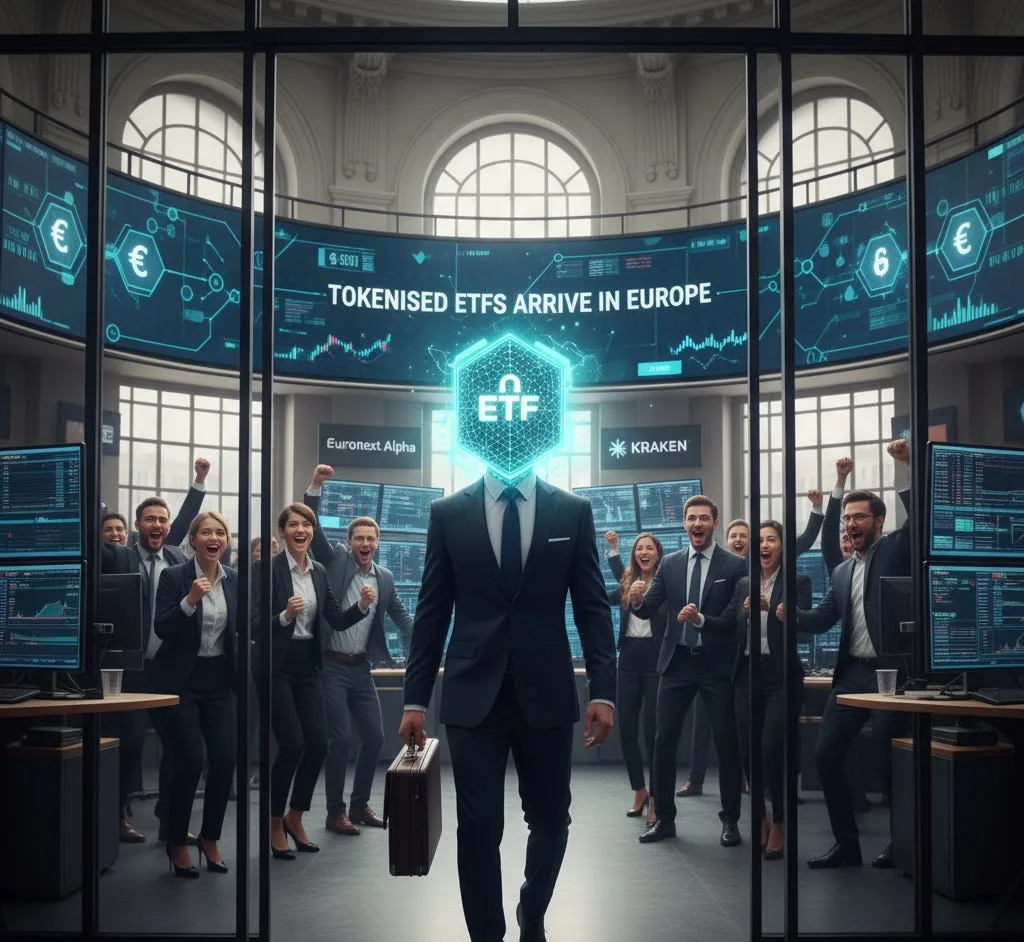
In early September, crypto exchange Kraken announced it would offer 60 tokenized U.S.-listed ETFs and stocks to European investors, a move that puts blockchain-enabled wrappers into mainstream circulation. Combined with BlackRock’s $2.2 billion BUIDL tokenized fund and regulatory pilots from Nasdaq and Abu Dhabi Global Market (ADGM), tokenization is moving from white papers to trading floors.
What Are tokenized ETFs?
At their core, tokenized ETFs are traditional funds whose ownership is represented by blockchain tokens rather than conventional shares. Each token corresponds to a share (or fraction) of the ETF, enabling features such as 24/7 trading, instant settlement, and fractional ownership.
Unlike synthetic crypto products, these tokens are backed by real ETF holdings, with custodians and transfer agents recording ownership on-chain.
For investors, the appeal is straightforward: tokenized ETFs promise access to U.S. and European products without the frictions of time zones, settlement delays, or full-lot minimums. For issuers and regulators, the promise lies in efficiency gains, automated compliance, programmable governance, and lower operational costs.
Kraken’s Rollout Marks a Turning Point
Kraken’s announcement in September marked a watershed moment: 60 U.S.-listed ETFs, including funds from BlackRock, Vanguard, and Invesco, will be available in Europe as tokenized products.
The exchange said these tokens will be available under the EU’s pilot regime for distributed ledger technology (DLT), giving investors a legal framework for participation.
The move follows momentum elsewhere:
- BlackRock’s BUIDL tokenized money-market fund, launched in 2024, now manages over $2.2 billion, mainly from institutions parking cash in a blockchain-native vehicle.
- Franklin Templeton’s OnChain U.S. Government Money Fund reached $707 million in assets by mid-2025, one of the largest tokenized funds globally.
- Nasdaq has filed to list tokenized shares and ETFs on its regulated exchange, potentially the first major U.S. bourse to adopt blockchain settlement.
- In the Gulf, ADGM approved Realize’s RBILL tokenized Treasury ETF fund in October 2024, with a $200 million target, the first such structure in the Middle East.
BlackRock’s role in tokenizing ETFs and money-market funds deserves closer examination, particularly given its potential impact on GCC investors. We explored that in detail here: From Wall Street to the Gulf: BlackRock’s ETF Tokenization Plan.
Together, these initiatives have pushed the tokenized real-world asset (RWA) market to around $29 billion as of September 2025, up from under $5 billion in 2022.
How tokenized ETFs Work
Traditional ETFs are settled via clearinghouses like DTCC on a T+2 basis. tokenized ETFs, bgy contrast, settle instantly on-chain. Investors receive blockchain tokens representing fund shares, which can be traded peer-to-peer, used as collateral in decentralized finance (DeFi) networks, or fractionalized to expand retail access.
tokenized ETFs promise several advantages, including the ability to trade 24/7 without being tied to market hours in New York or London, the fractionalization of shares into micro-units that lower entry barriers, and programmable smart contracts that can automate dividends, voting rights, and compliance. They also open the door to cross-border access, allowing European investors to gain exposure to U.S. ETFs without relying on UCITS structures.
Yet challenges remain: liquidity in tokenized real-world assets is still shallow, raising concerns about secondary market depth; dual listings of tokenized and traditional ETFs risk regulatory arbitrage and pricing dislocations; and questions of custody and governance persist, particularly around ensuring tokens remain legally enforceable claims on the underlying funds.
Why Europe Is the First Real Proving Ground
Kraken’s initiative highlights Europe as a proving ground. Under the EU’s DLT Pilot Regime, launched in 2023, exchanges and clearinghouses can experiment with blockchain-based trading of traditional securities in sandbox environments.
That gives Kraken, Nasdaq Europe, and others a head start in testing tokenized ETF adoption at scale.
For European investors, tokenization could reshape access to U.S. ETFs. Currently, most rely on UCITS-domiciled funds to avoid U.S. tax drag and comply with MiFID distribution rules. tokenized ETFs could bypass these hurdles though tax authorities may soon weigh in on how gains are reported and withheld.
The Global Numerical Scale
The market for tokenized real-world assets (RWAs) has been climbing sharply. As of September 16, 2025, the total value of on-chain RWAs is $30.14 billion, a gain of about 10.3% over the previous 30 days.
In the second quarter (Q2) of 2025, institutional demand was a major driver: the tokenized RWA market surged past $25 billion, up from much smaller bases over the past four years.
Breaking this down:
-Tokenized money-market funds now exceed $7.4 billion, led by BlackRock’s BUIDL and Franklin Templeton’s OnChain U.S. Government Money Fund.
-Tokenized U.S. Treasuries and other fixed income instruments are about $4-5 billion of that total.
-Equities and tokenized ETF-type assets remain small but are rapidly growing, especially following announcements like Kraken bringing 60 U.S.-listed tokenized ETFs to Europe.
To provide context, the global ETF market (traditional, non-tokenized ) is vastly larger. As of mid-2025, global ETF assets under management are approaching $17 trillion (or more) according to S&P Global Market Intelligence.
While tokenization still represents only a tiny fraction of the overall ETF/RWA universe, its growth rate is remarkable: the market has increased by ~300-300+% year-over-year in several segments.
Projections from Keyrock and other tokenization platforms anticipate the RWA market could reach $50 billion by end-2025 under favorable conditions.
How Investors Could Be Affected
For retail investors, tokenization lowers entry barriers, enabling them to own fractions of ETFs that might otherwise be too costly. For institutions, tokenized ETFs offer operational efficiencies and access to new liquidity pools, including DeFi protocols where tokenized assets can be pledged as collateral.
Yet risks remain. Liquidity is still untested at scale, regulatory frameworks differ across jurisdictions, and the complexity of custody solutions could deter conservative investors. Price discovery, too, may diverge if tokenized ETFs trade at persistent premiums or discounts to traditional markets.
Key Takeaways
Tokenization has shifted from concept to reality. With Kraken launching tokenized ETFs in Europe, BlackRock and Franklin Templeton expanding blockchain-based funds, and regulators in the U.S., EU, and GCC testing frameworks, the groundwork is being laid for ETFs to function directly on blockchain rails. The market remains small, but momentum is undeniable. If adoption continues, tokenization could redefine how ETFs are accessed and traded, bridging traditional finance with decentralized markets.