Quantum computing stocks are facing a sharp correction even as the industry reports progress in technology, funding and commercial development. On 5 November 2026, the Solactive Developed Quantum Computing Index, tracked by the Boreas Solactive Quantum Computing UCITS ETF, fell 50.2% from its June peak. This marked its second-deepest drawdown in the available index history.
The fund's accumulating share class trades as QQCC, while its distributing Class B share class is listed on the Abu Dhabi Securities Exchange (ADX) as QUANTM. The correction raises questions about valuations, commercial progress and how much direct quantum computing exposure investors receive through thematic ETFs.
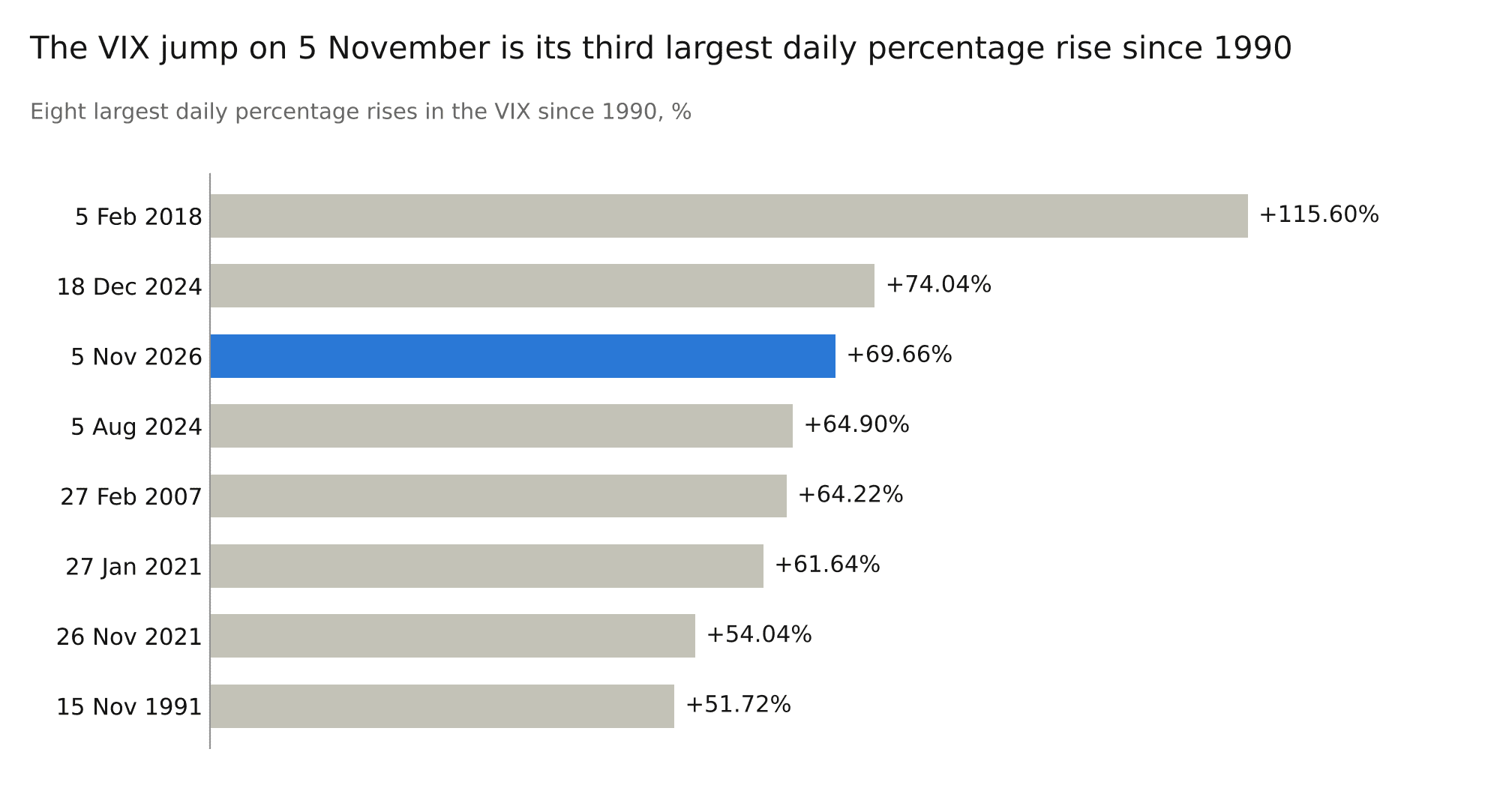
Broader market volatility also increased sharply during the sell-off. The Cboe Volatility Index (VIX) rose 69.66% on 5 November, its third-largest daily percentage increase since 1990, reflecting a wider reassessment of technology valuations and risk appetite.
Figure 1. VIX Surges 69.66%, Marking Its Third-Largest Daily Rise Since 1990
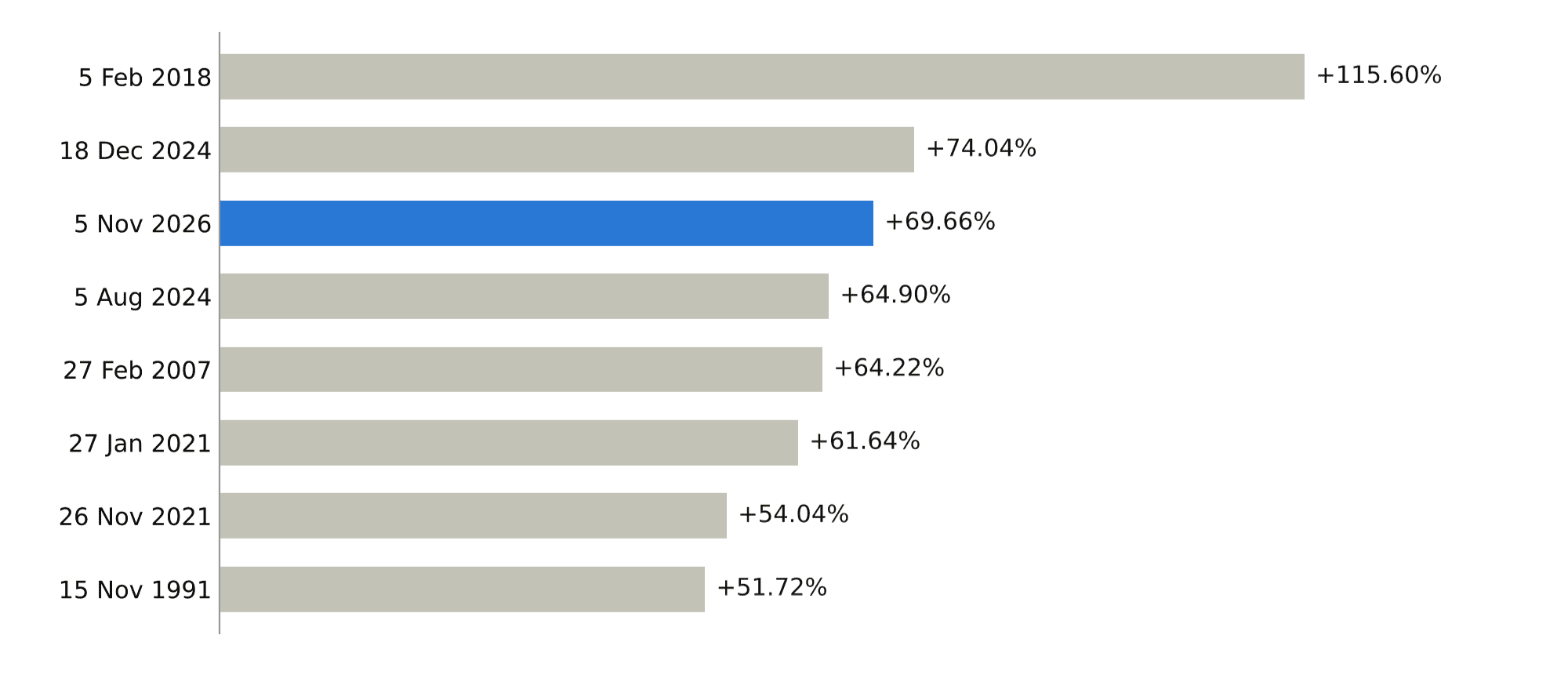
Source: Cboe daily closing data; Nukoud Research calculations. The VIX rose from 16.61 on 4 November to 28.18 on 5 November 2026.
Why Quantum Stocks Are Falling with Semiconductor Shares
The sell-off reflects a broader reassessment of technology valuations. Semiconductor stocks, central to the AI investment cycle, have come under pressure as investors reduce exposure to high-growth technology companies. The VanEck Semiconductor ETF (SMH) recorded a five-trading-day decline comparable to March 2020, according to Goldman Sachs. Quantum companies face additional sensitivity because many are still developing commercial applications and depend on future adoption to justify their valuations.
Figure 2. SMH Posts a Five-Day Decline Comparable to March 2020
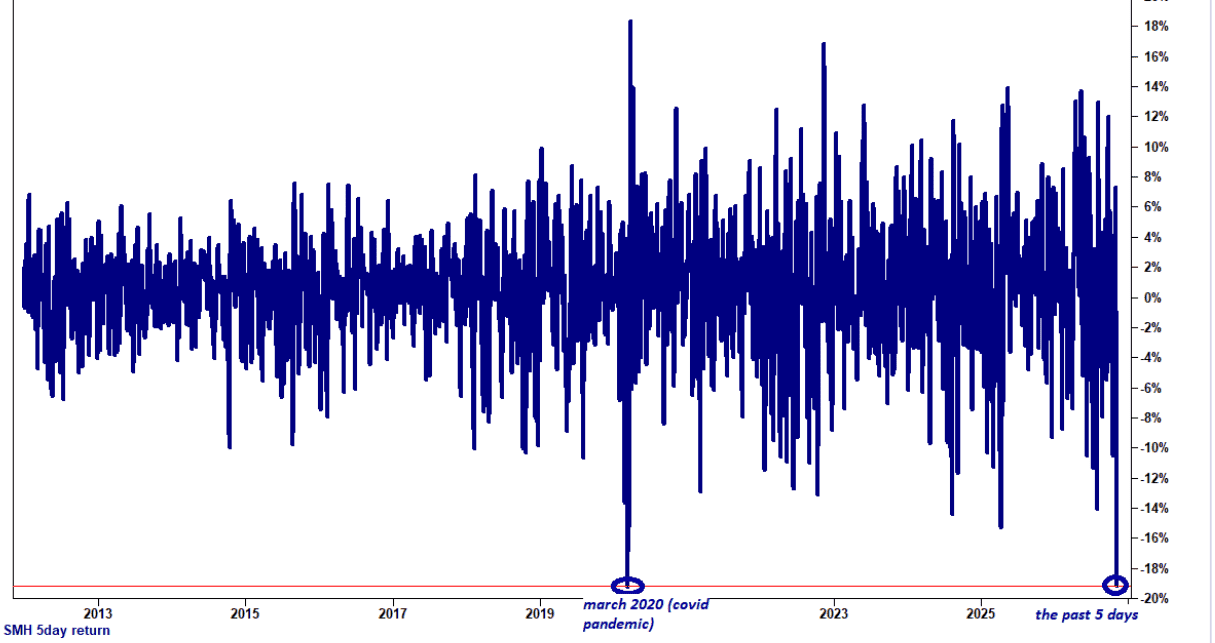
SMH is the VanEck Semiconductor ETF. The comparison uses rolling five-trading-day returns rather than single-day percentage changes. Source: Goldman Sachs research, 6 November 2026.
The Solactive Developed Quantum Computing Index stood 45.7% below its June peak on 6 November, after a 50.2% drawdown the day before. It is the index's fifth fall of more than 30% since January 2019 and the second deepest. The index launched on 31 October 2024, and earlier history is backtested.
All durations are calendar days. The 5 November low remains provisional based on index data available through 9 November 2026. The 156-day drawdown period runs from 2 June to the trough. Recovery is measured from the trough until the previous peak is first regained. Recovery times range from 37 days to 745 days, so the past gives no reliable timetable. Past performance does not predict future results.
Figure 3. Quantum Computing Index Falls 50.2%, Its Second-Deepest Drawdown on Record
 Source: Bloomberg index data. Index history before 31 October 2024 is backtested.
Quantum Computing Companies Show Technology and Revenue Progress
Quantinuum demonstrated 48 error-corrected logical qubits using 98 physical qubits on 4 March 2026. Its Sol system targets 100 logical qubits in 2027, while Apollo targets universal fault tolerance in 2029. Infleqtion reported 30 entangled logical qubits from 80 physical ones in September. Google's Willow processor reduced errors in magic-state preparation by 40 times, although estimates suggest RSA-2048 encryption would require error rates roughly a million times lower. These milestones show progress, but practical fault-tolerant quantum computing remains a substantial technical challenge.
IonQ reported third-quarter revenue of $173.8 million, up 336% year on year. This included $90.3 million from its IonQ Platform segment and $83.5 million from SkyWater foundry services, acquired earlier in 2026. The company expects quantum computing revenue to grow 110% in 2026. Its Superion 256 capacity is sold out for 2027, with orders extending into 2028. The 336% increase reflects both IonQ's existing business and the contribution from SkyWater. Foundry revenue and reserved capacity should not be interpreted as realised quantum computing revenue.
Quantinuum's IPO raised $1.68 billion in gross proceeds when it closed on 5 June. IQM began trading on Nasdaq on 2 July following a SPAC merger, while Pasqal completed a SPAC merger in August. Intel announced a definitive agreement to acquire quantum software company Classiq on 26 October. Its subsequent SEC filing disclosed approximately $1.9 billion in purchase consideration, plus up to $350 million in contingent consideration tied to specified performance milestones. The transaction is expected to close in the first half of 2027, subject to regulatory approvals and customary closing conditions.
The figures reflect company disclosures and announcements available as of November 2026. Revenue growth, technology milestones and capital raised indicate progress, but do not necessarily establish commercial viability or future profitability.
AI and quantum computing: a possible route to protein discovery
In a collaboration with Citrini Research, Anthropic used Claude to generate more than 318,000 candidate protein designs in 64 hours. Of 211 designs shortlisted for laboratory testing, 17 bound to scorpion neurotoxins. They have not been shown to neutralise venom or function as antivenoms. Quantum computing could eventually support molecular simulations and candidate testing, but this experiment used AI and conventional laboratory methods, not a quantum computer.
Quantum ETFs: Comparing Pure-Play Exposure and Index Composition
Quantum ETFs can differ significantly in their exposure to companies directly involved in quantum computing, even when they carry similar thematic labels. Nukoud Research compares five funds using their index composition and holdings dated 2 to 5 November 2026.
How quantum index composition has evolved
Solactive's ARTIS framework uses its proprietary natural-language processing algorithm to screen publicly available information, including financial news, business profiles and company publications, for companies with exposure to the quantum computing industry. Companies are assessed against the index theme and ranked using thematic exposure scores, with constituent selection governed by predefined rules. At its October 2024 launch, two pure-play quantum computing companies represented 13% of the index. By 29 October 2026, before the November rebalance, six companies accounted for 37%.
Figure 4. Pure Plays Grow from 13% to 37% of the Index Since Launch
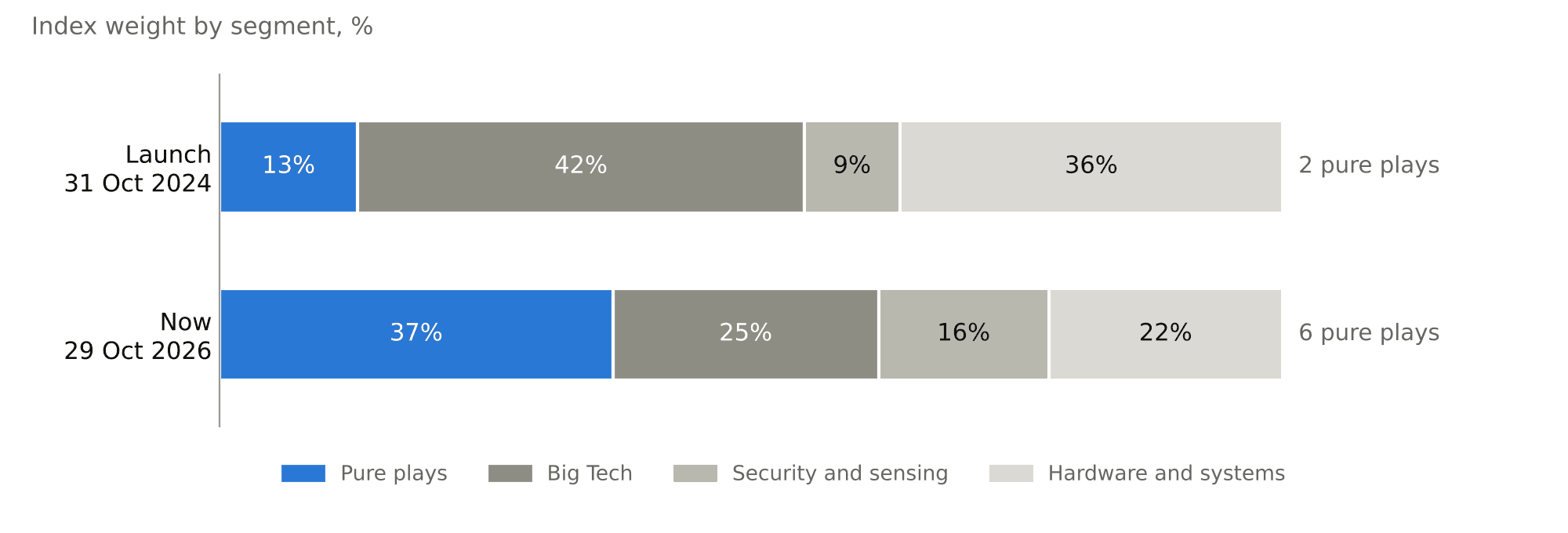
Source: Nukoud Research, based on Solactive index composition data as of October 2024 and 29 October 2026, before the 4 November rebalance.
What each fund tracks
*QQCC is the accumulating share class; QUANTM is the distributing Class B share class listed on ADX.
The Defiance Quantum ETF (QTUM) illustrates why investors should examine an ETF's benchmark. It tracks the BlueStar Quantum Computing and Machine Learning Index, which uses modified equal weighting and a minimum threshold of 70 constituents. If standard eligibility and market-capitalisation rules produce fewer than 70 companies, additional eligible constituents are selected. The index had 82 constituents at its March 2026 review and includes companies involved in quantum computing, machine learning, semiconductor packaging equipment and related technologies.
Separately, QTUM's holdings dated 11 November 2026 included Microsoft, Palantir, Cloudflare and Snowflake alongside quantum-related companies such as Horizon Quantum and Arqit. This broader exposure reflects the index methodology.
Figure 5. Quantum ETFs Vary Widely in Pure-Play Exposure, from 6% to 48%
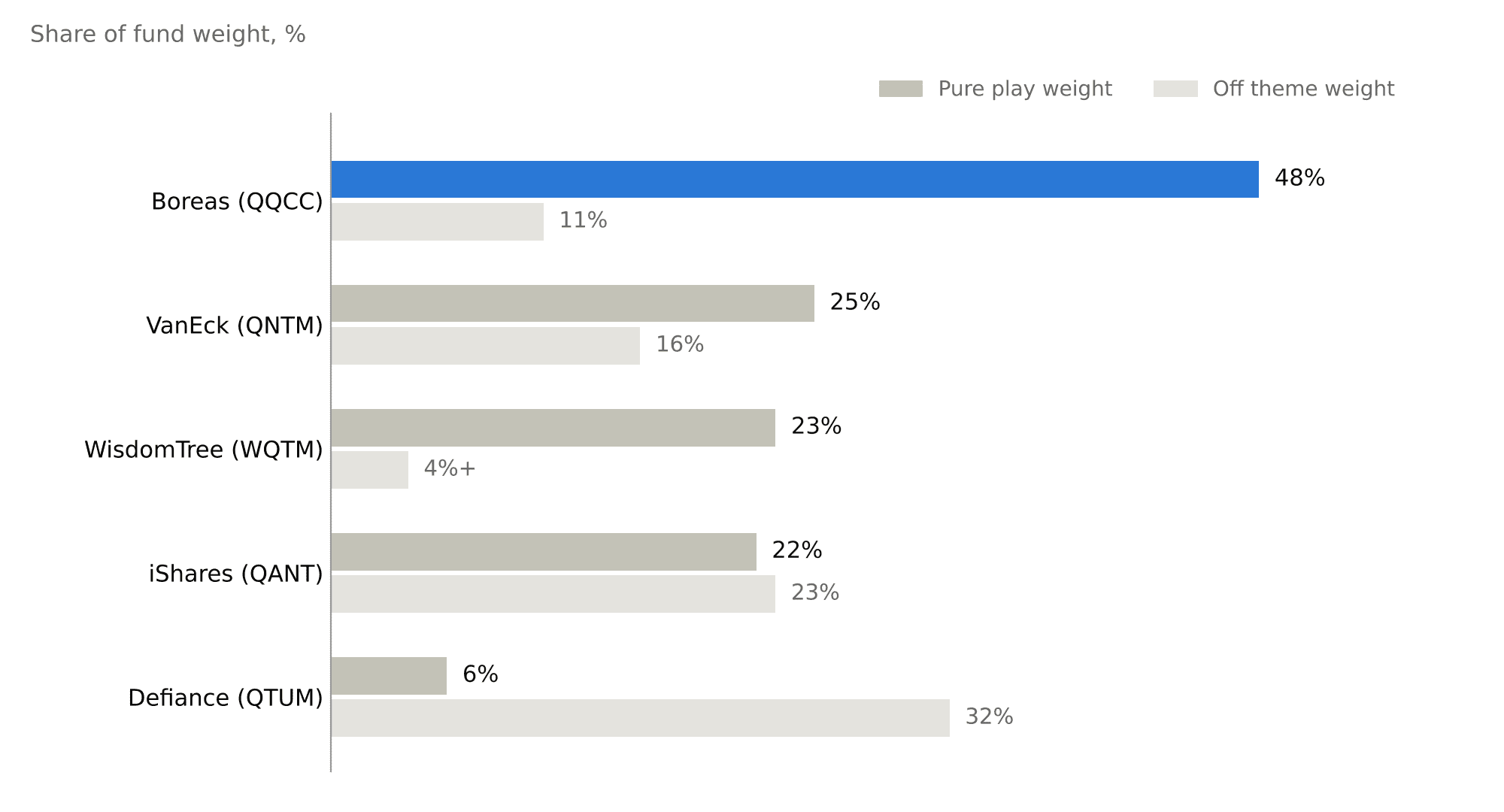
Source: Nukoud Research, based on portfolio holdings dated 2 to 5 November 2026 and Boreas index weights following the 4 November rebalance. The WQTM off-theme weight is a lower-bound estimate.
Pure-play companies derive their main business from quantum computing. Boreas' quantum exposure rises from 48% to 58% when quantum security specialists are included. Off-theme weight measures holdings assessed as having limited direct relevance to quantum computing. Nukoud's scores represent one thematic assessment, not an industry-wide ranking. WQTM's score covers 25 of 53 holdings and is provisional. The comparison does not assess fees, liquidity, risk or returns.
The 4 November Boreas index rebalance added five companies representing 23.4% of the basket: ASML (7.13%), Quantinuum (5.67%), IQM (5.32%), QinetiQ (3.26%) and Horizon Quantum (2.03%). Amazon, Intel, Microchip Technology and Onto Innovation were removed, while SkyWater no longer appears as a standalone holding following its acquisition by IonQ. ASML's September partnership with Xanadu on lithography for photonic quantum chips highlights its growing involvement in the quantum computing supply chain. Intel's agreement to acquire Classiq came after the selection date and was not reflected in the rebalance.
What GCC investors should check
The Boreas fund has traded on ADX as QUANTM since 22 September 2025, when the exchange described it as the region's first thematic ETF. The other four funds are listed on European or US exchanges. BlackRock lists Saudi Arabia among the registered locations for its iShares fund, but this does not confirm availability through individual GCC brokers. Investors should check access before trading.
When comparing funds, investors should consider pure-play exposure, holdings with limited direct relevance to quantum computing, expense ratios, and liquidity. Currency movements also matter for funds holding US dollar-denominated assets. The current correction highlights the trade-off: diversified technology exposure may offer less direct participation in quantum computing, while concentrated strategies can carry greater volatility and deeper drawdowns.
Important information
This article is for informational purposes only and does not constitute investment advice or a recommendation to buy or sell any financial instrument. ETF investments involve capital, market, currency and liquidity risks.
QQCC is the accumulating share class of the Boreas Solactive Quantum Computing UCITS ETF, while QUANTM is its distributing Class B share class listed on ADX. Investors should review the relevant fund documentation before investing.
The index launched on 31 October 2024; earlier data is backtested. Past performance does not predict future results. Pure-play classifications and thematic scores reflect Nukoud Research's own analysis, not official fund ratings.