A sharp reversal in U.S. technology shares is testing the assumptions behind the artificial-intelligence investment boom. As chipmakers and data-center-linked stocks lead the decline, investors are weighing the risk of slower infrastructure investment, stretched valuations and a more uncertain policy outlook.
Wall Street’s Rally Faces a Broad Market Test
U.S. equities fell sharply on November 5, reversing much of the optimism that followed the midterm election results. At one reported intraday snapshot, the Nasdaq Composite was down approximately 4.95%, the S&P 500 3.20% and the Dow Jones Industrial Average 2.15%. The outsized decline in the Nasdaq illustrates the sensitivity of growth-heavy benchmarks to changes in expectations for artificial intelligence.
This is more than a one-day swing. Reuters reported that the Nasdaq Composite had fallen more than 10% from its October 6 record close, crossing the commonly used threshold for a market correction. The speed of the reversal matters: when a handful of large technology companies account for a substantial share of index exposure, pressure on those stocks can quickly spread to diversified index funds.
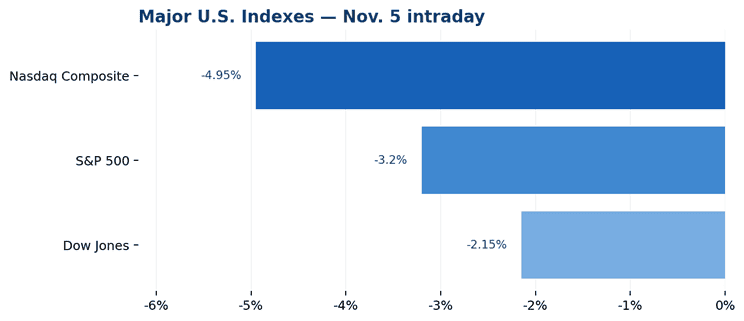
Chart 1. Major U.S. index declines, reported November 5 intraday snapshot. Blue bars show the magnitude of losses; figures are not official closing returns.
The AI Trade Comes Under Pressure
The investment thesis behind AI infrastructure has relied on sustained demand for advanced chips, high-bandwidth memory, networking, power equipment and cloud computing capacity. Companies have announced major capital spending plans to build the systems required to train and run increasingly sophisticated models. That spending has supported revenue growth across parts of the semiconductor supply chain.
The challenge is timing. Building data centers requires large upfront expenditures, while the resulting revenue and productivity gains may arrive over several years. Investors are therefore scrutinizing the gap between capital committed today and cash flow that may be generated tomorrow. Higher borrowing costs make that calculation more demanding, particularly for companies financing expansion with debt.
The market is also becoming less willing to treat all AI-related businesses alike. A chip supplier with current orders and strong margins may be evaluated differently from a data-center operator whose profitability depends on future utilization, financing conditions and long-term customer contracts. This divergence helps explain why company-specific earnings and guidance can amplify sector-wide moves.
Which Stocks Are Being Hit Hardest?
Semiconductors and AI infrastructure companies bore the brunt of the selling. Reported November 5 intraday declines included roughly 6.4% for Nvidia and double-digit declines for several chip and infrastructure names. Reuters also described heavy pressure on the broader semiconductor index. The chart below uses approximate snapshots from different points in the session, so it should not be read as a synchronized ranking of closing returns.
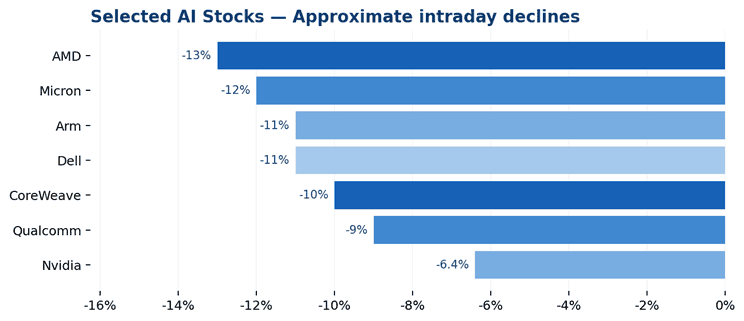
Chart 2. Selected AI and semiconductor stock declines on November 5, approximate intraday figures. Values can differ by reporting time and must be refreshed before publication.
Nvidia remains a bellwether because of its central role in AI computing hardware. AMD, Micron and other chipmakers face similar exposure to shifts in expectations for spending by cloud providers and enterprise customers, although their product mixes and earnings drivers differ. Data-center hardware providers and cloud-infrastructure businesses can face additional sensitivity to construction timelines, financing costs and customer concentration.
The breadth of the decline is as important as any single stock. When selling spreads from leading chip designers to memory, networking, servers and power equipment, it suggests investors are questioning the pace of the entire infrastructure buildout rather than merely reacting to one company’s results.
Why the Selloff Accelerated
1. Questions about returns on AI spending
Investors want evidence that spending on chips and data centers is translating into durable revenue, operating margins and free cash flow. Strong demand does not automatically guarantee attractive investment returns if capacity expands faster than monetization or if hardware must be replaced rapidly.
2. Political and regulatory uncertainty
The Democratic sweep of Congress added uncertainty about future oversight of data-center expansion, energy use and the wider AI industry. Regulatory change is a possible risk rather than a settled outcome; the timing and scope of any new policy remain unclear. Nonetheless, the prospect of permitting delays or additional costs can affect valuations before formal rules are adopted.
3. Valuation and positioning
Technology shares entered the correction after a long period of strong investor interest in AI. When earnings expectations are high, even a modest disappointment can prompt sharp repricing. Crowded positioning can reinforce this process as investors reduce exposure to the same widely held themes at once.
What the Nasdaq Correction Does—and Does Not—Mean
A correction is generally defined as a fall of at least 10% from a recent market peak. It is a measure of price movement, not proof of a recession or the collapse of a technology theme. Corrections can occur during otherwise positive calendar years, and subsequent outcomes vary widely.
The key distinction is between a valuation reset and a deterioration in fundamentals. If corporate profits continue to grow and AI utilization rises, lower valuations could eventually stabilize the market. If companies cut spending plans or struggle to monetize capacity, earnings estimates may need to fall as well, prolonging the adjustment. Neither outcome can be established from a single volatile session.
What It Means for UAE ETF Investors
The selloff has direct relevance for investors who access global growth and technology themes through exchange-traded funds on the Abu Dhabi Securities Exchange. ADX-listed thematic products, including Lunate’s QUANTUM and USGROWTH, offer exposure to different investment strategies and should not be assumed to hold identical securities or carry identical risk.
Investors should distinguish a fund’s theme from its actual portfolio. An AI-oriented ETF might emphasize chipmakers, cloud platforms, software or supporting infrastructure, while a broader growth fund may combine technology with other sectors. Concentration in a small number of holdings, currency exposure, fund methodology and rebalancing rules can materially change performance during a selloff.
For market makers, sharp moves in underlying U.S. securities can widen hedging costs and increase the importance of reliable price discovery, particularly when local trading hours do not overlap fully with the primary market. Transparent indicative values, access to underlying liquidity and effective creation/redemption arrangements help maintain orderly secondary-market trading, although the mechanics differ by ETF.
What Investors Should Watch Next
The next earnings cycle will be critical. Guidance from large cloud providers and semiconductor manufacturers should help clarify whether AI infrastructure budgets remain intact. Investors will also monitor data-center permitting, energy constraints, financing conditions and evidence that AI products are producing commercial returns.
For ETF investors, a useful approach is to examine underlying holdings and index concentration alongside performance rather than extrapolating from a single market headline. A broad-market fund, a technology-sector fund and a narrowly focused AI thematic ETF can behave very differently during the same correction.
Bottom Line
The November 5 selloff represents an important test of the AI-led equity rally. The long-term demand for computing and automation may remain substantial, but markets are increasingly demanding proof that investment spending can translate into sustainable profits. The central question is shifting from how much companies are spending on AI to how much value those investments can ultimately create.
Sources and Data Notes
MarketWatch, “Is this the big one for the stock market? Wall Street sounds off as tech plunges” (November 2026): https://www.marketwatch.com/story/is-this-the-big-one-for-the-stock-market-wall-street-sounds-off-as-tech-plunges-185df529
Reuters, November 5, 2026, “Nasdaq set to confirm correction as AI stocks tumble”: https://www.reuters.com/business/sp-500-futures-steady-after-midterm-rally-nasdaq-lags-chip-weakness-2026-11-05/
Reuters, November 5, 2026, “Nasdaq set for correction as investors reassess AI spending boom”: https://www.reuters.com/markets/us/nasdaq-set-correction-investors-reassess-ai-spending-boom-2026-11-05/
Performance figures are reported intraday snapshots, not final November 5 closing returns. The stock chart combines approximate figures reported at different times and should be refreshed with synchronized market data before release.