

Authored by Gerald Blondel
For Islamic fund managers, discretionary portfolio managers, family offices, takaful investors and institutional allocators, ETFs remain underutilized tools. This is understandable. An ETF may be liquid, transparent, low cost and operationally convenient, yet its Shariah status can be less obvious than that of a directly held security or a dedicated Islamic mutual fund.
That caution should not lead to avoidance. Properly selected ETFs can help Islamic asset managers obtain efficient exposure to global equities, sukuk, real estate, commodities and specific market segments while improving liquidity, diversification and implementation efficiency.
The difficulty is that an ETF described as “Shariah-compliant” should not be accepted merely because it carries an Islamic label, tracks an Islamic index, or is issued by a recognized institution. The relevant question is whether the manager can demonstrate that the underlying assets, ETF structure, operational practices and governance arrangements are consistent with the manager’s adopted Shariah standard.
Shariah compliance is not established by a factsheet. It is established by evidence.
The two-layer assessment
ETF due diligence begins with a simple distinction.
The first layer is the underlying exposure: the shares, sukuk, real estate securities, commodities or other instruments held by the ETF.
The second layer is the ETF vehicle: how the fund is structured, how it replicates its benchmark, how it manages cash, whether it borrows, lends securities, uses derivatives, manages collateral, treats incidental non-permissible income and receives Shariah oversight.
Both layers must be acceptable.
A Shariah-compliant index does not automatically make every ETF tracking it Shariah-compliant. The index may apply an acceptable screen to its constituents, while the ETF itself may hold cash in interest-bearing accounts, lend securities, use total-return swaps, enter into conventional derivatives, borrow funds, reinvest collateral or operate under a prospectus that permits activities not approved by the asset manager’s Shariah board.
Equally, a well-structured ETF can only be accepted if its underlying assets are screened according to a methodology that the manager and its Shariah advisers consider appropriate.
The review must therefore be both look-through and wrapper-through:
Underlying assets + Fund structure + Operational controls + Shariah governance
= A defensible compliance conclusion
The ETF due-diligence framework
A third-party ETF should be assessed across eight connected areas before it is admitted to a Shariah-governed portfolio. The first six concern the assets and operation of the fund; the final two concern the governance and approval process that allow an asset manager to rely on the Shariah claim.
|
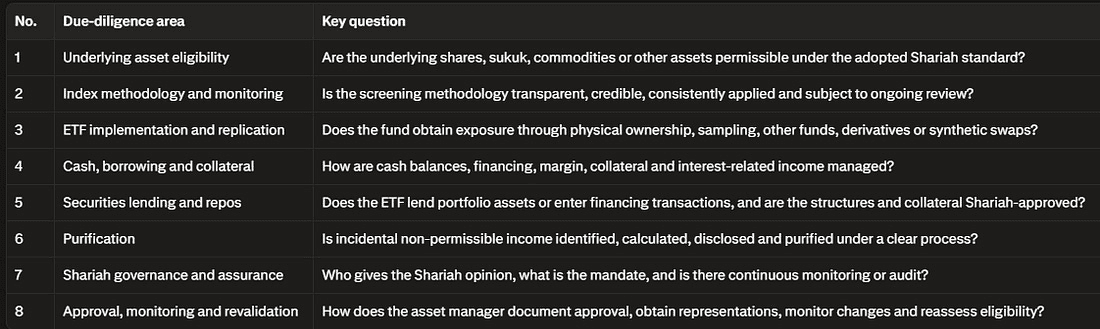
1. Underlying asset eligibility
The starting point is the nature of the assets held by the ETF and the rules used to select them.
For an equity ETF, the manager should confirm that the methodology applies both:
A business-activity screen, excluding prohibited activities such as conventional banking and lending, conventional insurance, gambling, alcohol, pork-related products, tobacco, adult entertainment and other impermissible sectors under the adopted Shariah standard.
A financial screen, assessing the company’s use of interest-bearing debt, interest-bearing cash or securities, receivables, and non-permissible income.
The exact thresholds are not universal. AAOIFI-based screens, FTSE Shariah, MSCI Islamic, S&P Shariah, Dow Jones Islamic Market, the Securities Commission Malaysia methodology and other recognized approaches may differ in their calculations, thresholds, denominators and treatment of exceptional cases.
The question is not whether the ETF says that it uses a “Shariah screen.” The questions are:
Which methodology is used?
Which Shariah standard or scholarly interpretation supports it?
Who applies the screen?
What financial data are used?
How often are holdings re-screened?
What happens when a company becomes non-compliant?
Is the screen applied consistently to every security in the portfolio?
For sukuk ETFs, the review must confirm that the underlying instruments are genuine Shariah-compliant sukuk rather than conventional debt securities relabelled through a marketing exercise. The manager should consider the sukuk structures, underlying assets or activities, Shariah certification, trading treatment and use of cash balances.
For commodity ETFs/ETCs, the analysis must go further. The manager should establish whether the ETC provides ownership exposure to a permissible physical commodity, exposure through futures or swaps, or merely a return linked to a commodity index. These structures have materially different Shariah implications.
2. Index methodology and monitoring
The benchmark is often the first source of Shariah assurance, but it should not be treated as conclusive.
The asset manager should obtain the full index methodology and assess:
The business-activity exclusions.
The financial-ratio screens.
The treatment of mixed-income companies.
The treatment of financial institutions and financial-service businesses.
The data sources used for screening.
The review and rebalance frequency.
The process for corporate actions, mergers, spin-offs, rights issues and delistings.
The treatment of companies that breach a Shariah threshold between review dates.
The authority responsible for resolving difficult or exceptional cases.
Whether the methodology is supported by a named Shariah board or Islamic-finance adviser.
A methodology should be sufficiently transparent for the manager’s Shariah board and investment committee to understand what is being approved. A generic statement that an index is “Islamic,” “ethical,” “values-based” or “Shariah-aware” is not enough.
The manager should also distinguish between an index that has been subject to an initial Shariah certification and one that is subject to a continuing Shariah review. Markets, issuers, accounting data and index methodologies change. A one-time opinion does not by itself prove that the current index continues to comply with the original ruling.
3. ETF implementation and replication
The ETF may not hold every constituent in the index. It may use full replication, representative sampling, optimisation, depositary receipts, other investment funds or derivatives to achieve its investment objective.
The manager should establish whether the ETF is:
Fully physically replicated.
Physically replicated through sampling.
Funded through other collective investment vehicles.
Synthetic, using total-return swaps.
Partly synthetic, with physical holdings and derivative overlays.
Futures-based or options-based.
Leveraged, inverse or short-oriented.
Physical ownership of screened securities is generally easier to assess than synthetic replication. A synthetic ETF may deliver the return of a Shariah index while the fund’s assets are held in a substitute basket and the desired return is obtained through a swap with a conventional counterparty.
The issue is not simply the economic result. The issue is the contractual and operational structure through which that result is delivered.
Where the ETF uses derivatives, the manager should obtain a specific explanation of:
The purpose of each derivative.
The type of derivative used.
The counterparties involved.
The margin and collateral arrangements.
The extent of derivative exposure.
Whether the transaction is used for hedging, replication, liquidity or return enhancement.
The Shariah basis on which it is considered permissible.
Whether the product has been reviewed by the ETF’s Shariah authority at fund level, rather than only at index level.
Broad prospectus language allowing derivatives “for efficient portfolio management” should not be treated as sufficient Shariah evidence.
4. Cash, borrowing and collateral
The treatment of cash is frequently overlooked, even though it is one of the most practical issues in ETF governance.
An ETF will often hold temporary cash due to subscriptions, redemptions, dividend receipts, settlement cycles, corporate actions and portfolio rebalancing. The asset manager should determine:
Where is this cash held?
Does it earn interest?
Is it placed in conventional deposits, money-market funds, treasury bills, repos or other interest-bearing instruments?
Is there an approved Islamic liquidity-management arrangement?
If interest is unavoidable, is it segregated and subject to purification?
Is the policy documented and subject to Shariah oversight?
The review should also cover borrowing and leverage.
Questions should include:
Can the ETF borrow money?
Is any borrowing interest-bearing?
Is it only for temporary settlement purposes or an integral investment feature?
Does the ETF employ leverage directly or through derivatives?
Does it use margin facilities?
Can it engage in short selling?
Can it hold leveraged, inverse or volatility-linked instruments?
An ETF may have a Shariah-screened portfolio but still operate with conventional borrowing powers. The existence of these powers does not always mean that they are used, but the manager should not assume that unused permissions are irrelevant. The policy, practice and Shariah treatment must be confirmed.
Collateral requires similar attention. Where the fund uses derivatives, securities lending, repos or other financing arrangements, collateral may consist of conventional bonds, interest-bearing cash, equities, money-market securities or other assets. The manager should know:
What collateral can be accepted?
How is it valued and held?
Is cash collateral reinvested?
What investments are permitted for reinvestment?
Who bears counterparty and reinvestment risk?
Is the collateral process covered by the ETF’s Shariah review?
5. Securities lending requires a separate decision
Securities lending deserves independent assessment. It is not a minor operational detail.
A conventional ETF may lend shares or bonds from the portfolio to other market participants in exchange for a lending fee and collateral. The income may be retained by the fund, shared with the manager or used to offset expenses. For Islamic investors, the assessment extends beyond the securities being lent.
The asset manager should examine:
The contractual form of the lending arrangement.
The identity and nature of borrowers.
Whether securities are lent to facilitate short selling.
The type of collateral accepted.
The treatment and reinvestment of cash collateral.
The source and allocation of lending income.
The treatment of manufactured dividends.
The fund’s ability to recall securities for voting or other purposes.
Whether the practice is permitted, restricted or prohibited by the relevant Shariah authority.
Some Shariah boards may take a restrictive view. Others may consider certain structures acceptable under carefully defined conditions. The asset manager should not assume that an acceptable conclusion for one fund, jurisdiction or Shariah board automatically applies to another.
If the ETF provider cannot provide a clear policy and Shariah position, the conservative approach is to exclude the fund or require securities lending to be disabled for the relevant share class or mandate.
6. Purification is not an afterthought
Purification is a central element of Shariah equity investing where the approved methodology permits limited incidental non-permissible income.
A company may pass the relevant business and financial screens while still receiving a small amount of interest income or other incidental non-compliant revenue. The impure portion attributable to the investor should be identified and donated to charity without the investor intending to benefit from that amount.
For an ETF, the manager should require clarity on:
Whether purification is required.
Which income sources are included in the calculation.
Whether it covers only constituent-company income or also fund-level interest and operational income.
The methodology used to calculate the amount.
The frequency of calculation and publication.
The amount attributable per share or per distribution.
The party responsible for the calculation.
The party responsible for making or facilitating charitable donation.
The treatment of amounts arising from cash balances, collateral, securities lending, corporate actions or settlement activity.
A statement that “investors may need to purify dividends” is not a complete policy. A credible ETF should provide the information required for the investor to discharge the obligation properly.
The asset manager should also determine whether the institution will undertake purification centrally for managed mandates or disclose the amount to clients for individual action. This should be addressed in the manager’s own Shariah governance policy, client documentation and operational procedures.
7. Who provides Shariah assurance?
A fund can be regulated, audited and listed on a major exchange without being Shariah-compliant. Regulation and conventional financial governance are necessary, but they serve different purposes.
The key question is whether the ETF has a credible Shariah-governance structure.
|
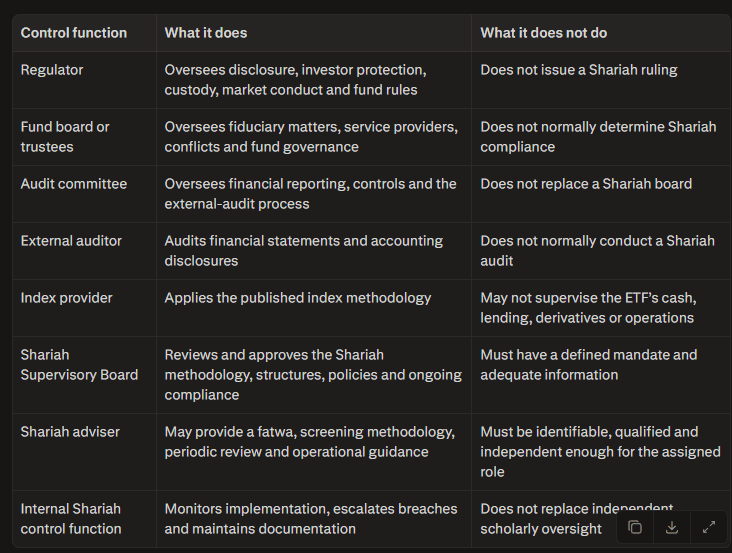
The distinction between Shariah certification and Shariah audit is particularly important.
A Shariah certificate or fatwa may approve an ETF’s structure, an index methodology or a proposed investment policy at launch. It is an important document, but it is not necessarily proof that the product has operated in accordance with that approval over time.
A Shariah audit or continuing Shariah review examines whether the actual operations, holdings, cash arrangements, purifications, exceptions and controls remained within the approved parameters.
A financial audit, meanwhile, examines financial statements and related controls. It should not be misrepresented as a Shariah audit.
An asset manager should therefore seek evidence of both:
An initial Shariah opinion or certification covering the relevant ETF or its complete structure.
Periodic Shariah review, audit, monitoring or re-certification confirming continuing compliance.
Does the issuer’s domicile matter?
The nationality of the issuer is not the test.
An American, European, Asian or global issuer can establish credible Shariah governance if it retains qualified scholars or a recognized Shariah advisory firm, adopts a transparent methodology, applies effective operational controls and provides evidence of continuing oversight.
Equally, an issuer in a Muslim-majority market should not receive automatic approval merely because of its domicile or branding. A product may be established in a recognized Islamic-finance centre and still provide limited disclosure on cash management, derivative use, securities lending, purification or the scope of its Shariah adviser’s mandate.
The relevant test is one of substance, not geography.
For an offshore ETF, the Middle Eastern asset manager should be able to identify:
The Shariah board members or advisory firm.
Their qualifications and experience in Islamic finance.
The scope of their appointment.
The exact product, index or share class covered by their mandate.
The applicable Shariah methodology.
The date and scope of the fatwa or certificate.
The frequency of review or renewal.
The process for identifying, reporting and remedying breaches.
The purification policy.
Any limitations or exceptions to the Shariah opinion.
A vague statement that the product has been “reviewed by Islamic scholars” should not be sufficient for an institutional approval.
The approval process
A robust ETF approval process should be documented and repeatable. It should not depend on the familiarity of the issuer, the popularity of the benchmark or the attractiveness of the expense ratio.
Define the governing standard
The asset manager should first establish its own reference framework. This may be based on AAOIFI standards, the rulings of the manager’s appointed Shariah board, a national Shariah authority, a recognised index methodology or a documented combination of these sources.
Without an internal standard, ETF approvals become inconsistent. One portfolio manager may accept an index using one set of financial thresholds, while another accepts a different methodology without board review. The result is not a Shariah policy; it is product-by-product discretion.
Obtain primary evidence
The review should rely on legal, operational and Shariah documentation—not only sales materials.
At a minimum, the manager should obtain:
The current prospectus and supplementary offering documents.
The statement of additional information, where applicable.
The latest annual and interim financial reports.
The current holdings file.
The index methodology.
The fatwa, Shariah certificate or formal advisory opinion.
The names and biographies of the Shariah advisers or board members.
Any Shariah audit, periodic review or compliance report.
The purification methodology and latest calculation.
The securities-lending policy.
The cash-management and collateral policy.
The derivatives and efficient-portfolio-management policy.
Details of the fund board, custodian, administrator, auditor and investment adviser.
Written confirmation of material changes since the latest Shariah approval.
Where a provider cannot supply material evidence, the asset manager should treat the product as insufficiently documented rather than relying on assumptions.
Confirm the chain of accountability
The manager should be able to map the following sequence:
1- Adopted shariah standard
2- Screening methodology
3- Index construction
4- ETF portfolio implementation
5- Operationals control
6- Shariah review
7- Purification and reporting
The investment should not be approved where this chain is incomplete.
A common weakness is a fund that has an Islamic index certificate but no clear evidence that the ETF’s own securities lending, cash management, derivatives, collateral or corporate-action procedures have been reviewed. In that case, the index may be acceptable while the ETF vehicle remains unverified.
Approve conditionally and review periodically
ETF approval should not be permanent.
The manager should reassess approval when there is a change in:
The index methodology.
The Shariah board, adviser or certification.
The investment adviser, sub-adviser, administrator, custodian or auditor.
The use of derivatives, borrowing, securities lending or cash-management practices.
The ETF’s legal structure, domicile or listing venue.
The purification policy.
The ETF’s holdings, tracking method or portfolio deviations.
Any reported Shariah breach, controversy or corrective action.
For a core allocation or a complex structure, annual review should be the minimum. More frequent monitoring may be appropriate where the ETF uses derivatives, sampling, securities lending, non-standard collateral or offshore operational arrangements.
Red flags
The following points should trigger escalation, further investigation or non-approval:
The ETF uses a Shariah label but does not identify the scholars or advisory firm responsible.
There is no current fatwa, certificate, methodology document or Shariah review report.
The certificate covers only the index and not the ETF vehicle.
The index methodology does not disclose financial screens, thresholds or review procedures.
The issuer cannot explain how non-permissible income is calculated and purified.
Cash is held conventionally, but interest treatment is unclear.
The ETF permits broad derivatives, securities lending, borrowing or collateral reinvestment without a Shariah-specific policy.
The ETF relies on synthetic replication or total-return swaps without an adequate Shariah analysis.
Securities lending is permitted but the collateral, income allocation and reinvestment policy are not transparent.
The fund’s Shariah certification is old, expired, generic or limited in scope.
There is no evidence of periodic Shariah monitoring or audit.
The fund’s marketing language is stronger than its legal documentation.
The provider refuses to provide primary documentation or written confirmations.
Actual holdings differ materially from the stated Shariah benchmark without an adequate explanation.
Case study: the “Shariah index” ETF
A global ETF tracks a recognized Islamic equity index. Its marketing material states that the benchmark excludes prohibited sectors and applies financial-ratio screens. The fund is physically replicated, liquid and competitively priced.
The asset manager’s review finds, however, that the public materials do not clearly state whether the fund engages in securities lending, whether cash collateral is reinvested, whether derivatives may be used, how temporary cash balances are managed, or whether fund-level incidental income is purified.
The Shariah certificate applies to the index methodology, but the documents do not clearly confirm that it extends to the ETF vehicle and its operational practices.
Conclusion: The fund cannot yet be approved as a fully Shariah-compliant ETF for the mandate. It may be approved only after the issuer provides written, current and fund-specific confirmation covering the outstanding matters—or it may be excluded until that evidence is available.
Conclusion
ETFs should not be viewed with suspicion merely because they are ETFs, foreign domiciled or issued by conventional global asset managers. They can be highly effective instruments for Islamic portfolio construction, offering liquidity, transparency, broad diversification and cost-efficient access to markets that may be difficult to reach through direct holdings.
But an Islamic asset manager cannot delegate its Shariah responsibility to a product label.
The manager must assess the assets, the index methodology, the ETF structure, the treatment of cash and collateral, the use of securities lending and derivatives, the purification process, and the quality of ongoing Shariah supervision. A well-known issuer, a major exchange listing, a recognized regulator and a financial audit are important controls—but none of them, alone, establishes Shariah compliance.