


Qatar offers an unusually clean case study in how ETF structure can matter almost as much as country exposure. Investors can buy the locally listed conventional QE Index ETF, QETF, the locally listed Shariah-compliant Al Rayan Qatar ETF, QATR, or the U.S.-domiciled iShares MSCI Qatar ETF, QAT on Nasdaq.
All three provide access to Qatari equities, but they differ in benchmark construction, Shariah status, fees, trading venue and portfolio concentration.
The size gap is the issue here. QETF reported net assets of QAR398.82 million as of June 30, 2026, equal to QAR9.82 per unit. QATR reported QAR446.62 million at the same date, or QAR2.1818 per unit.
Combined, the two local ETFs held about QAR845.4 million, equivalent to roughly $232 million at the riyal’s dollar peg. QAT, by comparison, held $63.5 million as of August 11. On that basis, Qatar’s two home-market ETFs together are about 3.7 times larger than the U.S.-listed fund.
QETF Offers the Closest Route to the Main Market
QETF seeks to replicate the Qatar Stock Exchange Price Index, which contains 20 of the market’s largest and most liquid companies. Doha Bank says the fund invests according to index weights and caps its total expense ratio at 0.50%. It distributes accumulated dividends at least annually. At the end of 2025, financial companies represented 54% of its equity portfolio, followed by industrials at 22%, transportation at 10% and telecommunications at 9%.
Its June NAV was down from QAR419.41 million a year earlier, despite remaining the main conventional local ETF route. The product’s advantage is operational simplicity for Qatar-based investors: QAR trading, Qatar Stock Exchange hours and local brokerage access.
QATR Changes the Sector Mix Through Shariah Screening
QATR follows the QE Al Rayan Islamic Index and caps annual charges at 0.50%. Its portfolio is therefore materially different from QETF even though both invest exclusively in Qatar.
As of the March index review, Industries Qatar carried a 15% weight, Qatar Islamic Bank 12%, Al Rayan Bank 10% and Dukhan Bank 7.5%. Conventional banks excluded by the Shariah methodology do not simply disappear without consequence; their removal reallocates weight toward Islamic financials, industrial companies, utilities and communications. QATR also distributes dividends at least annually after expenses and Shariah purification.
That makes QATR more than a faith-based version of QETF. It is a different factor and sector portfolio.
QAT Brings Qatar Into a U.S. Wrapper
BlackRock’s QAT tracks the MSCI All Qatar Capped Index and held 33 securities as of August 11. It charged a 0.60% expense ratio, offered a 4.87% trailing 12-month yield as of July 31 and had a 30-day median bid-ask spread of 0.40%. Its largest holding was Qatar National Bank at 22.48% in BlackRock’s latest factsheet, followed by Qatar Islamic Bank at 13.83%.
QAT gives international investors convenient dollar trading and U.S. brokerage access, but the wrapper introduces considerations that local investors do not face with QETF or QATR, including U.S. domicile, distribution treatment and potential U.S. estate-tax exposure for non-U.S. investors.
The Wrapper Matters as Much as the Market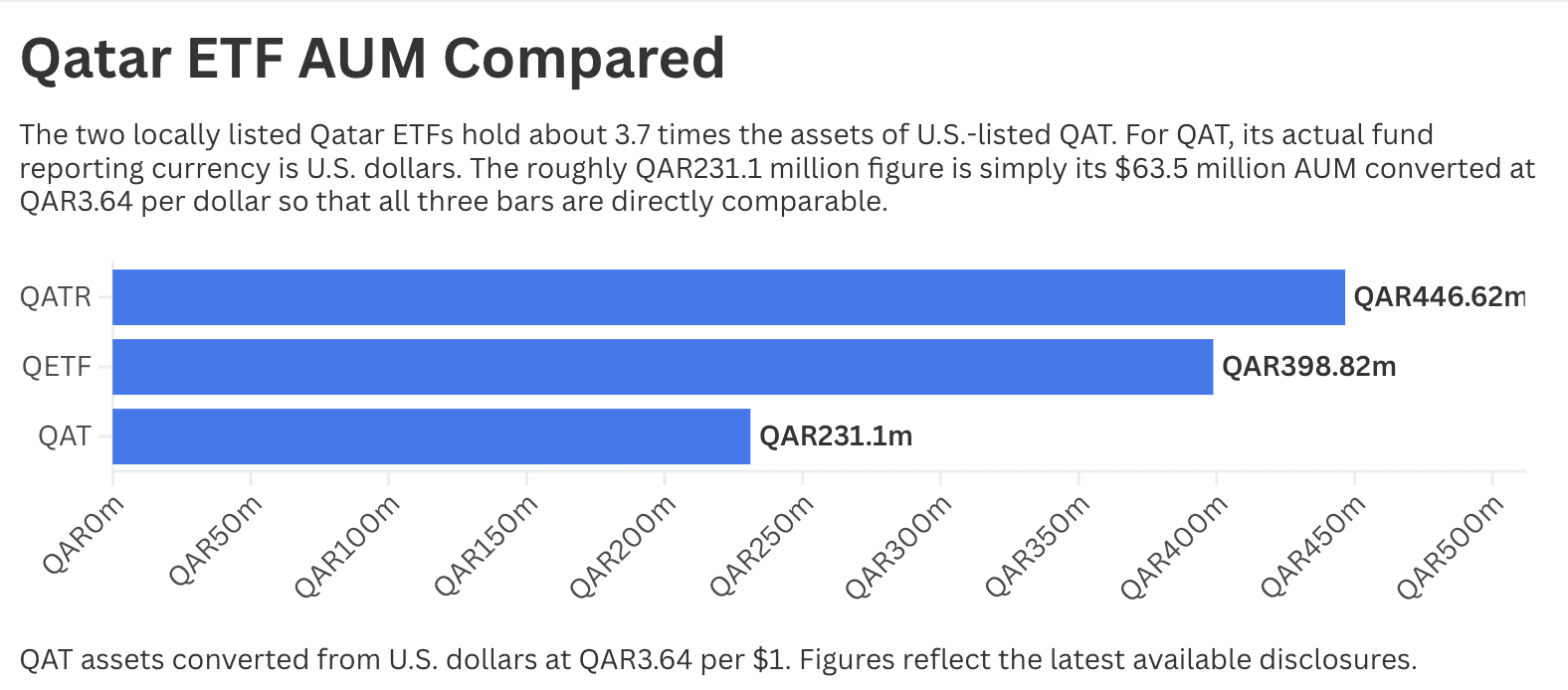
Qatar’s three ETFs show why country exposure alone does not tell the full story. QETF provides conventional exposure through the local market, QATR applies Shariah screening that changes the portfolio’s sector and company weights, while QAT packages Qatari equities inside a U.S.-domiciled, Nasdaq-listed structure.
Investors are therefore choosing between different benchmarks, fees, trading venues and regulatory wrappers alongside the underlying market.
A dedicated single-country Qatar UCITS ETF does not appear to be available, leaving investors who require a UCITS structure to access Qatar through broader GCC or emerging-market funds. For non-U.S. GCC investors, that can make the domicile of QAT an important consideration alongside liquidity and cost.
One regional alternative is the Lunate Solactive GCC Shariah Dividend ETF, GCCDIV, which allocates more than 30% of its portfolio to Qatari equities, concentrating that exposure among some of the market’s higher-dividend Shariah-compliant companies. The fund provides another route into Qatar for investors who prefer a diversified GCC portfolio rather than a dedicated single-country allocation.
The clearest signal comes from where investors have already placed their money. QETF and QATR together hold roughly 3.7 times the assets of the U.S.-listed QAT. For dedicated Qatar ETF exposure, the center of gravity remains in Doha.