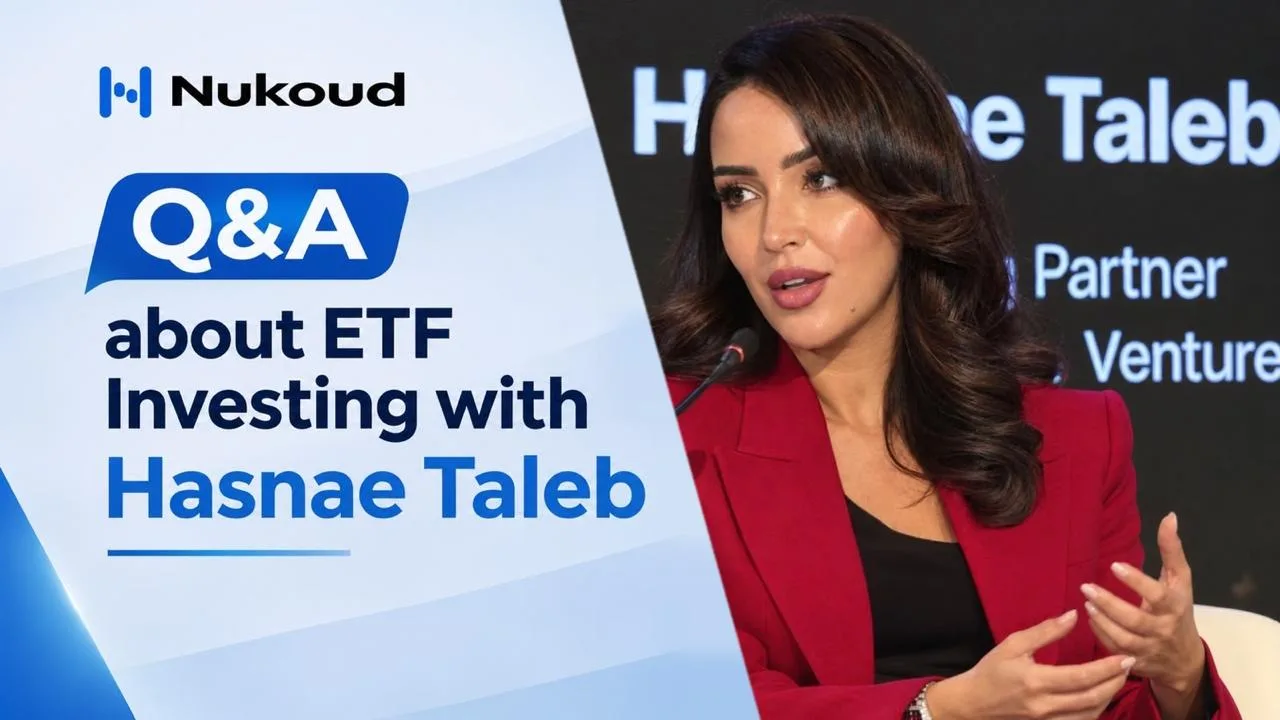
Hasnae Taleb is a financial markets professional with experience spanning Wall Street and the Middle East, bringing a unique perspective on trading, investing, and wealth creation. Hasnae shares her insights on ETF investing, building long-term wealth, AI and thematic ETFs, gold, and Bitcoin.
1. From the US to Dubai
Q: Hasnae, you’ve built a career spanning Wall Street and the Middle East. How has that experience shaped your investment philosophy, and what is the biggest mistake you see individual investors making today?
A: Working in the US markets and later building my career in the Middle East gave me two very different perspectives on capital.
Wall Street taught me discipline, to respect research, understand risk, question valuations and never fall in love with an investment. The market doesn't care about your emotions or how convinced you are about a particular stock.
In the Middle East, I've had the opportunity to see a different side of capital allocation. The region is seeing incredible ambition, institutional capital, and economic transformation. It has changed the way I look at opportunities. It also taught me that capital should always have a purpose.
The biggest mistake I see individual investors making is confusing activity with investing. They buy something because it's trending, sell because the market drops, and then move on to the next opportunity. There is no real strategy behind their decisions.
Working on the trading side, you learn that being right about market direction isn't enough. You need to understand your entry point, your risk and when to walk away. For anybody who’s reading this today, stop trying to make money on every market move and start thinking about where you want your capital to be long term- five or ten years from now.
2. Why ETFs?
Q: ETFs have transformed how people invest globally. What makes them such a powerful investment tool, and why should investors in the UAE and Saudi Arabia pay more attention to them?
A: I love ETFs! What I like them is that they have made investing much more accessible without necessarily making it complicated.
An investor who wants exposure to the US technology sector doesn't necessarily need to spend days and weeks researching individual companies, reading earnings reports and deciding which stock to buy. Through an ETF, they can simply gain exposure to a basket of companies through a single investment and that’s powerful.
You get diversification ,full transparency and, in many cases, lower costs compared with actively managed investment products. You can also access different markets, sectors, commodities and even fixed income through the same investment structure.
For investors in the UAE and Saudi Arabia, I think this is particularly interesting. We're increasingly seeing investment opportunities that were historically more difficult for retail investors in the region to access. So with ETFs, you can build exposure to international markets while also looking at regional opportunities, sukuk, Shariah compliant investments and other asset classes.
However, like any other asset class, an ETF is not always a good investment simply because it's an ETF. Investors will still need to understand what it holds, what it costs and how it behaves in different market conditions. The vehicle is important, but in my opinion the underlying investment is what ultimately matters.
3. ETFs vs. Individual Stocks
Q: Many investors dream of finding the next Nvidia or Tesla. Would you rather invest in a few promising individual stocks or build a diversified portfolio using ETFs? How do you approach that decision?
A: I actually think that both serve different purposes.
I've spent a significant part of my career analysing and trading individual equities, so I appreciate the opportunity that comes from identifying a great business before the broader market fully recognises its potential, but finding the next Nvidia is much harder than people make it look. We tend to look backwards at successful companies and forget how many businesses were once considered the next big thing and never delivered. I would look into what I would call a core and satellite strategy.
I like having a diversified core portfolio that provides broad exposure to markets and sectors. Around that, you can build smaller positions in individual companies where you have conviction, understand the business and believe the valuation justifies the risk. The important distinction is that you shouldn't confuse conviction with concentration.
Even when I really like a company, I still ask myself what happens if my investment thesis is wrong. How much can I afford to lose? What percentage of my portfolio should this position represent?
4. Building Wealth for the Long Term
Q: If someone in the UAE is just beginning their investment journey, what principles should guide their first investment decisions? Where might ETFs fit into a long-term strategy?
A: The first thing I would tell someone starting their investment journey today is not to rush.
Becoming a sophisticated investor doesn’t happen overnight, it’s not what you see on social media. You must start by understanding your own financial position. What are your expenses? Do you have an emergency reserve? What are you investing for? Is it retirement, buying property, financial independence, or simply building wealth over time? These questions matter more than anything else.
For someone starting out, I would look at broad market ETFs as a potential foundation. They provide exposure to multiple companies, which means you're not relying on the performance of one business. I would also invest consistently rather than trying to predict the perfect day to enter the market. Markets will always give you a reason to wait. There will always be another geopolitical concern, another interest rate decision, or another headline suggesting that a correction is coming.
Patience is another element. Compounding needs time, so you cannot expect a long term investment strategy to deliver meaningful results if you're constantly withdrawing money or changing direction every few months. And please, don't invest money you might need next month in assets that can fall 20% tomorrow.
5. The UAE and GCC ETF Opportunity
Q: We're seeing growing ETF offerings on the Abu Dhabi Securities Exchange and Saudi Exchange, including global equities, technology, gold, and Shariah-compliant investments. What do you think needs to happen for ETF adoption to accelerate across the GCC?
A: I think the GCC has a very interesting opportunity here.
We're at a stage where the region is everyday becoming sophisticated in terms of its iinstitutional infrastructure and investment offerings.
Abu Dhabi, in particular, has made a significant progress in expanding its ETF offering. We're seeing exposure to international equities, Shariah compliant strategies, fixed income and newer thematic areas. Saudi Arabia is also developing its listed ETF market. I believe the next phase is going to be less about increasing the number of products and more about increasing participation. To prepare for this, I would prioritise.
First, education. Many investors still associate investing with buying individual stocks or purchasing property. They need to understand how ETFs work, how to build portfolios and how different asset classes behave.
Second, liquidity. We need deeper trading activity, competitive bid and ask spreads and strong market making infrastructure as investors need to be able to enter and exit efficiently.
Third, product diversity. The region needs more access to a wider range of global markets, fixed income, sukuk, commodities, sectors and pretty much different investment strategies that reflect the different needs of investors such as greater cross border accessibility across GCC markets.
I believe ETFs shall become an important part of how a new generation of investors participates in capital markets.
6. AI, Technology and Thematic ETFs
Q: AI and technology stocks have experienced significant volatility despite their long-term growth potential. How can investors navigate these market swings, and are thematic ETFs suitable for everyone, or are they better suited to investors with a higher risk tolerance and a longer investment horizon?
A: I've been following technology markets for years. Identifying a technological shift and making money from it are honestly two very different stories.
I have no doubt that AI is transforming industries, as we are already seeing its impact on productivity, infrastructure, financial services, healthcare and the way businesses operate, but a great technology doesn't necessarily make every company associated with it a great investment.
Valuation matters. Earnings matter. Cash flow matters. And expectations matter as well. Sometimes markets price in years of future growth in a matter of months.
The way I would approach this is by separating long term exposure from short term speculation. For investors who believe in the AI opportunity, thematic ETFs can provide them with exposure to a broader group of companies rather than trying to identify a single winner. On the other hand, other thematic ETFs are much more concentrated than people realise.
I wouldn't recommend them as the entire foundation of someone's portfolio, particularly for investors with limited experience. Understand the holdings, look at the valuations, check the overlap with your existing technology investments and, importantly, know how much volatility you can tolerate.
7. Gold and Gold ETFs
Q: Gold has experienced significant price volatility despite its reputation as a safe-haven asset. How should investors navigate these price swings, and does gold deserve a place in everyone's portfolio? Are gold ETFs an effective way to gain exposure?
A: I've always believed that gold should be viewed as a strategic asset, not as a trade.
There's a reason central banks, institutional investors and sovereign wealth funds pay attention to gold. It has historically played an important role in diversification, particularly during periods of economic uncertainty, currency concerns and geopolitical instability.
However, gold is not a straight line upwards, and it is not immune to volatility. I've seen investors treat gold as if buying it automatically protects them from every market correction. That's not how it works. Gold can experience meaningful drawdowns, and buying at the wrong price can leave investors sitting on losses for a considerable period.
I personally look at gold in the context of the overall portfolio. What is its purpose? Is it there to provide diversification? To hedge certain macroeconomic risks? Or is the investor simply speculating on price movements?
As for gold ETFs, I think they are an efficient way for many investors to gain exposure without having to purchase, store and insure physical gold. They are one of my favorites today.
Before getting into choosing the best gold ETF for you, try to understand the structure. Is it physically backed? Who holds the gold? What are the management fees? How closely does the product track the underlying gold price?
8. Women and Investing
Q: You've inspired many women across the region to become more financially independent. What would you say to women who want to start investing but feel that financial markets are too complicated or risky?
A: I would tell them something I wish more women heard growing up; you don't need to be an expert to start taking control of your financial future.
I meet incredibly intelligent, capable women who manage businesses, families, careers and great responsibilities. But when it comes to investing their own money, they sometimes feel they need someone else to make the decisions. I don’t like it to be that way.
You don't need to become a professional trader. You don't need to sit in front of Bloomberg terminals all day or understand every movement in the stock market. You need to understand the basics. Learn what stocks, bonds and ETFs are. Understand risk, diversification and the difference between investing and speculation.
Start with an amount you are comfortable with. Ask questions. Read. Make informed decisions and give yourself time to learn. And please don't let the fear of making a mistake become a reason for never starting. Every investor, including professionals, makes mistakes. The difference is learning how to manage them. I want more women to understand that building wealth is not something reserved for a particular group of people. It's a skill, and like any skill, it can be learned.
9. Cryptocurrency and Bitcoin ETFs
Q: Bitcoin and cryptocurrencies have experienced significant growth and continue to attract growing institutional interest. How should investors look at crypto? Would you rather hold Bitcoin directly or invest through a Bitcoin ETF?
A: I think Bitcoin has evolved considerably as an asset in terms of market participation and institutional attention. The introduction of spot Bitcoin ETFs in the US was an important development because it gave investors another way to obtain exposure through traditional brokerage infrastructure.
Bitcoin remains highly volatile. Its price can move significantly in either direction and investors should not confuse growing institutional adoption with a guarantee of future returns. As for holding Bitcoin directly versus using an ETF, I think it depends on the investor. Holding Bitcoin directly gives you direct ownership and control, but it also comes with responsibilities around wallets, private keys, cybersecurity and custody.
A Bitcoin ETF can be more convenient for an investor who prefers using a traditional brokerage account and doesn't want to manage digital assets personally. But there are fees, custody arrangements and product structures to understand. Personally, I would never make this decision based purely on which option is more fashionable and I would be very careful about position sizing.
10. A Final Message to GCC Investors
Q: If you could give investors across the GCC just one piece of advice about building long-term wealth, what would it be?
A: Learn to think like an owner, not a speculator.
I have spent years in financial markets and I've seen people make money very quickly and lose it just as quickly. I've also seen investors quietly build substantial wealth because they understood the importance of discipline, patience and protecting their capital. The biggest difference in my opinion is behaviour.
Don't buy something simply because everyone around you is buying it. Don't sell everything because the market has had a bad week. Don't confuse a bull market with investment genius. Understand what you own, why you own it and what could go wrong.
Diversify. Pay attention to fees. Don't take unnecessary leverage. And give your investments enough time to work. One thing I always say is that making money is only one part of investing. Keeping it, allocating it intelligently and allowing it to compound is where the real work happens.
The GCC has tremendous opportunities ahead. We have young populations, growing financial markets, ambitious economic agendas and increasing access to global investment opportunities. My advice is to eventually become financially educated, start building your portfolio and think beyond the next market cycle.
Follow Hasnae on Instagram: https://www.instagram.com/hasnaebtaleb/