
Total foreign direct investment (FDI) inflows into Saudi Arabia reached SAR 159.1 billion in 2025, up 33.5% from SAR119.2 billion in 2024, according to figures from the General Authority for Statistics (GASTAT), as reported by Saudi Gazette. The Kingdom’s FDI stock rose 8.3% to SAR 1,058.8 billion by the end of 2025, equivalent to approximately US$282.3 billion at the riyal’s dollar peg. The figures highlight the scale of foreign investment entering the Saudi economy as Vision 2030 reforms advance.
Saudi Arabia FDI Statistics: Key Figures for 2025
Total vs. Net FDI Inflows in Saudi Arabia
Total FDI inflows rose 33.5% to SAR 159.1 billion in 2025. However, net FDI inflows increased by just 1.7% to SAR 81.4 billion, from SAR 80 billion in 2024.
The difference reflects FDI outflows, which nearly doubled to SAR 77.7 billion from SAR 39.2 billion. Net inflows represent total inflows minus outflows. Therefore, the 33.5% increase in total inflows does not mean the same amount of foreign investment remained in Saudi Arabia. These two measures should be distinguished when comparing FDI across markets.
Which Sectors Attracted the Most FDI in Saudi Arabia in 2025?
The report also provides a sector breakdown of total inflows, which links the headline number to economic diversification.
Saudi Arabia’s largest FDI inflows by sector, 2025 (SAR billion)
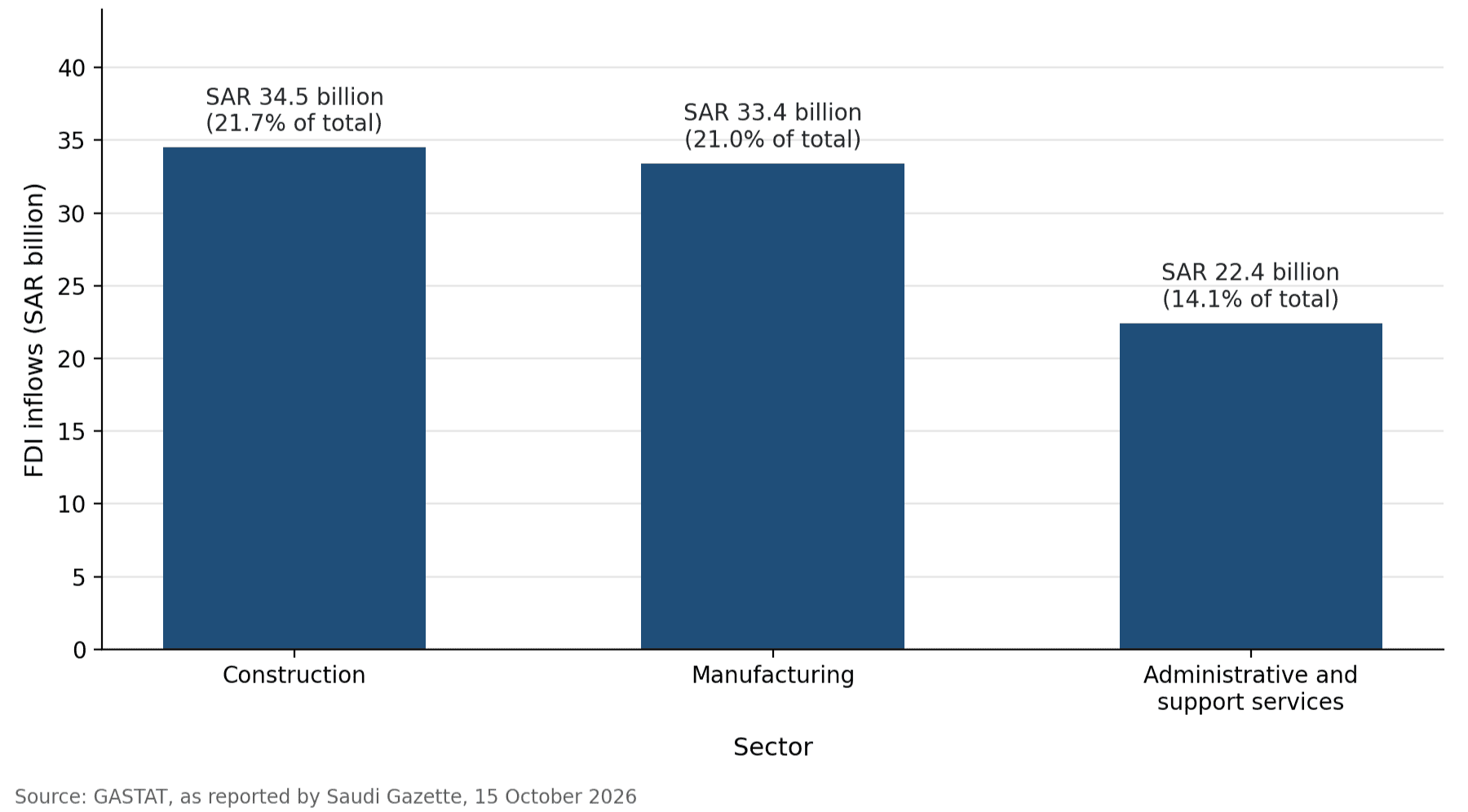
Construction and manufacturing together account for 42.7% of total FDI inflows in 2025, and administrative and support services add another 14.1%. The distribution shows the weight of construction and industrial activity in attracting foreign capital, although the sector figures alone do not establish how much of the investment results directly from Vision 2030 initiatives.
Vision 2030 and Saudi Arabia’s Foreign Investment Outlook
Vision 2030 is the national strategy to diversify the economy and reduce reliance on oil revenues. Attracting more foreign direct investment is a stated goal, alongside growth in domestic investment. The report presents the 2025 figures as a sign of rising investor confidence in the Saudi economy and its outlook.
Higher FDI inflows do not eliminate investment risks. Geopolitical uncertainty, project execution, and the pace of economic diversification remain important factors to watch. The 2025 figures show the scale of investment entering Saudi Arabia, but future releases are needed to establish whether this growth is sustained.
For a broader regional perspective, see Nukoud’s analysis of UAE and Saudi Arabia’s position in Arab FDI rankings in 2025. The article examines regional investment concentration using a separate dataset, so its reported country figures should not be directly compared with GASTAT’s gross FDI inflows without reconciling the underlying definitions.
What Saudi Arabia's FDI growth means for equity investors
Rising FDI highlights the scale of investment entering Saudi Arabia, but it does not directly measure investment in listed shares or predict stock-market returns. Investors seeking listed exposure can consider the US-listed iShares MSCI Saudi Arabia ETF (KSA), which provides broad Saudi equity exposure, or the Tadawul-listed SAB Invest Saudi Quant ETF (9402), which uses a quantitative approach to selecting Saudi equities.
Both funds provide exposure to listed companies rather than all the businesses and projects included in FDI statistics. Their returns also depend on corporate earnings, valuations, oil prices, interest rates, and market conditions.
For related reading, see Nukoud’s analysis of Saudi foreign ownership reform and potential index flows.
Bottom Line
Saudi Arabia’s FDI inflows rose 33.5% to SAR 159.1 billion in 2025, highlighting the scale of foreign investment entering the Kingdom as Vision 2030 reforms continue. However, net inflows reached SAR 81.4 billion after accounting for outflows, underscoring the importance of distinguishing gross investment from net capital flows. Construction and manufacturing attracted the largest shares of reported inflows. For equity investors, these figures provide useful economic context, but they do not guarantee stock-market gains or ETF returns. Corporate earnings, valuations, and broader market conditions will remain important determinants of investment performance.