

Saudi Arabia’s next capital-market opening could have consequences well beyond direct foreign investment. The appointment of Mazen Al Sudairy as chairman of the Capital Market Authority has brought foreign ownership reform back into focus, according to Morgan Stanley. A recent Morgan Stanley Saudi Arabia Equity Strategy report revisited the potential easing of foreign ownership limits, or FOLs, and the implications for the amount of Saudi equity recognized as investable by international benchmarks. The connection to exchange-traded funds is particularly important because changes in investability can eventually force passive portfolios to rebalance.
Current ownership data show a wide gap between Saudi Arabia’s headline foreign ownership limits and actual foreign participation in several of the Kingdom’s largest listed companies. That gap helps explain why changes to foreign investability could have meaningful implications for index weights and international capital flows.
Foreign Ownership Can Change Index Mathematics
International indices generally weight companies according to the portion of their market capitalization considered available to investors rather than headline market value alone. Restrictions on foreign ownership can therefore reduce the weight assigned to a company in an international benchmark.
Morgan Stanley’s analysis puts this mechanism at the center of the FOL discussion. If regulatory changes allow index providers to recognize a larger portion of Saudi companies as investable, foreign inclusion factors could rise. That could increase the companies’ weights in international benchmarks and eventually require passive funds tracking those indices to purchase additional shares.
Any impact on passive flows would depend on how index providers translate the regulatory change into benchmark weights:
FOL reform → investability review → foreign inclusion factor → index weight → passive fund rebalancing
An easing of an ownership limit does not guarantee an equivalent increase in an MSCI or FTSE Russell index weight. Free float, foreign room and each provider’s methodology determine how much of a company enters the benchmark calculation.
What Could Trigger the Next Re-Rating?
Morgan Stanley has linked renewed interest in Foreign Ownership Limit (FOL) reform to the appointment of the CMA’s new Chairman. Mazen bin Turki Al-Sudairi was appointed Chairman of Saudi Arabia’s Capital Market Authority (CMA) by royal decree, succeeding Mohammed bin ElKuwaiz.
Al-Sudairi brings extensive capital markets experience, having previously served as Head of Research at Al Rajhi Capital, Head of Sales Research at Alistithmar Capital, and an energy and petrochemicals analyst at Samba Capital. In 2024, he was appointed an advisor to the General Secretariat of the Saudi Cabinet.
The leadership change could provide fresh momentum for regulatory reforms that increase the portion of Saudi equities available to international investors, potentially followed by recognition from global index providers.Such a move would fit Saudi Arabia’s broader market-opening agenda. In February 2026, the CMA eliminated the Qualified Foreign Investor (QFI) framework, opening the Main Market directly to all categories of foreign investors. International investors already held more than SAR590 billion across Saudi capital markets at the end of Q3 2025, including around SAR519 billion in the Main Market.
The direction is also reflected in the CMA’s 2024–2026 strategic plan, which identifies reviewing foreign-investor restrictions and increasing international ownership of free-float shares as explicit objectives.
Foreign Ownership Remains Far Below the Headline Ceiling
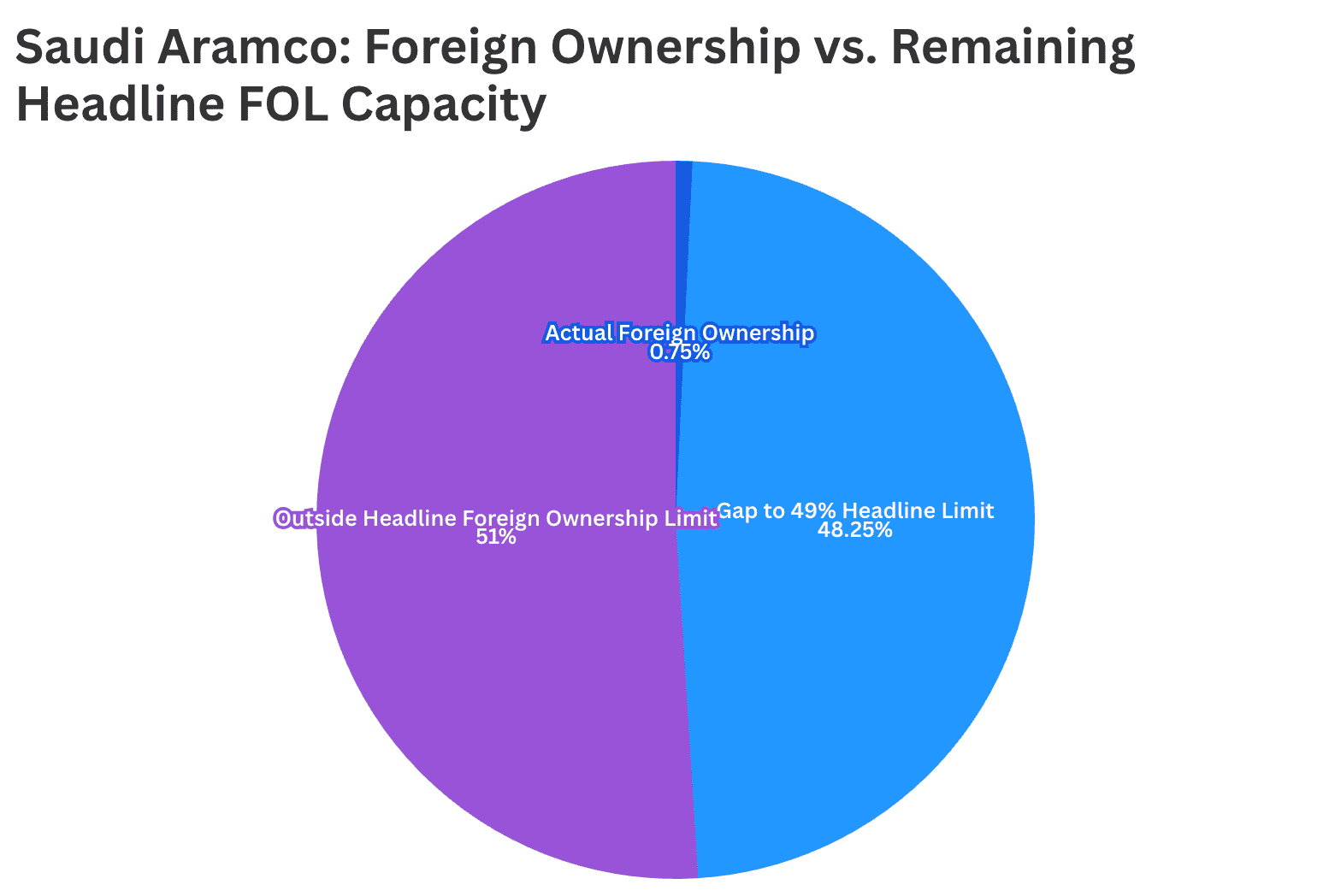
The difference is particularly striking among several major Saudi companies.
Source: Saudi Exchange Foreign Ownership Report. Figures exclude foreign strategic investors and include interests under swaps.
Aramco is the most consequential example because of its scale. The Saudi government still directly owned 81.48% of the company as of June 30, 2026, according to Aramco’s half-year filing. Its enormous market capitalization therefore bears little resemblance to the portion readily represented in international free-float-adjusted indices.
Even a relatively modest change in recognized investability can consequently matter in dollar terms when applied to a company of Aramco’s size.
Saudi ETFs Would Be Directly Exposed to Index Changes
Any increase in Saudi companies’ recognized investable weights could feed directly into funds that track the affected benchmarks. BlackRock’s iShares MSCI Saudi Arabia ETF, KSA had $622.3 million in net assets as of August 14, 2026, while its UCITS counterpart gives eligible investors another route to Saudi equities.
Saudi-listed products such as the Albilad MSCI Saudi Equity ETF would also be sensitive to changes in the composition and investability of their underlying Saudi benchmarks. Albilad’s fund tracks the MSCI Saudi Arabia Domestic Total Market Islamic M-Series Index and includes Aramco, Maaden and SABIC among its holdings.
The UAE-listed Lunate S&P KSA Shariah ETF, SAUDIA provides another regional route to Saudi equities, although it tracks an S&P Shariah benchmark rather than an MSCI index. The larger potential effect remains in broad emerging-market portfolios: if MSCI, FTSE Russell or other index providers raise Saudi companies’ investable weights following an FOL reform, passive funds tracking those benchmarks could be required to increase their Saudi allocations.
Active managers benchmarked against the same indices would also have to decide whether to follow the higher weight or accept a larger underweight
Saudi Arabia’s Market Opening is Entering a New Phase
Saudi Arabia has spent more than a decade opening its equity market to international capital, culminating in its inclusion in major emerging-market benchmarks and a broader institutional investor base. Morgan Stanley’s FOL analysis points to a potential next stage: increasing the portion of Saudi corporate value that global benchmarks can recognize as investable.
The market impact could begin before any ETF is required to rebalance. When investors expect an index change to generate future passive demand, active funds and other market participants can adjust positions ahead of the effective date, potentially bringing part of the price and liquidity effect forward. The scale would depend on which companies receive higher investable weights, the size of those adjustments and the assets tracking the affected benchmarks.
For Saudi equities, that makes the path from FOL reform to index inclusion as important as the eventual ETF flows themselves. A regulatory change recognized by MSCI, FTSE Russell or other index providers could alter benchmark weights, attract passive capital and influence positioning ahead of implementation. If Saudi Arabia moves further in that direction, the effects could extend beyond dedicated Saudi ETFs into the much larger pool of global emerging-market portfolios.