
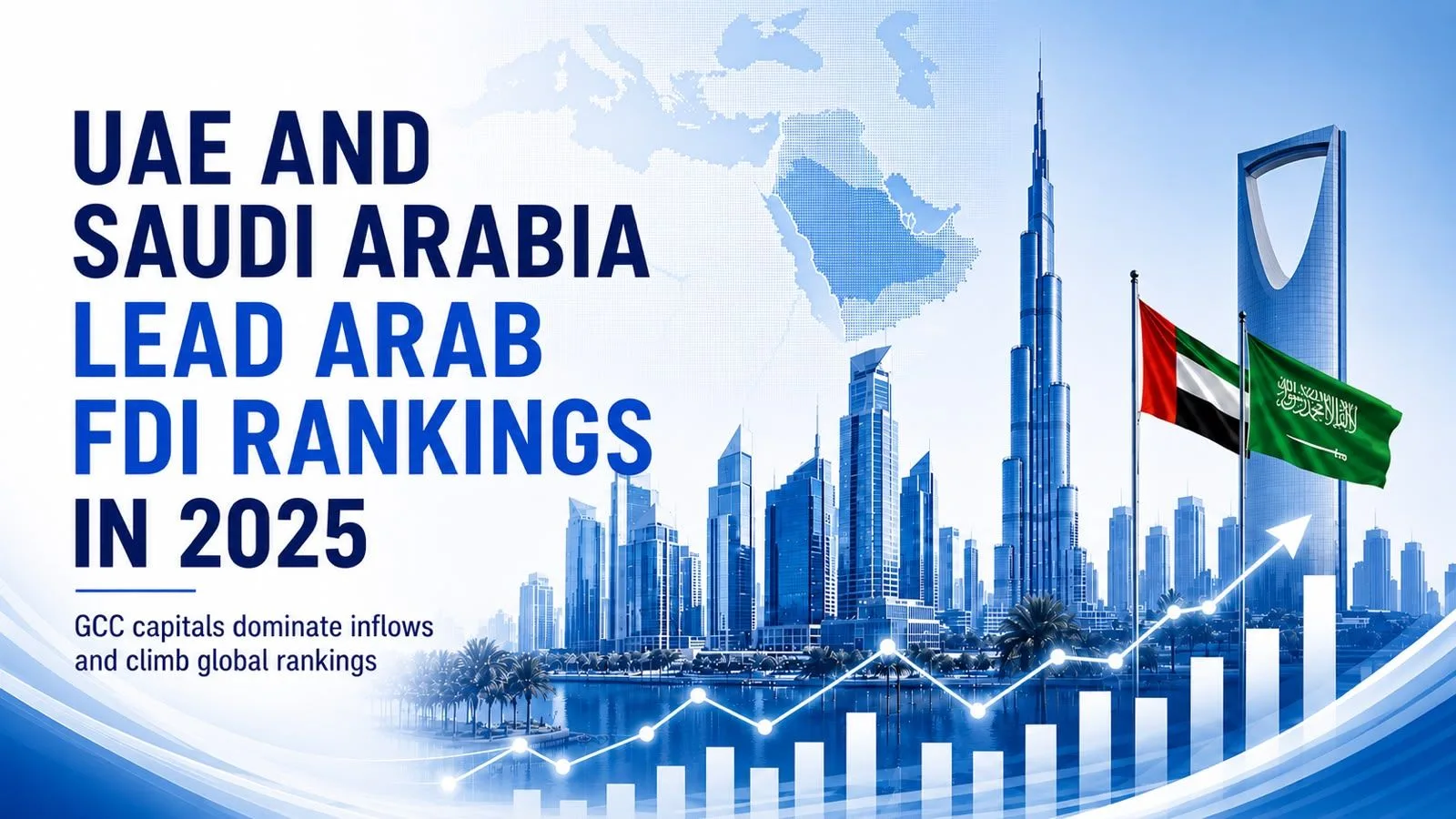
Despite a 10 percent decline in total FDI inflows to the Arab world in 2025, the GCC continued to attract the overwhelming share of international capital. The UAE and Saudi Arabia alone accounted for 67.7 percent of regional inflows while improving their positions in the global FDI rankings, highlighting the growing concentration of investment in the Gulf's largest economies. For investors, the figures reinforce the structural case for GCC capital markets and the ETFs that track them.
Arab FDI Inflows: GCC Takes the Lead
According to the Arab Investment and Export Credit Guarantee Corporation (Dhaman), citing UNCTAD estimates in its 41st Annual Investment Climate Report 2026, total FDI inflows to Arab countries fell 10 percent year-on-year to US$119.3 billion in 2025. The region's share of global FDI declined to 7.3 percent, while its share of FDI flowing to developing economies fell to 13.3 percent, highlighting that the Arab region captured a smaller share of global investment despite the GCC's strong performance. UNCTAD also noted that West Asia continues to benefit from its position as a trade and investment corridor linking Asia, Europe, and Africa, even as geopolitical tensions remain a downside risk to the subregion's outlook.
The table below shows the leading Arab destinations for FDI in 2025.
The UAE, Saudi Arabia, and Egypt together attracted US$96.3 billion, or roughly 80.7 percent of all Arab FDI inflows in 2025, one of the clearest signals in the report of just how concentrated regional capital formation has become. Three of the region's four largest recipients, the UAE, Saudi Arabia, and Oman, were GCC economies, with only Egypt breaking the bloc's hold on the top of the table; outside the GCC, Egypt is in fact the only country that remains among the region's major FDI destinations. The UAE's inflows continued to be underpinned by investment into financial services, renewable energy, logistics, technology, advanced manufacturing, and real estate, reinforcing its position as the region's primary FDI hub. Saudi Arabia's 51 percent jump reflects continued capital deployment linked to Vision 2030, including infrastructure, industrial development, renewable energy, and large-scale giga-projects that continue to draw international investors.
Oman's US$13.3 billion placed it fourth, reflecting continued investment across logistics, ports, energy, and industrial sectors. Qatar posted one of the region's sharpest percentage gains. Inflows rose from just US$460 million in 2024 to US$3 billion in 2025, driven by investment in chemicals, energy, and information and communication services.
Announced greenfield investment told a more cautious story. Dhaman estimates that capital expenditure (Capex) tied to announced FDI projects across the Arab world declined 9 percent to US$112 billion in 2025 amid regional geopolitical developments. This distinction matters while newly announced greenfield investment softened, realised FDI inflows into the GCC's largest economies remained resilient, indicating that previously committed projects continued to be executed even as investors turned more selective about new commitments.
Saudi Arabia and the UAE Advance in Global Rankings
UNCTAD's separate global FDI ranking, from its World Investment Report 2026, shows Saudi Arabia jumping to 13th place worldwide in 2025, up from 17th in 2024, after attracting US$32.6 billion in FDI (rounded to US$33 billion by UNCTAD), a 51.14 percent increase year-on-year. The Kingdom is targeting US$100 billion in annual FDI by 2030 as part of its Vision 2030 diversification programme. Momentum appears to have carried into 2026. Saudi Arabia's General Authority for Statistics reported Q1 2026 FDI inflows of SR26.6 billion (US$7.1 billion), up 2.4 percent year-on-year.
The UAE and Saudi Arabia were also the only Arab economies to rank among the world's top 15 FDI destinations in 2025. On Dhaman's Composite Investment Climate Index, which combines political stability, institutional quality, macroeconomic conditions, and production factors to gauge a country's attractiveness to foreign investors, the UAE ranked 17th globally, up two places, with Qatar 38th, Saudi Arabia 40th, Oman 51st, Kuwait 52nd, and Bahrain 57th. All six GCC states placed inside the global top 60, while the average Arab country ranked 102nd globally, a gap of roughly 23 places versus the global average, even though 13 Arab countries improved their standing year-on-year.
The GCC's Position in the Global FDI Landscape
Globally, FDI rose 6 percent to US$1.6 trillion in 2025, ending two consecutive years of decline. Developed economies grew 11 percent while developing economies managed only 2 percent growth to US$901 billion, a reminder that the GCC's double-digit gains stand out even against a broader emerging-market backdrop.
Note: GCC member states are shown in red; other Arab countries are shown in blue.
Why FDI Matters for GCC Capital Markets
The UAE and Saudi Arabia together account for the large majority of GCC equity market capitalisation and dominate benchmark indices such as MSCI GCC and S&P GCC. Sustained FDI growth in these two markets therefore carries implications beyond the macro headline rising FDI typically translates into higher financing demand, construction activity, industrial expansion and banking-sector business, supporting earnings across the financials, industrials, energy and utilities sectors that dominate GCC-listed ETFs and are most closely tied to Vision 2030 and Vision 2040 diversification spending.
For investors comparing GCC market access, the concentration of FDI in the UAE and Saudi Arabia versus the rest of the Arab world is a useful lens capital continues to gravitate toward the region's most reform-advanced economies, a pattern consistent with the region's ETF AUM growth over the past year. UNCTAD cautions, however, that rising geopolitical tensions could slow implementation of announced investments, particularly in transport, logistics, and energy infrastructure, a risk worth flagging alongside the positive inflow data.
Bottom Line
The GCC's dominance of Arab FDI in 2025, led by the UAE's US$48.2 billion and Saudi Arabia's 51 percent jump to US$32.6 billion, confirms that international capital is consolidating around the region's most reform-driven economies. While geopolitical risks and softer announced-project Capex warrant caution, the latest data suggests international capital continues to favour the GCC's largest and most diversified markets, reinforcing the long-term investment case for regional equity markets and GCC-focused ETFs.