
DeepSeek’s planned Shanghai listing arrives at an awkward moment for Chinese technology investors. Artificial intelligence and semiconductor shares are attracting strong capital, while many internet stocks remain weighed down by weak consumption, the property downturn and persistent doubts over China’s broader growth outlook.
The KraneShares CSI China Internet ETF (KWEB) was down 23.64% year to date through August 31, with its NAV falling 7.27% in August alone. By contrast, the KraneShares China Technology & Semiconductor STAR 50 Index ETF (KSTR) had gained 31.59% in 2026 through the same date.
That 55-percentage-point performance gap captures a larger shift inside Chinese technology. Investors have been much more willing to pay for AI infrastructure and semiconductor capacity than for internet platforms still exposed to a weak domestic consumer.
DeepSeek Could Add Another Catalyst to the AI Trade
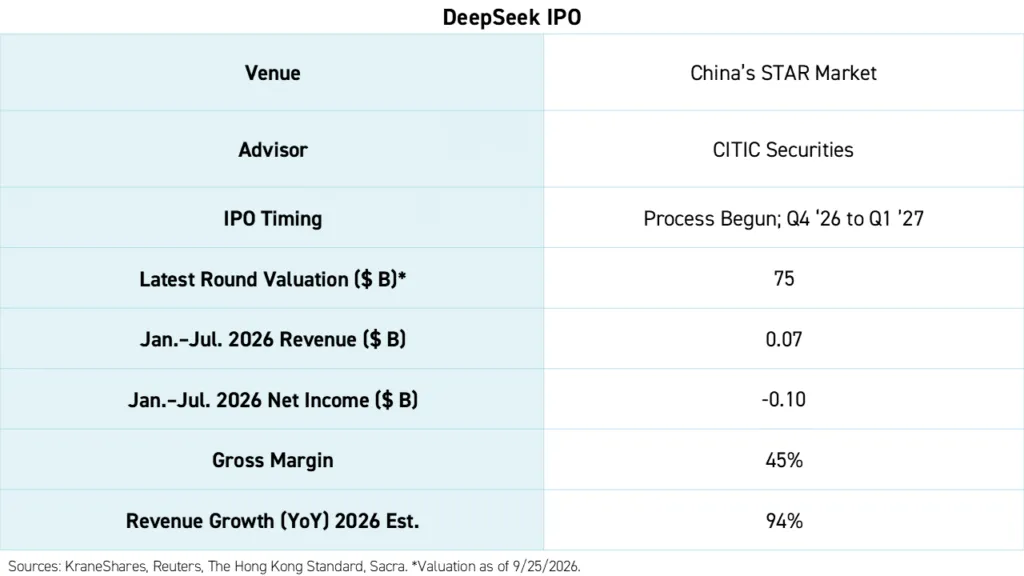
DeepSeek has hired CITIC Securities to prepare for a potential STAR Market initial public offering, according to Reuters. The company is also raising capital at a valuation of about 500 billion yuan, roughly $75 billion, after a June funding round valued it above $50 billion.
At that valuation, DeepSeek would enter public markets as one of China’s most valuable AI companies. Revenue is beginning to catch up with the attention. Its annualized revenue run rate reached about $1 billion in September, more than double the level reported several months earlier.
The listing would also be different from many recent STAR Market technology deals. Much of the current rally has been built around semiconductors, equipment and other physical AI infrastructure. DeepSeek would offer public investors direct exposure to model development and software intellectual property.
Source: KraneShares estimates, Bloomberg and company reports, as of August 31, 2026. DeepSeek figures are estimates.
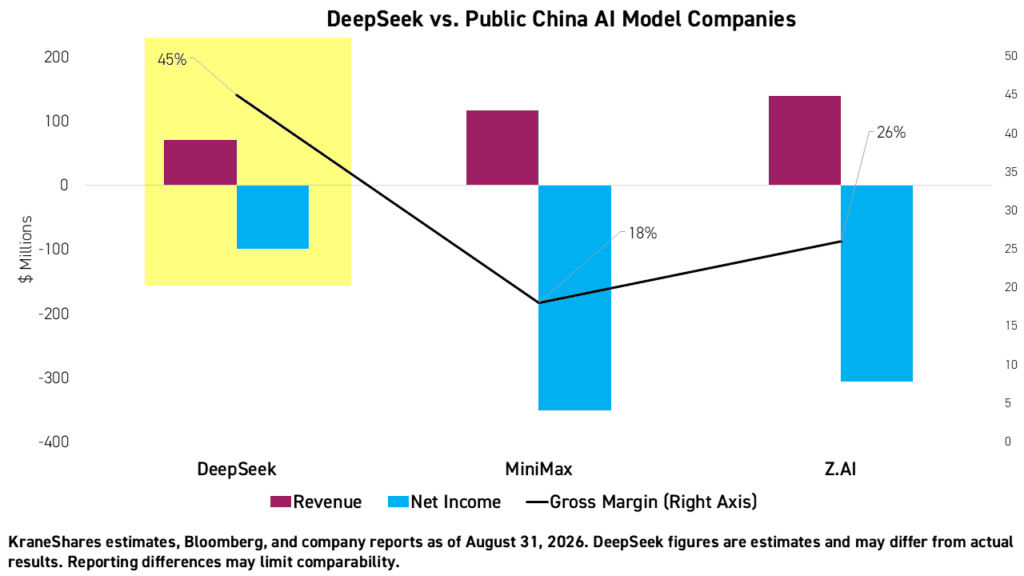
KraneShares estimates DeepSeek’s gross margin at roughly 45%, compared with about 18% for MiniMax and 26% for Z.AI. The figures are not audited DeepSeek results, but they help explain why efficiency has become central to the company’s valuation case.
KSTR Has Been the Stronger China Tech Trade
KSTR provides a useful measure of investor demand for China’s semiconductor and domestic technology buildout.
The fund gained 31.59% year to date through August 31 and 32.38% over the previous 12 months. Its top positions are concentrated in companies such as Cambricon Technologies, Montage Technology, Advanced Micro-Fabrication Equipment and Hygon Information Technology.
KSTR Top 10 Holdings
That portfolio is already closely tied to China’s push for greater technology self-sufficiency. DeepSeek’s newly announced partnership with Huawei strengthens the connection. The companies are developing open-source programming tools optimized for Huawei’s Ascend AI chips, part of an effort to reduce dependence on Nvidia’s CUDA ecosystem.
DeepSeek is not currently held by KSTR, and an IPO would not guarantee index inclusion. A sufficiently large STAR Market listing, however, would make future eligibility far more relevant to the ETF.
KWEB Shows Why China Internet Still Faces a Macro Problem
Through August 31, KWEB had fallen 23.64% in 2026, lost 16.37% over six months and declined 25.85% over one year on a NAV basis.
The weakness is difficult to separate from China’s domestic economy. August retail sales increased only 0.4% year on year, while property investment fell 19.9%. Fixed-asset investment dropped 7.2%, and second-quarter GDP growth slowed to 4.3%, its weakest pace in more than three years.
September manufacturing data improved, with the official PMI rising to 50.1, but Reuters reported that consumption and investment remained weak while the property downturn continued to restrain the recovery.
That matters because KWEB owns internet businesses whose revenues are more directly tied to advertising, e-commerce and domestic spending. DeepSeek can improve sentiment around Chinese AI, but it cannot by itself repair weak consumer demand.
Nukoud has previously examined how China’s AI rally is producing a new wave of ETFs, while its DeepSeek V4 analysis looked at how the company’s model releases can feed through to China technology funds.
One China Tech Market, Two Valuation Stories
DeepSeek’s IPO could provide another catalyst for Chinese technology shares, but the ETF evidence suggests investors are already discriminating sharply between different parts of the market.
KSTR reflects enthusiasm for AI chips and domestic technology infrastructure. KWEB remains tied to a slower macro recovery and weaker internet-sector earnings expectations.
That makes DeepSeek’s possible listing more important for the first group than the second. A successful IPO near $75 billion could reinforce demand for STAR Market technology and give investors another high-profile benchmark for valuing China’s AI sector. For internet ETFs, the larger test remains whether consumption, property and private-sector confidence improve enough to support earnings beyond the AI theme.