


China is building gold infrastructure that could strengthen the yuan's role in international trade by expanding offshore vaults, continuing central-bank purchases, and upgrading its domestic gold industry. Yet for all the momentum, gold still accounts for only about 8% of China's total foreign-exchange reserves, well below the global average of 25%. The reserve gap highlights how much room China has to increase gold's role in its reserve portfolio, even as the vault strategy serves the separate objective of expanding the yuan's international utility.
China's Gold Vault Network Extends the Yuan's Reach
Beijing is building a global network of gold delivery vaults to improve the yuan's usability and credibility in international trade. The first offshore vault opened in Hong Kong last year under an agreement with the Shanghai Gold Exchange (SGE), operated by Bank of China (Hong Kong). Alongside the launch, the SGE listed two new yuan-denominated gold contracts that can be settled through either physical delivery or cash transfer.
S&P's Charles Chang, greater China lead for corporate ratings, frames the logic simply: renminbi usability has long been a sticking point for global trade partners, but a currency with greater access to a tradeable, widely accepted asset like gold changes that calculus. Cities reportedly under consideration for the next wave of vaults include Singapore, Kuala Lumpur, Dubai, Riyadh, and Moscow a footprint that would put GCC gold trading hubs directly inside China's settlement infrastructure. The network could therefore serve two purposes at once: expanding the yuan's role in gold settlement while giving international holders an alternative venue for storing and trading physical bullion outside mainland China.
China's Gold Reserves Still Lag Global Benchmarks
Despite the vault buildout, China's gold reserves remain modest as a share of total official reserves, a gap the InvestorSight/World Gold Council data below illustrates clearly:
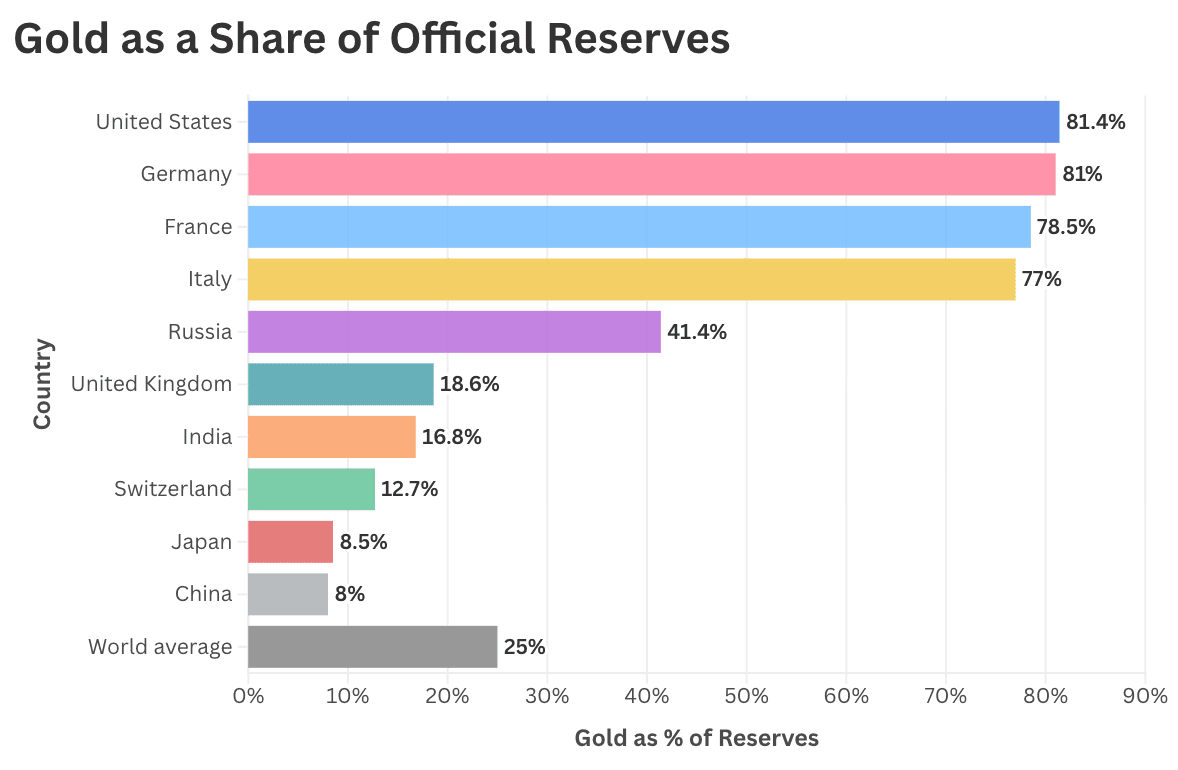
Even after 21 consecutive months of buying, China's gold weighting sits at roughly one-third of the global average and far behind the legacy reserve holders. The gap highlights why China's gold strategy extends beyond central-bank purchases to structural moves such as the vault network and its 2025 policy designation of gold as a "strategic mineral resource."
PBoC Buying Accelerates After 21 Months of Accumulation
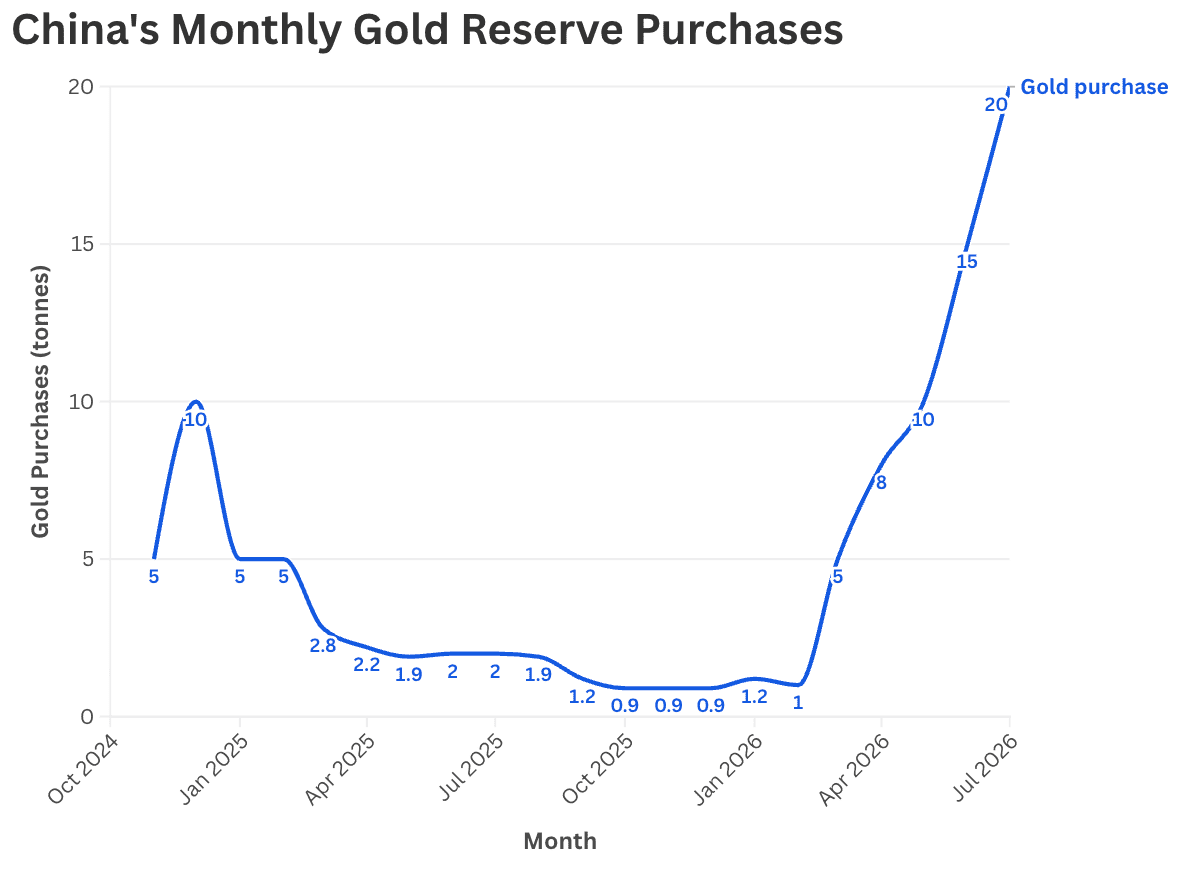
The People's Bank of China(PBoC) added 19.9 tonnes of gold in July 2026, its largest single-month purchase since October 2023, taking total reserves to 76.08 million ounces (about 2,366 tonnes), a 21st straight month of accumulation. That places China sixth globally by tonnage, behind the US, Germany, France, Italy, and Russia. The latest World Gold Council data put gold at about 8% of China's total foreign-exchange reserves. The latest acceleration builds on the momentum we previously tracked as China's central-bank buying helped drive the gold breakout.
China's gold demand is not limited to the central bank. Net gold imports reached 764 tonnes in the first half of 2026, up 138% year on year, according to the World Gold Council, with June imports alone reaching 152 tonnes. The figures point to strong private-sector and investment demand alongside official reserve accumulation.
Beijing's Gold Strategy Reaches the Mining Sector
China's gold-mining sector is also receiving policy support as Beijing seeks to strengthen domestic resource security. Its 2025–2027 gold-industry plan targets a 5%–10% increase in gold resources and more than 5% growth in gold and silver production by 2027, alongside deeper mining, technological upgrades and greater industry concentration. Zijin Mining, one of China's largest gold producers, and Shandong Gold Mining are both expected to expand faster than most global peers, according to S&P Global. Zijin Gold International's overseas mines in Ghana and Kazakhstan contributed to the increase, helping lift first-half 2026 net profit 179% year-on-year to about $1.45 billion. Notably, Zijin terminated its planned takeover of Canada's Allied Gold in late July and subsequently completed a US$295 million investment for a 9.2% stake in the company on August 10, highlighting the greater regulatory scrutiny facing large Chinese outbound mining investments.
Bottom Line
The vault network, the SGE's yuan-gold contracts, and accelerating PBOC purchases all point toward the same goal: making the renminbi more usable in international trade by linking it more closely to global gold infrastructure. But the reserve math is a reminder that this is a multi-year build, not a near-term shift. China's gold weighting would need to rise more than threefold to match today's 25% global average.