

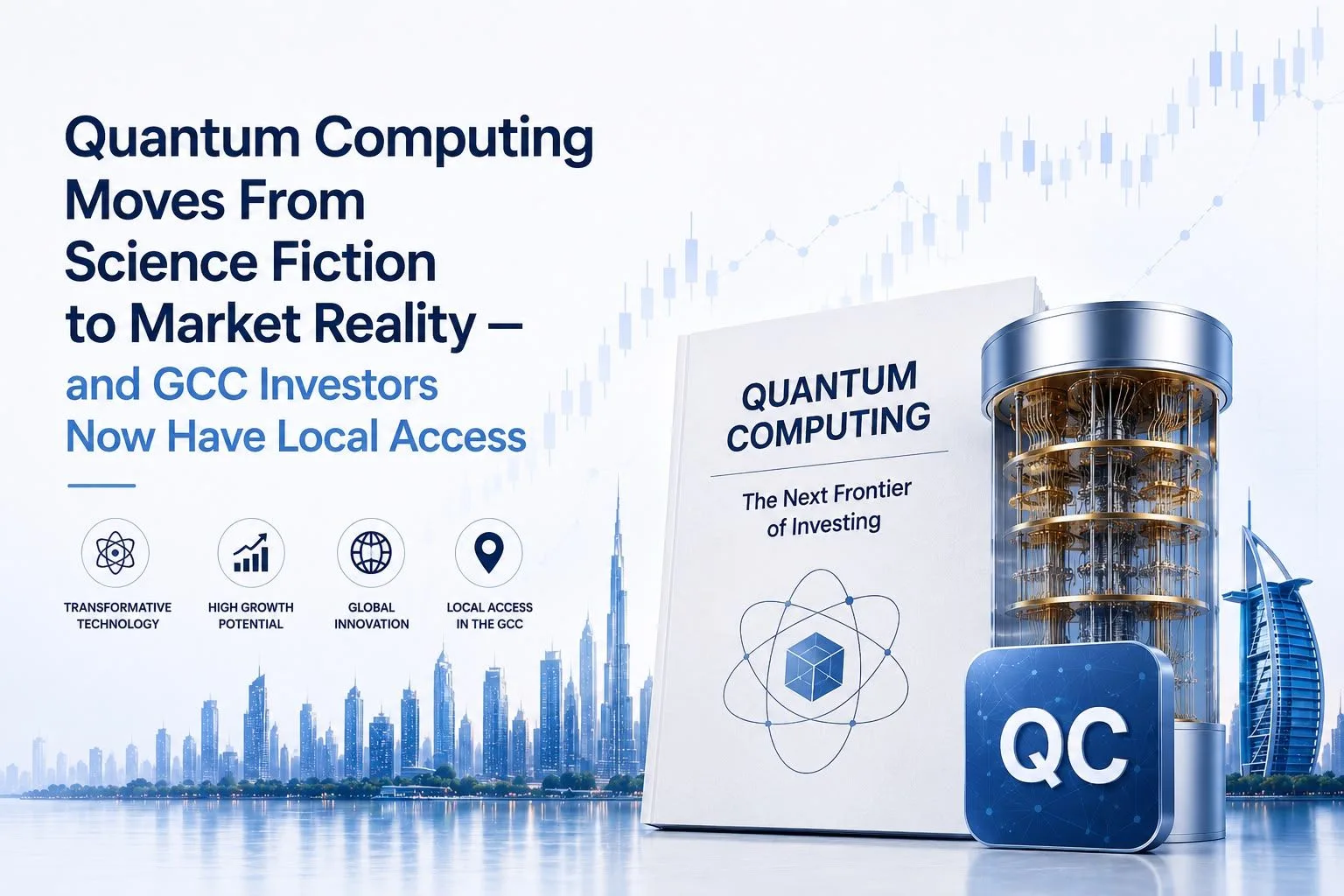
Quantum computing is quickly becoming one of the most closely watched themes in global technology markets. A recent Financial Times article highlighted how the industry is moving beyond the research-lab phase, with major technology companies, governments and financial institutions increasingly positioning for what many believe could become the next major computing revolution.
For GCC investors, the story is no longer only a global technology headline. It is now locally investable through the Lunate Boreas Solactive Quantum Computing UCITS ETF, listed on the Abu Dhabi Securities Exchange under the ticker QUANTM.
QUANTM rose around 4% yesterday during US market hours, reflecting renewed investor interest in the quantum theme following a wave of global headlines around quantum chips, cybersecurity, artificial intelligence and the potential commercial use cases for the technology.
Why Quantum Computing Is Attracting Investor Attention
Quantum computing is designed to solve highly complex problems that traditional computers may struggle to process efficiently. Instead of relying only on binary bits, quantum computers use quantum bits, or qubits, which can process multiple possibilities at the same time.
This could eventually have important implications across several industries, including pharmaceuticals, finance, cybersecurity, energy, materials science, artificial intelligence and logistics. The technology remains early and highly experimental, but the potential market opportunity is attracting growing attention from companies and investors.
The FT article noted that many of the world’s leading technology companies are now betting that quantum computers could start outperforming conventional computers in certain tasks by around 2030. That timeline has helped shift investor perception from “distant science project” to “emerging investable theme.”
The AI Connection
One of the most important parts of the quantum story is its relationship with artificial intelligence. Quantum computing is not expected to replace AI or traditional computing. But a complementary for the two technologies.
AI can help improve the calibration and error correction needed to make quantum computers more reliable. Quantum computing, in turn, could eventually support more powerful AI models, faster simulations and new synthetic data generation.
This sets the narrative for the next period, quantum computing may become part of the next phase of AI infrastructure, alongside semiconductors, data centers, cloud platforms and advanced software.
Why Financial Services Are Watching Closely
For GCC investors and financial institutions, the quantum theme is especially relevant because of its potential applications in finance.
Quantum computing may one day improve risk modelling, portfolio optimization, fraud detection, pricing models and the processing of large financial datasets. Global banks and payment companies are already experimenting with early use cases, even though the technology is not yet commercially mature.
Cybersecurity is another major area of focus. The FT article highlighted the concept of “Q-Day” — the point at which sufficiently powerful quantum computers could challenge existing encryption systems. This has already pushed governments and companies to prepare for post-quantum cryptography.
For investors, this means quantum computing is not just a technology theme. It is also a security, finance, data and infrastructure theme.
How GCC Investors Can Access the Theme Locally
Until recently, GCC investors looking for exposure to quantum computing had to access global markets directly or buy individual international technology stocks. That has changed with the listing of the Lunate Boreas Solactive Quantum Computing UCITS ETF on ADX.
The ETF provides local investors with a single listed vehicle offering exposure to a basket of global companies involved in quantum computing. The fund tracks an index of 25 companies across the quantum value chain, including specialist innovators and large technology companies active in quantum research and development.
This is important because quantum computing is still an early-stage theme. Picking individual winners may be difficult, and many pure-play companies can be highly volatile. An ETF structure allows investors to gain diversified exposure to the theme through one trade on a local exchange.
The listing of QUANTM on ADX is also significant for the development of the GCC ETF ecosystem. It shows that regional exchanges are moving beyond broad market and dividend ETFs into more specialized thematic strategies.
For Abu Dhabi and the wider GCC, this is an important step. Investors can now access global innovation themes including quantum computing through locally listed ETFs, traded in the region, through regional brokerage accounts.
Investors Should Understand the Risks
Despite the excitement, quantum computing remains a high-risk, early-stage theme. The FT article also made clear that the technology still faces major engineering challenges. Existing quantum machines remain error-prone, and many practical commercial applications may still be years away.
That means investors should not view quantum computing as a short-term certainty. The sector is likely to remain volatile, driven by news flow, scientific breakthroughs, company announcements, funding rounds and shifts in market sentiment around AI and advanced technology.
QUANTM’s recent 4% move is a reminder that investor interest can accelerate quickly. But thematic ETFs can also move sharply in both directions, especially when the underlying theme is still developing.
Bottom Line
Quantum computing is moving from theoretical promise toward early commercial experimentation. The world’s largest technology companies, banks, governments and industrial groups are preparing for a future in which quantum systems may solve problems beyond the reach of traditional computers.
For GCC investors, the key development is access. Through the Lunate Boreas Solactive Quantum Computing UCITS ETF listed on ADX under the ticker QUANTM, local investors now have a direct way to participate in one of the most ambitious technology themes of the coming decade.
The opportunity is significant, but so are the risks. Quantum computing may become one of the defining technologies of the 2030s. For investors, the challenge is to gain exposure with diversification, patience and a clear understanding that this remains an early-stage, high-volatility theme.