
Reports that Elon Musk’s rocket and satellite giant has confidentially filed for a U.S. IPO with a valuation potentially approaching $1.75 trillion have reignited investor appetite across the broader commercial space ecosystem. The move is beginning to reshape how markets price satellite infrastructure, launch providers, defense-linked space companies, orbital data firms, and next-generation connectivity platforms.
According to Bloomberg data, several publicly traded space-related companies posted strong gains as IPO expectations accelerated:
The reaction reflects a growing market belief that a public SpaceX listing could fundamentally rerate the entire sector.
Space Is Becoming an Institutional Investment Theme
For years, space investing remained largely speculative and venture-capital driven, with many public companies struggling to generate sustainable revenue or scale commercial demand.
That dynamic is beginning to change.
The rapid expansion of AI infrastructure, satellite communications, missile defense systems, geospatial intelligence, and low-earth-orbit connectivity is increasingly turning space into a strategic infrastructure trade rather than a niche thematic bet.
The shift is already becoming visible in ETF flows.
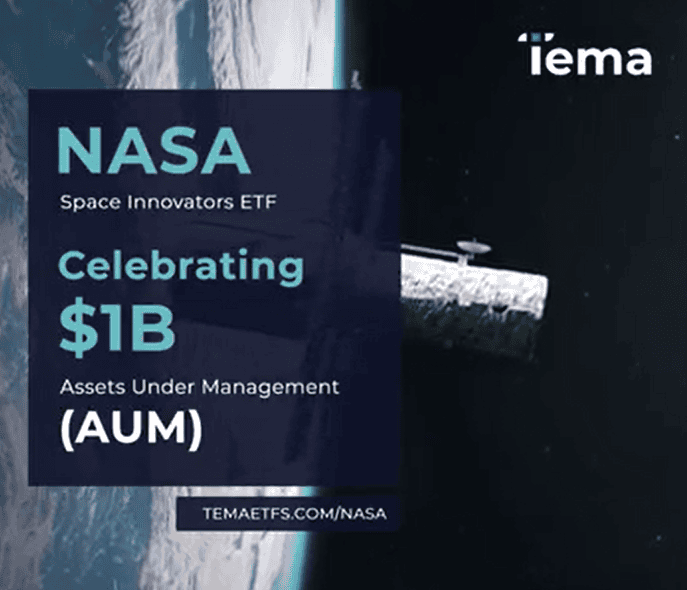
Tema ETFs recently announced that its Space Innovators ETF (NASA) surpassed $1 billion in assets under management just over a month after launch, making it one of the fastest-growing thematic ETF launches tied to the space economy. The ETF also includes indirect SpaceX exposure through a special purpose vehicle structure, allowing investors limited access to one of the most sought-after private companies globally.
The Real Trade Is Bigger Than Rockets
Importantly, investors are no longer only buying launch companies. The modern space investment theme increasingly spans satellite manufacturing, orbital communications, earth-observation platforms, defense infrastructure, geospatial intelligence, and AI-driven data systems tied to national security and global connectivity.
Rocket Lab, for example, is increasingly being valued not simply as a launch provider, but as a vertically integrated space infrastructure company with exposure across satellites, launch systems, and defense-related contracts. AST SpaceMobile is building direct-to-device satellite communications infrastructure, while firms such as BlackSky and Planet Labs are becoming increasingly tied to surveillance, intelligence, mapping, and AI-powered geospatial analytics.
As geopolitical tensions rise globally, governments are simultaneously accelerating spending on missile defense systems, satellite resilience, intelligence gathering, and sovereign space capabilities. That shift is increasingly blurring the line between commercial space investing and defense infrastructure investing, turning parts of the space economy into a broader geopolitical and national-security trade.
Theme NASA ETF crosses $1 Billion in AUM
Tema’s Space Innovators ETF (NASA) has rapidly emerged as one of the biggest beneficiaries of renewed investor appetite for the commercial space sector, surpassing $1 billion in assets under management just over a month after launch. The ETF offers exposure across launch systems, satellite infrastructure, defense-linked space technologies, and next-generation communications, while also holding indirect exposure to SpaceX through a special purpose vehicle structure.
What This Means for Investors
The growing excitement around a potential SpaceX IPO is not simply about one company going public. It may represent a broader turning point for the commercialization of space markets.
For institutional investors, the sector is increasingly becoming investable at scale through ETFs, public equities, satellite infrastructure providers, and defense-linked space businesses tied to long-term technological and geopolitical trends.
Many space companies continue operating with limited profitability, high capital requirements, and heavy dependence on government contracts or future commercialization assumptions. Valuations across parts of the sector have also become increasingly momentum-driven as investors search for the “next SpaceX.”
But for now, markets appear willing to price space not as science fiction, but as the next major infrastructure cycle.