
Egypt's stock market has been one of the standout growth stories among frontier and emerging markets since 2022. Headline market capitalisation has more than quadrupled, trading volumes have surged, and a new generation of retail brokers has pulled hundreds of thousands of investors onto the tape. But scale alone doesn't tell the whole story; currency dynamics and a still-narrow product wrapper matter just as much for GCC investors weighing exposure.
Currency Moves Explain Part of the Market's Nominal Gains
Egypt's equity rally needs to be viewed alongside the pound's sharp depreciation. The currency has lost roughly two-thirds of its value against the dollar since early 2022, including a 38% official depreciation when Egypt unified its exchange rate and moved to a more flexible regime in March 2024. The move came alongside an expanded $8 billion IMF programme and the $35 billion Ras El-Hekma investment deal, which helped ease Egypt's foreign-exchange shortage and restore investor confidence. As a result, part of the stock market's rise in EGP terms reflects the repricing of domestic assets after currency devaluation and subsequent capital inflows, rather than a comparable increase in dollar terms.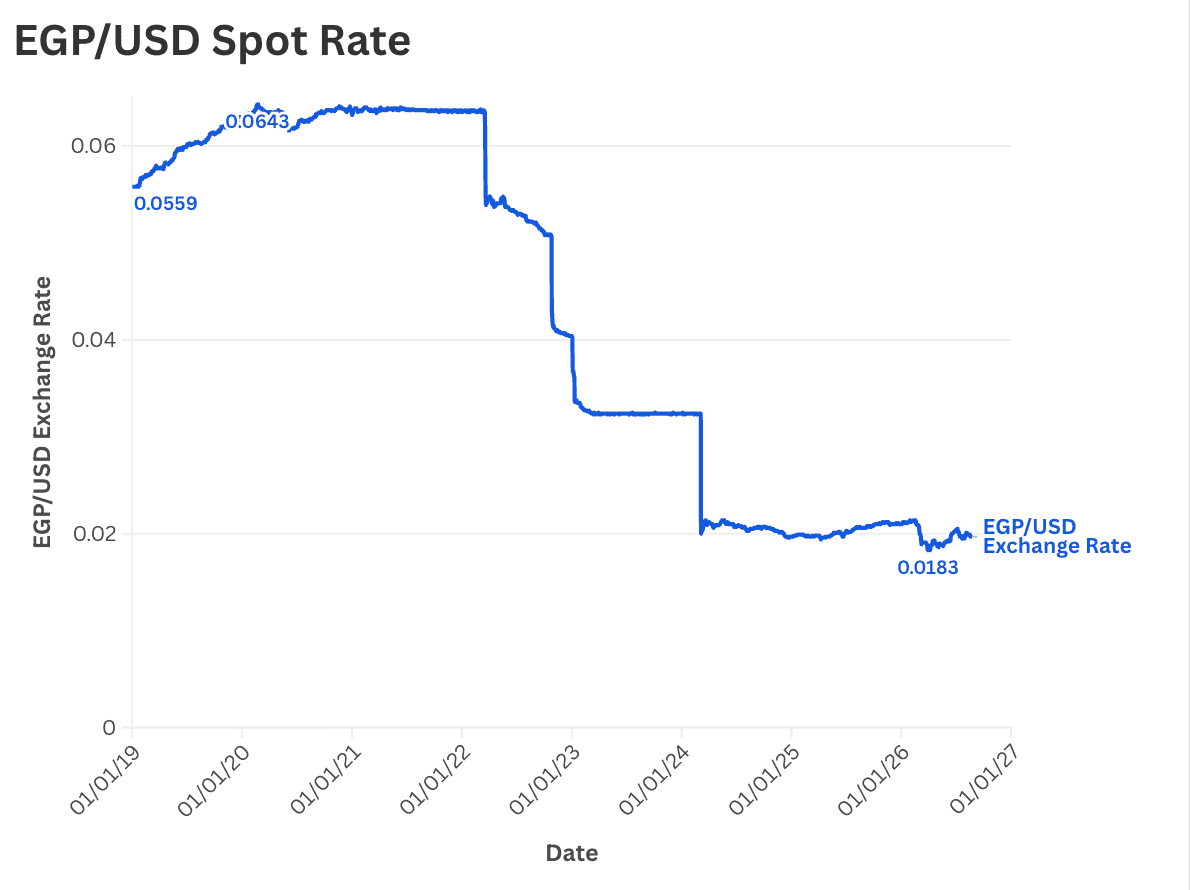
Egypt's Equity Market Has Expanded More Than Fourfold in EGP Terms
The Egyptian Exchange's (EGX) total market capitalisation has grown at a striking pace in local-currency terms: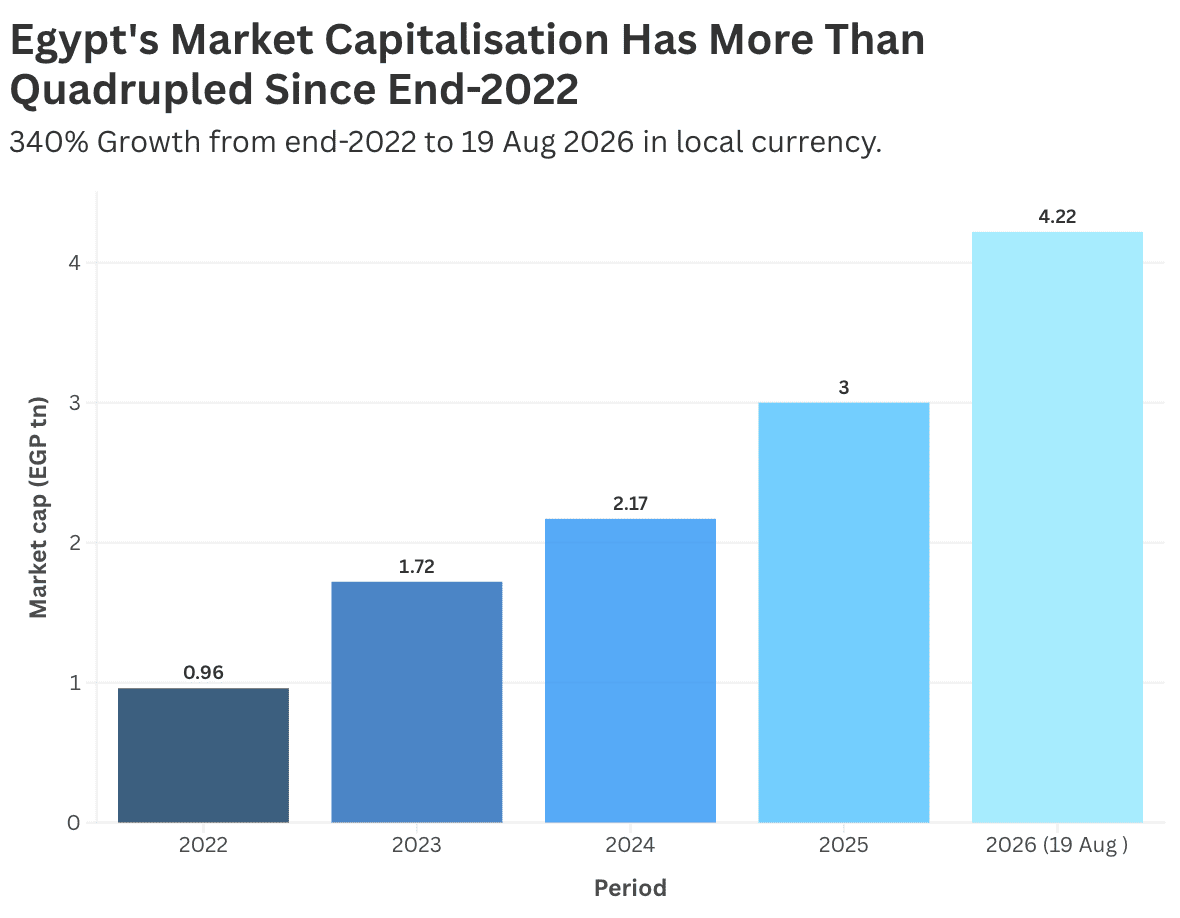
That's +340% growth from end-2022 to 19 August 2026, per official EGX data. At end-2025, market capitalisation was approximately 16.5% of GDP, according to the WFE review. The EGX deck lists 259 securities.
Trading Volumes Are Surging, but Turnover Is Lagging Market Growth
Trading activity has also climbed sharply. Listed volumes rose from 121.58bn securities in 2022 to 430.74bn in 2025, with EGX reporting a 70.3% increase in listed volume in 2025 alone. Average daily trading volume also increased by 57%.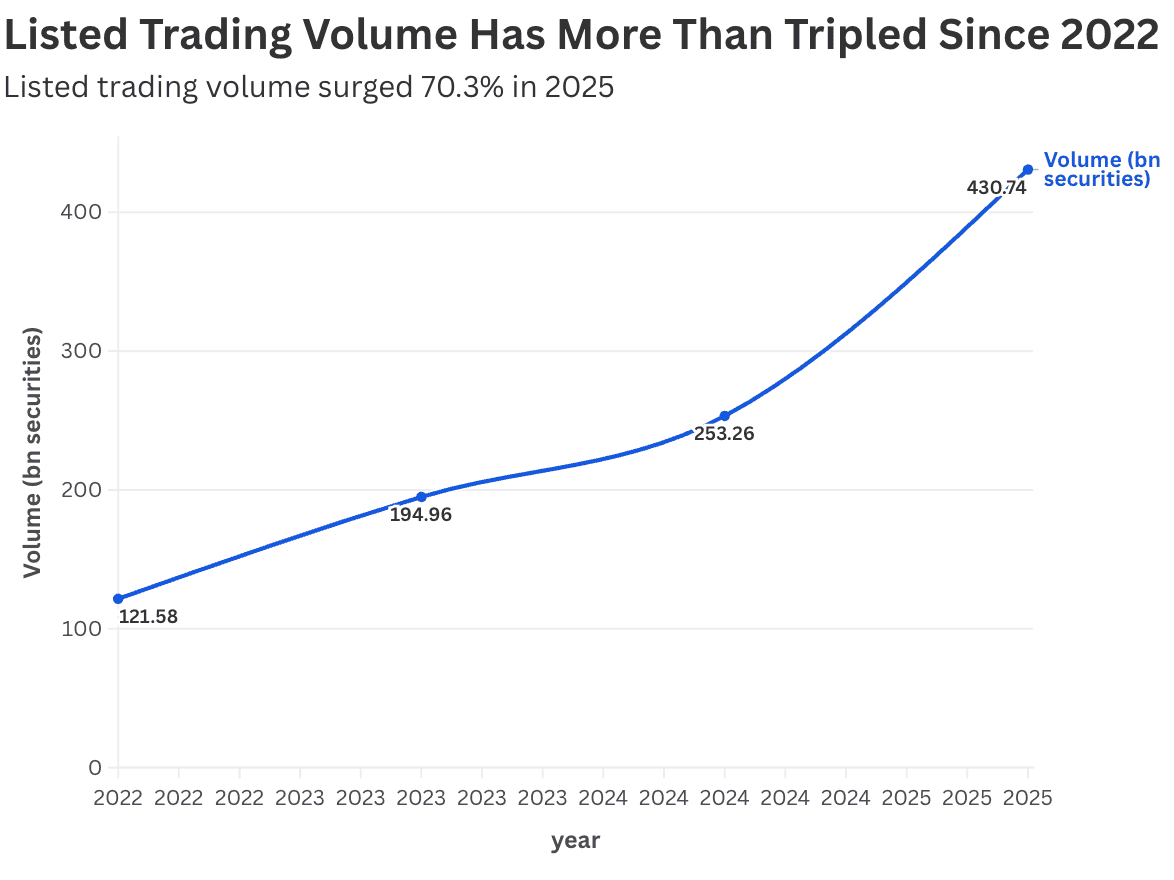
The catch: the annualised turnover ratio, trading value relative to market cap, has actually fallen, from 50.2% in 2024 to 29.7% in the January–July 2026 period. Share and transaction activity has increased sharply, but the market's turnover ratio has declined relative to its capitalisation. For allocators, the practical implication is to validate executable depth by name, time bucket, and order size, not headline share count.
A Trillion-Pound Market Still Has Only One Listed ETF
For investors seeking passive exposure, Egypt currently has one listed ETF: the EGX30 Index ETF (ISIN EGS69491M015, Reuters: EGX30ETF.CA), tracking the EGX30, which comprises 30 of Egypt's most liquid companies and is weighted by free-float-adjusted market capitalisation, with constituents reviewed twice yearly.
Trading activity in the ETF is modest too: EGX data show 48,209 shares traded for EGP 3.06 million on 23 August 2026 alone.
The market's execution infrastructure reinforces that gap: EGX currently identifies just one official market maker, Beltone Market Maker. For institutional investors, the access question therefore extends beyond the broker or ETF itself to DMA/FIX connectivity, custody integration, stock-borrow availability, and executable depth.
The Currency Factor: How Much Growth Is Real?
The pound's depreciation is central to interpreting Egypt's equity performance. From roughly EGP 15.7 per dollar at the start of 2022 to around EGP 50–51 today, the currency has lost roughly two-thirds of its value against the dollar.
That matters directly for the "+340%" market-cap headline, which is stated in local currency. Converting at approximate period-end rates tells a very different story: EGP 0.96tn at end-2022 (~EGP 24.7/USD) equates to roughly US$39bn, while EGP 4.22tn today (~EGP 50–51/USD) equates to roughly US$83bn, a near-doubling in dollar terms, not a quadrupling. Investors pricing Egyptian equities in dollar or Gulf-currency terms should size expectations off that USD figure, not the EGP headline.
Retail Participation Is Expanding as Brokerage Competition Intensifies
The rise of digital retail platforms has coincided with stronger retail participation in the market. Thndr reported roughly 700,000 funded accounts, according to the supplied market analysis, and ranked first in its 2025 main listed-market brokerage view with a 9.82% share. Hermes Securities ranked second at 9.19% in that view but led the deal-inclusive all-market table, highlighting how brokerage rankings can shift depending on the market perimeter used. The supplied analysis also reports EFG group's Egypt share at 27.76% in FY2025.
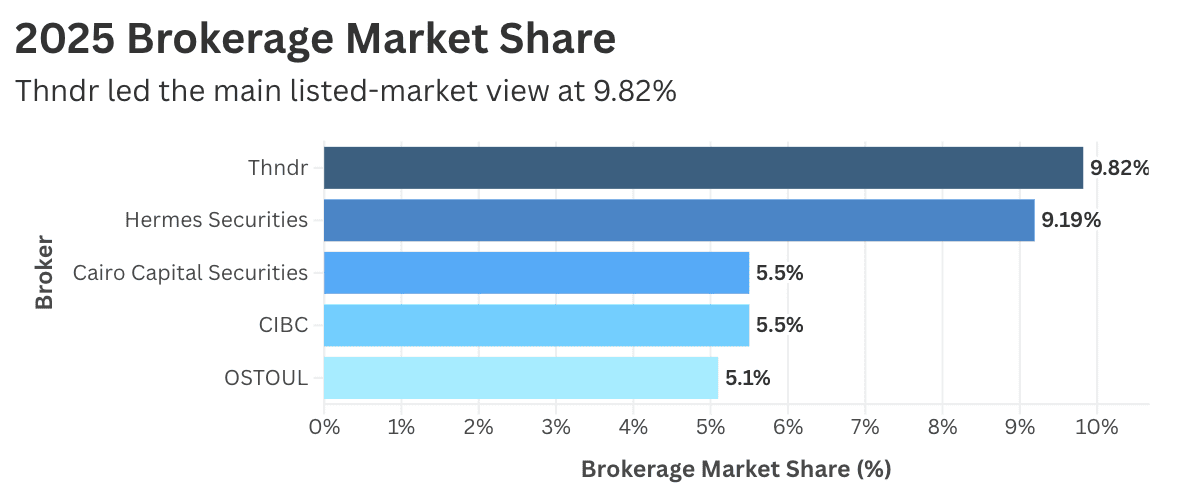
Source: Supplied market analysis, based on EGX brokerage rankings. Brokerage shares vary depending on the market perimeter and inclusion of deals.
The Bottomline
Egypt's market has genuinely scaled bigger, busier, and more retail-engaged than it was at end-2022. But a bigger market does not automatically mean a deeper, hedgeable one. For GCC investors, three factors matter: the gap between local-currency and dollar-adjusted growth, the expansion of trading activity relative to market capitalisation, and a product ecosystem that remains shallow relative to the size of the underlying market. With one listed ETF and limited market-making infrastructure, the key question is not simply whether Egypt's market has grown, but how efficiently institutional investors can access and hedge that growth.