
Chinese equities staged a surprising rebound on November 5 as technology stocks across the United States and much of Asia suffered a sharp selloff. But behind the recovery lies a troubling picture: weak domestic demand, a prolonged property downturn and a dramatic reversal in China’s once-booming semiconductor sector.
China has endured a difficult 2026, with internet stocks suffering persistent losses and mainland technology shares experiencing extraordinary volatility.
The KraneShares CSI China Internet ETF (KWEB) had fallen 33.74% year to date through October 31, while the KraneShares China Technology & Semiconductor STAR 50 ETF (KSTR), which had surged more than 70% by the end of June, ended October with a 9.06% year-to-date loss.
Yet on Thursday, November 5, China’s equity markets moved in the opposite direction from Wall Street. Hong Kong’s Hang Seng Tech Index surged 5.55%, the broader Hang Seng gained 3.67%, and mainland China’s CSI 300 advanced 0.29%.
Later that day, the US Nasdaq Composite plunged 5.52%, while the Philadelphia Semiconductor Index lost approximately 12%. It was a notable reversal in relative performance after months of pressure on Chinese technology companies.
China Rallies While Global Technology Stocks Fall
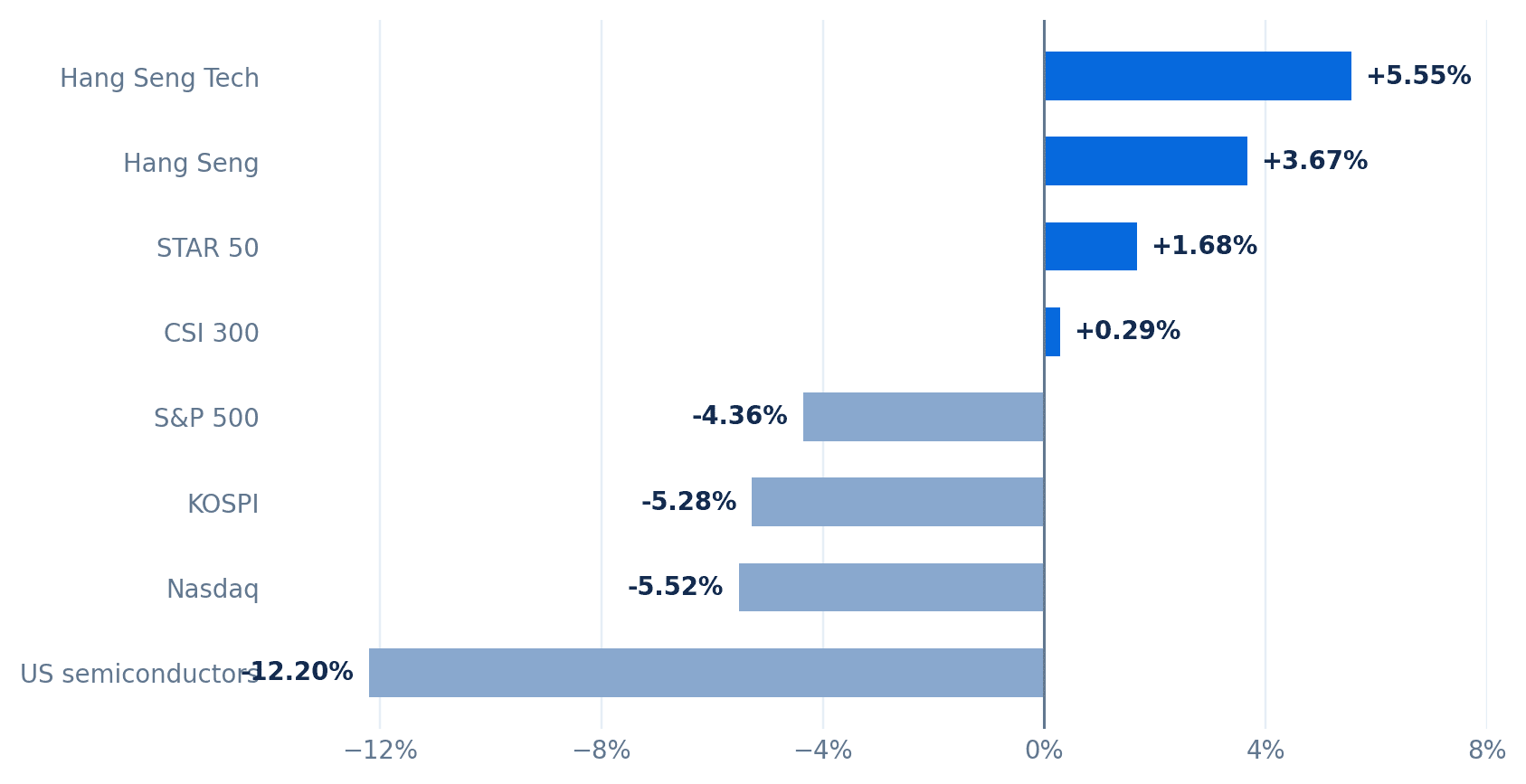
Figure 1. November 5, 2026 daily market returns. Asian exchanges closed before the US selloff later that day; figures compare the same calendar date rather than simultaneous trading hours. Sources: Reuters, AP and published market closing data cited in the original Nukoud draft.
The divergence suggests investors may be beginning to distinguish between Chinese technology companies and the US-led artificial intelligence infrastructure boom.
The rebound was particularly evident in Chinese internet stocks, with Alibaba and Tencent both advancing strongly in Hong Kong trading.
The question is whether this represents the beginning of a sustainable recovery or simply a technical rebound following an extended period of losses.
China’s Technology Boom Has Turned Into a Bust
One of the most striking developments in China this year has been the collapse of its domestic semiconductor and artificial intelligence rally.
During the first half of 2026, Chinese technology stocks attracted significant investment as investors anticipated accelerating domestic chip production, AI infrastructure development and government support for technological self-sufficiency. The KraneShares China Technology & Semiconductor STAR 50 ETF (KSTR) provides a useful illustration of this cycle.
By late May, the ETF had gained more than 40% year to date. Its rally continued into June, when its return reached 71.7%. However, the gains subsequently evaporated as concerns over excessive valuations, earnings expectations and technology spending triggered heavy selling.
By October 31, KSTR was down 9.06% year to date.
China’s Semiconductor Boom and Bust
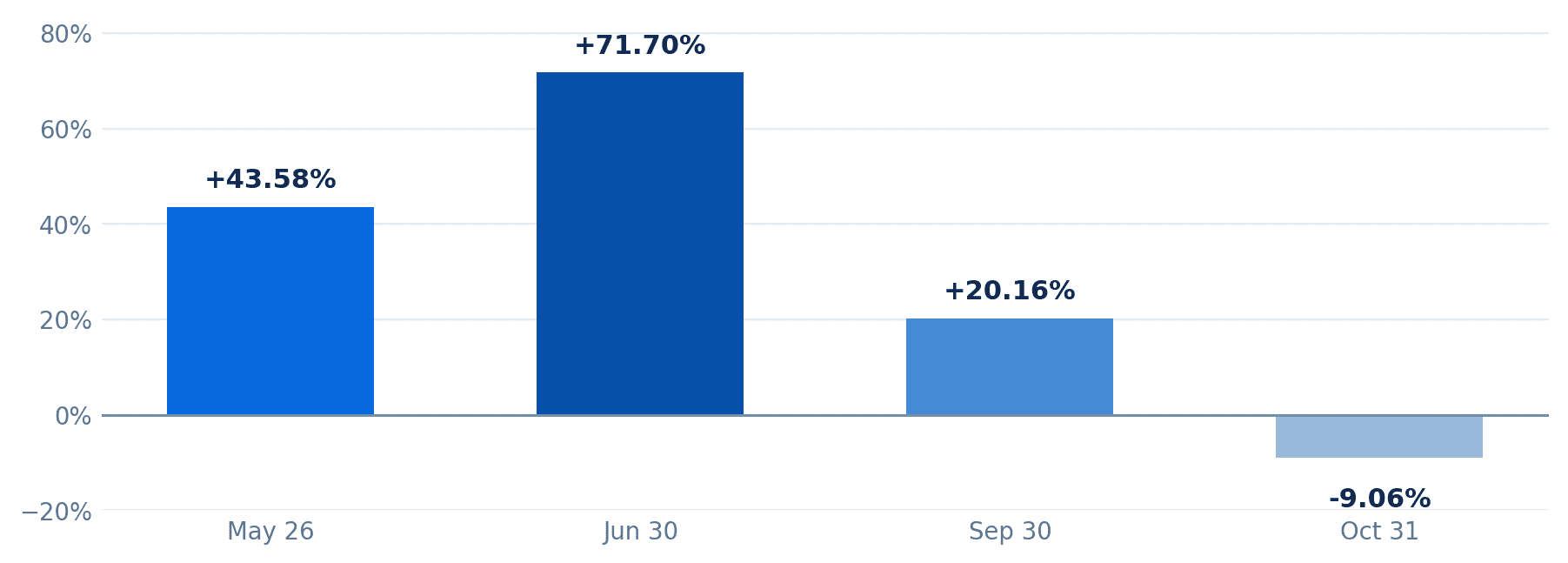
Figure 2. KSTR selected 2026 year-to-date fund return snapshots, not a continuous daily series. Sources: KraneShares and historical fund total-return observations referenced in the original article.
The downturn has been even more severe for some mainland semiconductor stocks. According to Reuters, the STAR 50 Index, home to several of China’s leading AI and chip companies, lost approximately 40% from its July peak through late October, wiping out an estimated $480 billion in market value.
The correction also reflects growing concerns over potential restrictions on exports of Chinese technology components, intense domestic competition and whether demand for AI products can justify earlier valuations.
China’s technology market therefore faces two distinct problems: internet companies are struggling with weak consumer spending and valuation pressure, while domestic semiconductor firms are confronting the unwinding of a speculative investment boom.
Chinese Internet Stocks vs. Domestic Technology Stocks
Sources: KraneShares fund performance reports. Returns are US ETF NAV total returns except the June observation, which is the manager’s reported total return.
Although KWEB experienced a substantially worse year overall, the October collapse was considerably more pronounced in the semiconductor-focused KSTR.
That distinction suggests the downturn is not uniform across Chinese equities. Different segments face different earnings challenges, and their recoveries may follow different paths.
Weak Domestic Demand Remains China’s Biggest Economic Challenge
The equity market correction comes as China’s broader economy continues to struggle with weak consumer confidence, declining property values and subdued domestic investment.
China’s manufacturing sector unexpectedly returned to contraction in October, with the official Purchasing Managers’ Index falling from 50.1 in September to 49.3.
Retail sales increased just 1.1% year over year in September, while new-home prices declined 2.8% annually.
China Economic Dashboard
Sources: China’s National Bureau of Statistics, Reuters and S&P Global/RatingDog, as cited in the original article.
These figures illustrate the divide within China’s economy. While external demand and parts of the manufacturing sector have remained resilient, household consumption and real estate continue to constrain domestic growth.
The prolonged property downturn is particularly significant because housing represents an important component of Chinese household wealth. Declining property prices can weaken consumer sentiment, encouraging households to increase savings rather than spending. That can have a direct impact on businesses dependent on domestic consumption, including several large Chinese internet platforms.
China’s private manufacturing survey, which remained above 50 in October, suggests conditions are not uniformly negative. However, the broader challenge is generating sustainable domestic demand rather than relying predominantly on exports.
Beijing Responds With New Stock Market Stimulus
With investor sentiment deteriorating, Chinese authorities have introduced additional measures to stabilize financial markets. On November 2, the People’s Bank of China announced a new round of liquidity support through its Securities, Funds and Insurance Companies Swap Facility.
The operation involved RMB 100 billion, approximately $15 billion, in liquidity arrangements for eligible financial institutions. The mechanism allows institutions to exchange qualifying securities for highly liquid assets, improving their ability to finance stock purchases.
These measures are aimed at restoring confidence and mitigating selling pressure rather than directly addressing the underlying weakness in consumer spending and real estate. The challenge for policymakers is that liquidity support can help stabilize stock prices in the short term, but a sustained recovery generally requires improvements in corporate earnings and economic activity.
China Also Moves to Limit the Yuan’s Appreciation
While Chinese stocks have struggled, the yuan has been surprisingly strong. The Chinese currency has appreciated more than 5% against the US dollar this year, supported by export earnings, large trade surpluses and companies converting foreign-currency revenues into yuan. On November 3, the People’s Bank of China announced that it would increase the foreign-exchange reserve requirement ratio from 4% to 6%, effective November 15. The move is expected to withdraw approximately $24 billion in foreign-currency liquidity from the banking system, helping moderate the appreciation of the yuan.
For an economy heavily dependent on exports, excessive currency appreciation can reduce international competitiveness and place additional pressure on manufacturers already operating with narrow profit margins. Interestingly, Beijing is therefore pursuing two different objectives simultaneously: supporting its domestic stock market through liquidity measures while managing foreign-exchange liquidity to reduce upward pressure on its currency.
Could the US Election Results Be a Turning Point for China?
The US midterm elections may have introduced an unexpected development for Chinese equities. Democrats won control of both chambers of Congress in the November 3 elections, introducing the prospect of greater legislative oversight and potential constraints on some of President Donald Trump’s policies.
Initially, global investors welcomed the possibility of fewer abrupt policy changes and reduced uncertainty surrounding international trade. However, the election results also raised concerns over the future of the American AI infrastructure boom.
Some newly elected officials and lawmakers have expressed support for tighter oversight of data-center construction, including restrictions related to electricity costs, water consumption and environmental impacts. These developments contributed to a significant reassessment of US technology valuations, particularly among companies exposed to data-center construction and semiconductor demand.
Why the election outcome could benefit Chinese equities
First, trade policy. A divided Washington could reduce the likelihood of some additional aggressive tariff measures, although the president retains substantial trade-policy authority. A reduction in trade uncertainty would be particularly relevant for China’s export-oriented economy. Global X’s Hong Kong research team characterized the election outcome as potentially neutral to positive for Chinese equities, citing reduced extreme tariff risks. Nevertheless, strategic competition and technology restrictions are expected to remain important US policy priorities.
Second, a possible rotation away from expensive US AI stocks. As investors reassess valuations in US semiconductor and AI infrastructure companies, some may seek alternatives in markets that have already undergone substantial corrections. Chinese technology stocks could attract renewed attention, particularly if investors believe much of the downside has already been reflected in prices.
There are also potential beneficiaries in Chinese renewable energy and clean technology. On November 5, China’s STAR new-energy index rose 6.46% as investors speculated that changes in US clean-energy policies could benefit the sector. However, existing trade barriers remain a significant obstacle. The election results do not guarantee a more favorable environment for China. US export controls, national-security restrictions and strategic competition have support across both major parties.
What Could Drive a Sustainable China Recovery?
The recent rally is encouraging, but a durable turnaround will likely depend on several developments.
· Stabilization in semiconductor and AI shares: China needs to demonstrate that earnings can support valuations following the dramatic correction.
· Stronger domestic consumption: A recovery in household confidence would support internet platforms and consumer-focused companies.
· Improvement in the property market: Stabilizing housing prices could reduce one of the main drags on household wealth and confidence.
· More effective stimulus: Investors will be looking for measures that support economic activity, rather than only equity-market liquidity.
· Greater clarity on US–China relations: Reduced trade uncertainty would benefit market sentiment, although technology restrictions may persist.
What Does This Mean for GCC Investors?
For investors in the UAE, the developments are particularly relevant to China’s growing presence in the region’s ETF market. The KraneShares CSI China Internet ETF (KWEB) provides exposure to large Chinese internet and technology platforms through its ADX cross-listing.
However, investors should distinguish between exposure to Chinese internet businesses and the more volatile domestic semiconductor sector represented by KSTR. The November 5 rebound demonstrates that Chinese equity markets can perform differently from their US counterparts, even during episodes of global technology-sector stress.
For regional investors evaluating Chinese ETFs, performance will depend on the fund’s underlying sector exposures, currency movements, valuations and the strength of China’s eventual economic recovery.
Outlook: A Market Rebound or the Beginning of a Turnaround?
China’s latest rally provides some relief after an exceptionally difficult period for its equity markets. The combination of lower valuations, renewed government support and potentially reduced trade uncertainty has created conditions that could support a recovery. However, weak domestic consumption, the property downturn and uncertainty surrounding technology earnings continue to present substantial challenges.
The most important question is whether the November rebound marks a genuine improvement in fundamentals or simply a rotation toward stocks that have already suffered large losses.
For now, China has delivered one of the most surprising market performances of the week: rising as much of the global AI trade came under pressure. Whether that divergence persists will depend on earnings, economic policy and the evolving relationship between Washington and Beijing.