As technology stocks face mounting selling pressure, investors are increasingly turning toward healthcare, energy and defensive sectors, signaling a potential shift in market leadership.
The US stock market is showing signs of a significant divergence. While technology and artificial intelligence (AI) stocks suffered heavy losses during the final trading sessions of October, several companies across healthcare, energy and consumer staples continued to reach record highs.
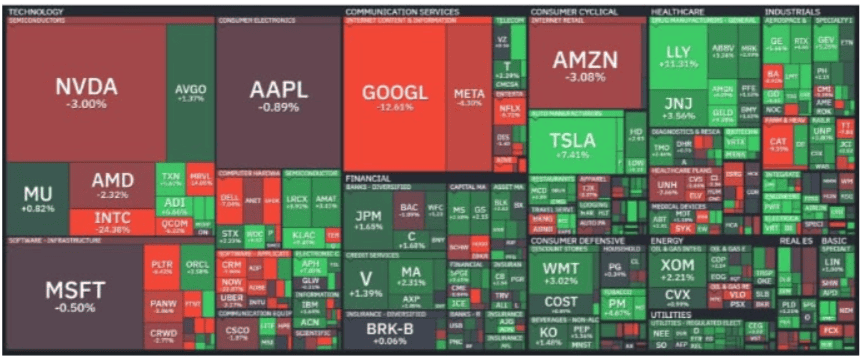
A widely circulated market snapshot, attributed to Bull Theory and Finviz, estimated that approximately $1.5 trillion in US equity market value was erased in a single session, even as 25 stocks reached new all-time highs. Although the precise figures have not been independently verified, the broader divergence is evident in recent market performance.
On Friday, October 30, the Nasdaq Composite fell 2.86%, while the S&P 500 declined 1.82% and the Dow Jones Industrial Average lost 1.09%. Concerns over the enormous capital expenditure associated with AI development, disappointing earnings and stretched technology valuations contributed to the selloff.
Technology Stocks Under Pressure as AI Enthusiasm Fades
The latest selloff has been particularly severe among semiconductor manufacturers and AI-related companies.
Intel plunged nearly 29% following disappointing guidance, while Nvidia declined 4.2% and AMD lost approximately 10.9%. The broader semiconductor index fell 7.2% during Friday’s session.
Investors are increasingly questioning whether the billions of dollars being invested in AI infrastructure, data centers and advanced chips will translate into sufficient profits to justify elevated valuations.
The Nasdaq ended October approximately 7.8% below its October 6 record, highlighting the growing pressure on previously dominant technology stocks.
Healthcare, Energy and Defensive Stocks Emerge as Relative Winners
While AI-related stocks struggled, other sectors demonstrated greater resilience. A market snapshot circulating among investors highlighted 25 companies reportedly reaching new highs, with healthcare accounting for the largest share, followed by energy and financial services.
Notably, none of the companies on the circulated list represents a major AI infrastructure or semiconductor stock.
Energy companies were among the notable beneficiaries of the rotation. Exxon Mobil and Chevron reached record highs during Friday’s trading after reporting stronger-than-expected earnings, supported by higher refining margins.
Healthcare companies also demonstrated resilience, benefiting from their relatively defensive characteristics and earnings drivers that are less directly dependent on the AI investment cycle.
A Potential Rotation Away from AI Concentration
October’s performance suggests investors may be reconsidering their exposure to the largest technology companies that have driven US equity returns over recent years.
The divergence between the market-capitalization-weighted S&P 500 and its equal-weight counterpart is particularly revealing. While the traditional S&P 500 declined approximately 0.9% in October, its equal-weight counterpart gained nearly 5%. This suggests that weakness among a relatively small group of highly valued megacap companies masked stronger performance across other parts of the market.
What Does the Rotation Mean for ADX-Listed ETFs?
For UAE investors, the contrast can be illustrated through three Abu Dhabi Securities Exchange-listed ETFs: Lunate USGRWTH and QUANTM for US growth and frontier technology exposure, and Lunate USVALUE for dividend-oriented US equities.
USGRWTH tracks a concentrated index of 30 large Shariah-compliant US companies, including major technology and AI beneficiaries. Its growth exposure may make it sensitive to changing valuations and sentiment around US mega-cap technology. QUANTM takes a different, more specialized approach, targeting 25 companies involved in quantum computing, from established technology leaders to emerging specialists. Quantum computing is related to, but distinct from, the broader AI theme; the two ETFs should not be treated as interchangeable AI funds.
USVALUE offers a different lens on the market. It tracks 30 US Shariah-compliant companies selected from a dividend-aristocrat universe, emphasizing established dividend payers. Reported holdings have included Exxon Mobil, Chevron, Johnson & Johnson, AbbVie and Coca-Cola—names also featured in the circulating list of stocks reaching highs. USVALUE does not track that list and should not be described as holding all 25 companies.
The comparison highlights how a rotation in US equities may affect locally listed ETFs with different exposures. However, USVALUE is not a pure defensive-sector fund: its portfolio has also included Microsoft as a substantial holding. All three ETFs remain exposed to equity-market risk, and portfolio weights change over time.
ADX ETF Performance: Value Outperforms Growth and Quantum
The performance comparison reinforces the divergence in investment styles. Over the latest reported week, USVALUE gained 1.27%, compared with declines of 1.65% for USGRWTH and 0.53% for QUANTM. The difference is more pronounced over the year-to-date and one-year periods, although these returns reflect more than the latest market rotation.
Source: ETF performance snapshot supplied for USVALUE, USGRWTH and QUANTM; one-week figures supplied separately. Returns are reported as provided, with the snapshot date not specified. Period returns are not directly comparable without confirming a common as-of date and calculation methodology.
In the reported one-week period, USVALUE outperformed USGRWTH by 2.92 percentage points and QUANTM by 1.80 percentage points. The figures illustrate the recent relative resilience of the dividend-oriented strategy, rather than proving that the individual stocks reaching all-time highs caused the ETF performance.
Is the AI Trade Over?
The recent market action does not necessarily signal the end of the AI investment cycle. Rather, it suggests investors are becoming more selective about valuations, earnings quality and the potential return on capital invested in AI infrastructure.
The distinction is important. AI may continue transforming industries and generating substantial economic value, even as the share prices of companies associated with the technology undergo significant corrections.
For ETF investors, the key development may be less about abandoning innovation and more about the widening gap between growth-oriented and dividend-oriented portfolios. On ADX, USGRWTH and QUANTM illustrate different forms of technology exposure, while USVALUE offers an alternative dividend-focused US equity strategy with some overlap with the stocks highlighted in the market snapshot.
As November begins, investors will be watching whether the rotation into healthcare, energy and other sectors continues or whether lower technology valuations attract renewed buying interest.
Sources: Reuters, Associated Press, MarketWatch, Finviz, Bull Theory; Lunate fund pages and published fund disclosures for USGRWTH, QUANTM and USVALUE. Market figures through October 30, 2026. Holdings are subject to change; verify the latest factsheets before publication.